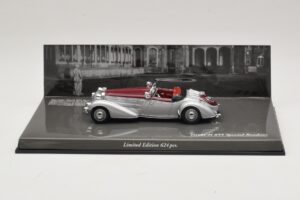
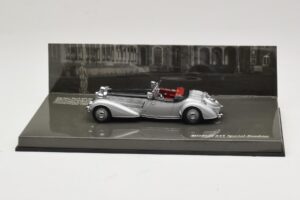
Last one
This model is currently sold out. Enter your email and we'll let you know when it's back in stock. We'll also send you news about new models. You can unsubscribe at any time.
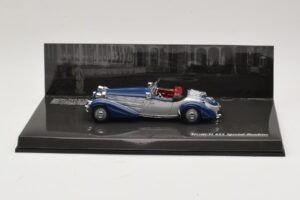
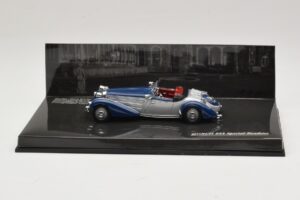
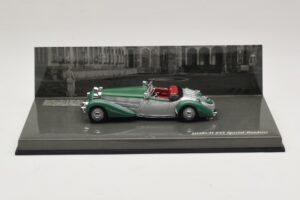
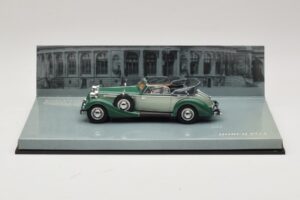
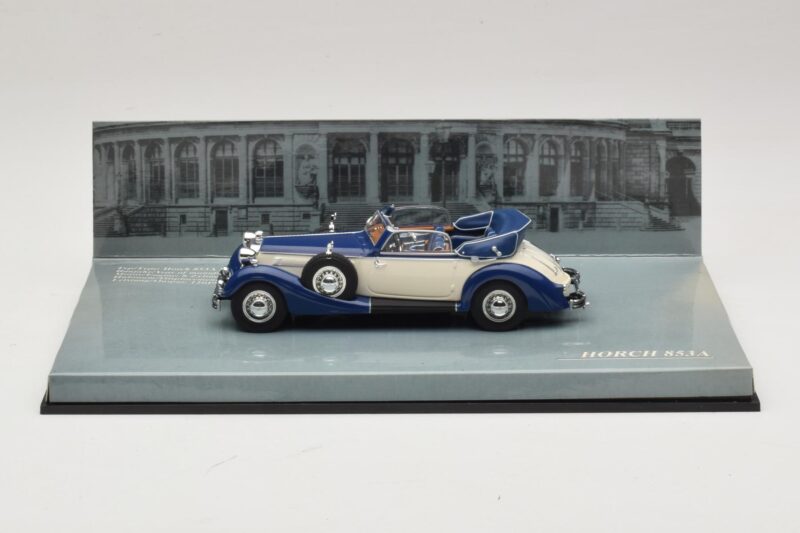
TL;DR: Minichamps' 1:43 Horch 853 Cabriolet is a sealed-body zinc alloy diecast in blue, reproducing Auto Union's 1938 flagship open tourer. Built under the four-rings badge that also covered Audi, DKW and Wanderer, the 853 represented pre-war German luxury motoring at its most elaborate, and this casting suits a considered vintage centrepiece rather than a routine saloon shelf addition.
Long-bonneted, low-waisted and built for buyers who never needed to ask the price, the Horch 853 sat at the very top of pre-war German motoring. Minichamps renders that presence in blue over a sealed diecast body, a colour that lets the cabriolet's flowing wing line and long running boards read clearly against the paint rather than disappearing into a darker finish.
The blue finish carries genuine depth rather than a flat single tone, catching light differently along the long, sweeping front wings than across the flatter door panels, a variation that only shows properly on a metal-bodied casting. Zinc alloy gives the model real weight for its size, and that density suits a car whose original coachwork ran to substantial gauge steel over a separate chassis. Under angled light the flake reads almost navy at the shoulder line and lighter across the bonnet, exactly the kind of subtlety a considered display lamp rewards. The body is a single sealed casting, so the long door line and the cabriolet's folded hood profile are moulded in as continuous, consistent grooves rather than working joints, which keeps the silhouette clean from the split windscreen right back to the boot.
Pre-war coachwork favoured long, unbroken curves over the sharper creases later decades adopted, and that puts real pressure on any diecast tooling trying to reproduce it faithfully. Minichamps keeps the running boards, the freestanding headlamps and the long front wings in correct proportion to the passenger compartment, rather than compressing the bonnet the way lower-cost castings sometimes do to save tooling cost. The wire-style wheels and the exposed spare carried at the rear are picked out with genuine definition rather than moulded as a flat silhouette, details that matter enormously on a car whose whole appeal rests on elegant proportion rather than outright performance.
Horch built its reputation as the most prestigious of the four marques that merged into Auto Union in 1932, sitting above Audi, DKW and Wanderer within that combine and effectively serving as its flagship brand. Where DKW and Wanderer built accessible transport for a mass market, Horch competed directly with the era's most expensive coachbuilt cars, offering buyers a German alternative to the grand luxury tourers coming out of France and Britain at the time, a distinction period buyers understood as clearly as any badge on the grille. That positioning is exactly why the 853 carried such elaborate coachwork rather than the practical bodywork Auto Union's smaller marques favoured.
Within Horch's own catalogue, the 853 sat as one of the most expensive and visually dramatic cabriolet bodies the marque offered, built on a long-wheelbase eight-cylinder chassis that gave coachbuilders generous proportions to work with. It was not a car built in volume, and it was never intended to be. Owning this specific casting gives a collector a defined entry point into Auto Union's pre-war hierarchy, a single identifiable flagship model rather than a generic vintage German car standing in for the far more modest saloons underneath it. That contrast between flagship and family car is part of what makes pre-war Auto Union collecting genuinely rewarding.
A Horch 853 works best as a considered centrepiece rather than one entry among many, since its appeal rests on scarcity and elaborate coachwork rather than the everyday familiarity a family saloon carries. At 1:43, the cabriolet's long-bonneted proportions still command real presence on a shelf, more so than most contemporary saloons of the same scale, without demanding the floor space a larger scale would need. Displayed under even lighting away from direct sun, the blue paint keeps its depth over years rather than fading toward a flat finish, and the sealed body's consistent lines mean there are no hinges to loosen with handling.