Last one
This model is currently sold out. Enter your email and we'll let you know when it's back in stock. We'll also send you news about new models. You can unsubscribe at any time.
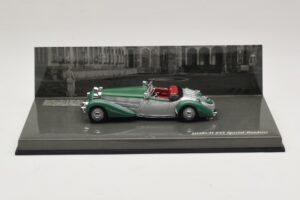
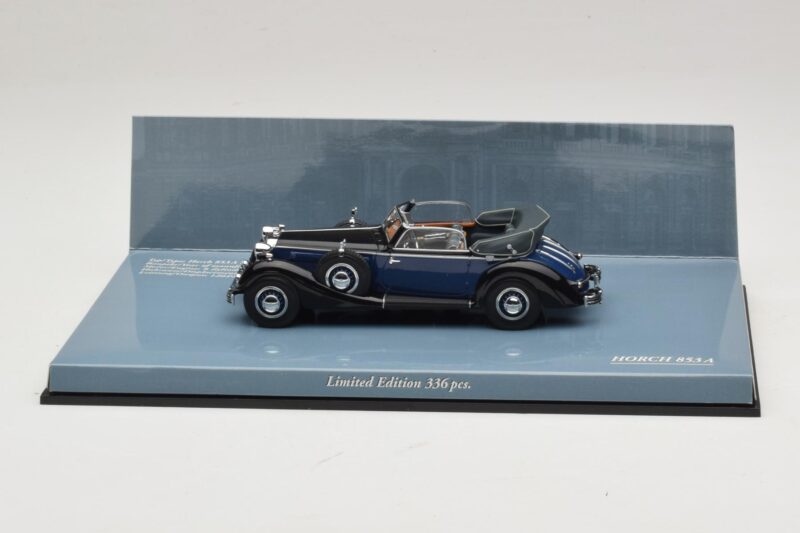
TL;DR: Minichamps' 1:43 diecast Horch 853 A Sport Cabriolet reproduces the 1938 Auto Union flagship in black over blue, a sealed one-piece body with crisp shut lines and deep paintwork. Horch sat above Audi, DKW and Wanderer as the luxury arm of the group, and this cabriolet shows why.
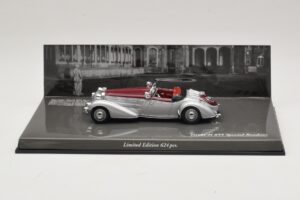
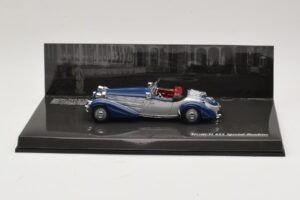
Horch built its reputation on cars that outclassed everything else in the Auto Union stable, and the 853 A Sport Cabriolet was the model that proved it. Minichamps' 1:43 rendition captures the car's long-hood elegance in a black and blue livery, giving collectors of pre-war luxury motoring a compact, precisely finished way to own a slice of 1930s German coachbuilding.
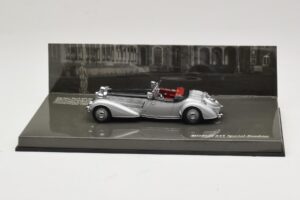
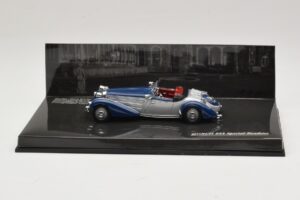
The 853 A Sport Cabriolet sat at the top of Horch's range, built for owners who wanted the drama of a long bonnet and flowing wings without sacrificing a proper four-seat body. Minichamps' 1:43 casting follows that silhouette closely, with the sweeping front wings, the split windscreen, and the low waistline that gave the original its poised stance at rest. The black over blue two-tone finish picks out the coachwork's panel breaks precisely, so the eye reads the bonnet, the scuttle, and the folded hood as distinct forms rather than one flat mass. That separation of colour along real panel lines is where a careful diecast casting earns its keep.
This Horch is cast as a sealed, one-piece shell, with no doors or bonnet that open, entirely normal at 1:43 and it lets Minichamps concentrate its tooling budget on surface accuracy rather than hinge mechanisms. Run a fingertip along the door line and it tracks as a single, consistent groove rather than a series of gaps that widen and narrow. The paintwork sits with genuine depth under direct light, the blue holding its tone rather than flattening to grey, and the chrome grille and headlamp surrounds catch light cleanly against the black bodywork. For a pre-war subject this exterior-only focus suits the car well, since the original's appeal was always about silhouette rather than mechanical display.
Horch built the 853 around a straight-eight engine, a configuration the company favoured for its smoothness at a time when most luxury makers were still wedded to six-cylinder units. The Sport Cabriolet body gave the car sporting pretensions that its size and weight didn't entirely support, but that contradiction is part of what makes the model interesting today: a grand tourer trying to look faster than it was, dressed in coachwork good enough to get away with it.
Within the Auto Union group, formed from four separate marques, Horch occupied the position Audi holds in the modern Volkswagen Group: the flagship, reserved for straight-eight luxury while Audi, DKW and Wanderer worked further down the market. That hierarchy explains why the 853 wears its badge so proudly and why Minichamps has chosen this model for its 1:43 pre-war programme. A shelf built around German motoring history reads incompletely without a Horch on it, since the marque defined what luxury meant inside that group before the Second World War ended its independent existence.
A 1:43 Horch sits well alongside other Auto Union subjects from the same era, or on its own as an anchor piece for anyone tracing pre-war German luxury motoring rather than post-war sports cars. The scale keeps the footprint modest, so a handful of similarly scaled pre-war cabriolets and roadsters share a single shelf without crowding. Because the body is sealed, display is simple: set it at a slight angle to catch the two-tone paintwork under cabinet lighting, and the long bonnet does the rest of the work. Collectors comparing this against other 1:43 pre-war castings should look first at panel line consistency and paint depth, the two areas where cheaper tooling usually falls short.