Last one
Used
Back in stock
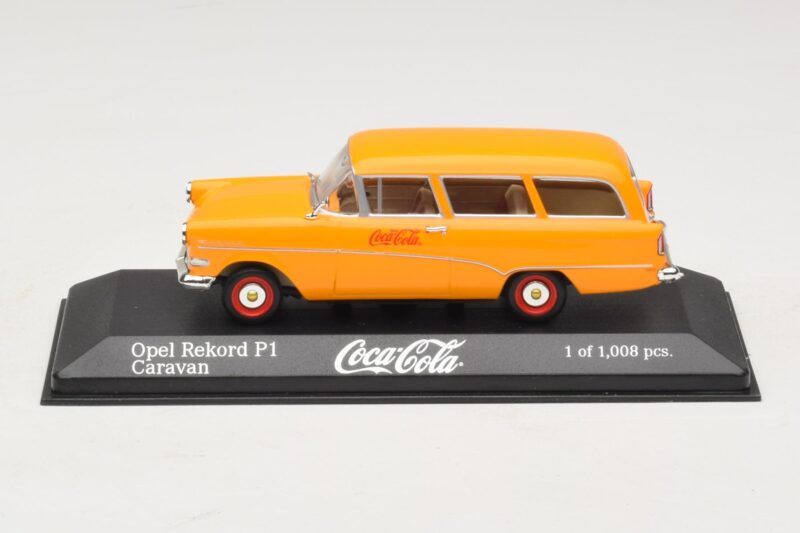
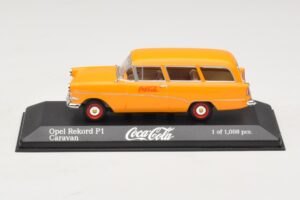
TL;DR: Minichamps' 1:43 Opel Rekord P1 Caravan wears a period Coca-Cola delivery livery over a sealed diecast body, reproducing Opel's first-generation Rekord estate from 1958. With no opening panels, the model's precision lives in its printed graphics and shut lines, making it a compact anchor for a promotional livery collection.
Corporate liveries turned everyday delivery vans and estates into rolling advertisements across 1950s Europe, and the Coca-Cola script was among the most recognisable of them. Minichamps applies that period graphic to the Opel Rekord P1 Caravan, the estate version of Opel's first postwar Rekord, in 1:43 diecast. The livery, not the mechanical spec, is the reason this casting earns a place on a themed shelf.
Opel's first Rekord generation, retrospectively known as the P1, arrived in 1957 as the brand's answer to a growing market for affordable, modern family cars, and the Caravan estate followed to extend that practicality into load-carrying duty. Estate versions of ordinary saloons were the workhorses of small delivery fleets across 1950s Europe, and a bottling plant or regional distributor running a handful of liveried Rekords to service local shops was a common sight rather than an exception. The Coca-Cola script on this casting reflects exactly that practice: a period brand identity applied to a genuinely modest, hardworking estate rather than to anything glamorous. Minichamps' choice of the P1 Caravan for this livery makes sense on those terms, because the estate body offered the flat load floor and rear door that a delivery operation needed, while the saloon never carried that role in the same way. Collectors drawn to promotional and livery diecast, a distinct branch of the hobby from pure marque collecting, look for exactly this pairing: a plausible period vehicle carrying a recognisable period brand, rather than a fantasy livery applied to a car that never wore it. That plausibility is what separates a considered livery model from a novelty repaint.
With no doors, tailgate or bonnet that open, the entire account of this model plays out on its painted surface, and that is precisely where a livery casting has to succeed or fail. A sealed diecast shell removes the shut-line interruptions a hinged tailgate would introduce across the Coca-Cola script, letting the lettering run in one continuous, unbroken curve along the flank rather than breaking at a panel gap. Zinc alloy gives the body real heft for its size, a density that signals proper diecast construction the moment it is lifted from its tray, and that mass also gives the flat panels the rigidity a crisp tampo print needs to sit evenly. Registration is the term collectors use for how precisely a printed graphic aligns across a body's contours, and on a script logo like Coca-Cola's, even a slight misalignment across the wheel arch or the rear pillar is immediately visible to a trained eye. Minichamps' sealed-body approach here is a construction choice rather than a limitation: nothing about the P1 Caravan's role as a delivery vehicle calls for an opening load door on the model, and the fixed shell is what lets the livery read cleanly from end to end.
At 1:43, an estate the size of the Rekord P1 Caravan comes out to a compact footprint, comfortably under ten centimetres in length, which means a themed row of liveried delivery vehicles from several eras can share a single cabinet shelf without crowding. That compactness is part of why 1:43 remains the standard scale for European livery and promotional collecting: it keeps a fleet of similar vehicles to a manageable size while still carrying enough surface area for a script logo to read clearly. The estate's boxy, upright proportions, tall enough for a driver to stand a crate of bottles inside without stooping, translate well to the scale, because the flat sides that make the shape practical in real life are also the surfaces a livery needs. Judging fidelity on a casting like this starts with the roofline and the rear pillar angle rather than any mechanical detail, since those are the panels a period photograph of a liveried Rekord would actually show. Wheel size and stance matter too: a P1 sitting too high or too low on its axles immediately reads as slightly wrong to anyone who has seen the real car's proportions in period advertising material.
This Rekord P1 Caravan works best as one entry in a broader promotional livery collection rather than as a standalone Opel purchase. Paired with other period delivery vehicles carrying different brand liveries, from soft drinks to bakeries to petrol companies, it demonstrates how ordinary estates carried advertising across 1950s Europe long before branded vans became standard. The sealed diecast body and Minichamps' registration accuracy on the script matter more here than any mechanical authenticity, because a livery buyer is judging the graphic first and the underlying car second. At an accessible 1:43 price point, it is a reasonable way to start that themed collection. It also stands on its own as a period Opel piece, since the P1 generation itself is not heavily represented in current diecast ranges, giving this Caravan a scarcity value beyond its livery.




Save £14.00