Last one
Used
Back in stock
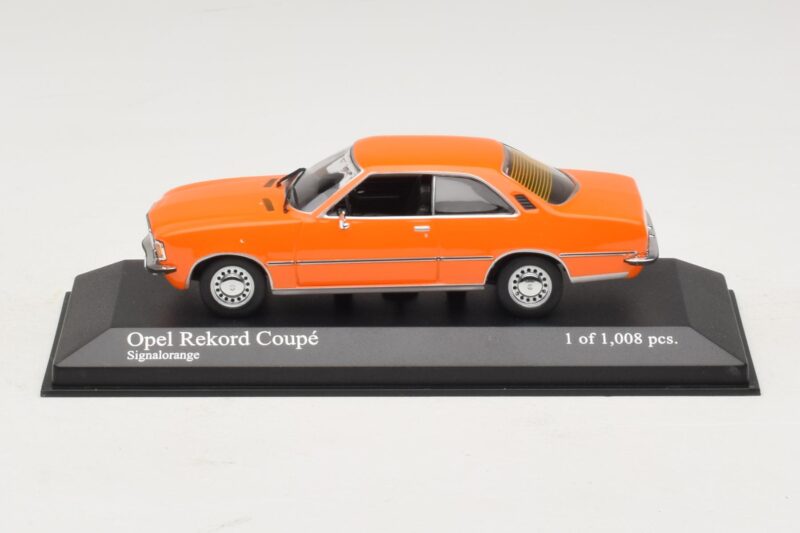
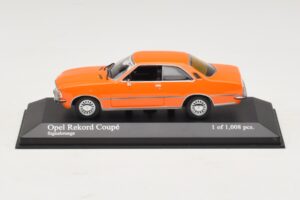
TL;DR: Minichamps' 1:43 Opel Rekord D Coupe reproduces the two-door version of Opel's 1972-1977 mid-size range in orange diecast, cast as a sealed one-piece body with no opening panels. The Coupe was the least common Rekord D body style, making this a genuinely uncommon subject for a 1970s German saloon shelf.
Opel sold the Rekord D chiefly as a practical saloon and estate, the kind of car German families used for daily commuting rather than weekend showing off. The Coupe existed alongside them in smaller numbers, aimed at buyers who wanted the same mechanical simplicity in a sportier two-door shape. Minichamps' orange finish suits that intent well, giving an otherwise understated family car a genuine splash of period colour.
The Rekord D's Coupe body kept the saloon's straightforward, upright glasshouse but trimmed it into a two-door shape with a slightly lower roofline. There is nothing exotic about the panel work here; Opel built these cars for volume and durability rather than flair, and Minichamps' casting reflects that honestly. The body comes as one fixed diecast shell with no opening doors, bonnet or boot, which keeps the shut lines tight along the door skins and around the C-pillar, an area where a hinged model would otherwise need a visible gap. For a subject this unpretentious, a clean, sealed casting is arguably the more faithful choice than an articulated one would be.
Orange was a common enough shade on 1970s European family cars, but it still reads as a bold choice against the more frequently seen saloon liveries of white, beige or metallic silver from the same period. Minichamps applies it evenly across the Coupe's flat door panels and rounded nose, and under direct light the finish should show a consistent, unbroken gloss from the front wing to the tail. Zinc alloy construction gives the small model real heft in the hand, weight that flatters an otherwise modest subject and helps it hold its own on a shelf beside flashier contemporaries.
Opel built the Rekord D between 1972 and 1977 as a straightforward replacement for the Rekord C, and the vast majority of examples left showrooms as four-door saloons or practical estates aimed at company car fleets and family buyers. The Coupe was a minority body style within an already unglamorous range, ordered by drivers who wanted a two-door silhouette without stepping up to Opel's more expensive Commodore or Manta. That rarity within the range is precisely why a Coupe survivor, or a faithful model of one, stands out more today than a common saloon from the same generation ever could.
There is no racing pedigree to lean on here and no famous owner to invoke; the Rekord D's appeal is honest rather than dramatic, a well-engineered, unpretentious German family car built to be used rather than admired. That honesty is exactly what makes it a worthwhile subject for a collection focused on everyday European motoring history rather than headline supercars. Minichamps treats the subject with the same care it brings to its more glamorous Italian and German coupes, and the result is a small, well-finished reminder that not every worthwhile model needs a famous badge behind it.
Collectors building a shelf around 1970s Opel history often reach first for the Manta or the Commodore, cars with sportier reputations and more visible motorsport connections. The Rekord D Coupe offers a useful counterpoint: proof that Opel's everyday range also produced a genuine two-door variant, built in far smaller numbers than the saloon it was based on. Placed next to a Manta, the Rekord D reads as the more conservative, family-oriented choice, which is exactly the contrast a themed 1970s German shelf benefits from rather than a run of similarly sporting silhouettes.
At 1:43, the Coupe's compact footprint, comfortably under eleven centimetres, makes it easy to slot into a dense arrangement of period saloons, estates and coupes without needing extra shelf space. The orange finish also gives it a role as a colour anchor: bright enough to stand out among more common white and silver Opels of the same generation, without clashing with brighter Italian or French subjects displayed nearby. For a buyer assembling a broad 1970s European survey rather than chasing a single marque, this is a sensible, moderately priced addition.
This Rekord D Coupe will not anchor a collection the way a rarer Italian grand tourer might, and it does not try to. Its value lies in representing a genuine, uncommon body style from a manufacturer whose everyday cars rarely receive this level of attention in miniature, and in doing so at a modest, accessible price point.
Buyers who already own Opel's more celebrated 1970s and 1980s subjects, whether Manta, Commodore or Kadett, will find this Coupe a sensible, entry-level companion piece, priced well within reach and finished carefully enough to reward a closer look. It suits a collection built on breadth and honest representation of ordinary European motoring history, rather than one chasing headline names alone.

Save £33.00
Save £14.00