Last one
Used
Back in stock
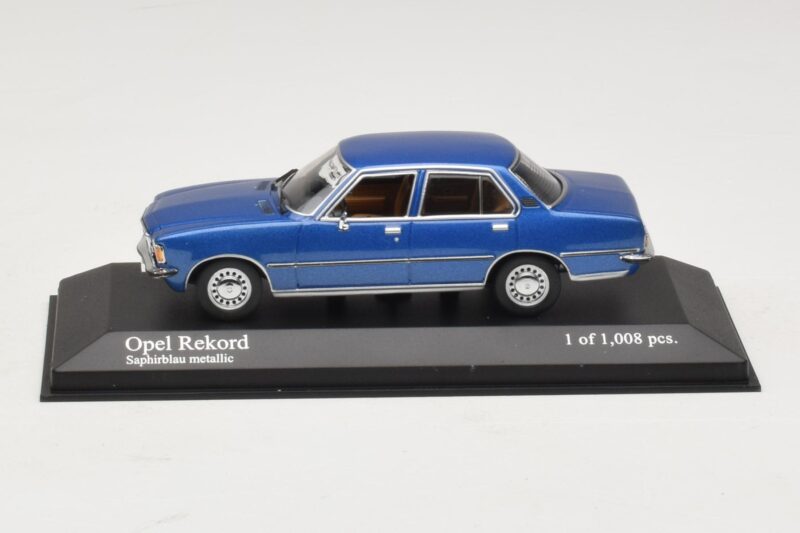
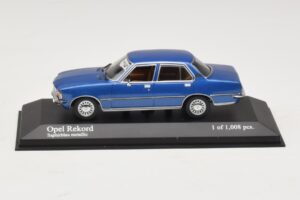
TL;DR: Minichamps' 1:43 Opel Rekord D Blue Metallic reproduces Opel's mainstream 1970s saloon, built at Rüsselsheim on the same platform as the Commodore B. Cast as a sealed one-piece diecast body, it holds tight panel lines and even blue metallic paint typical of the era. An honest, accessible entry point into 1970s German family motoring for a collector's shelf.
Not every model earns its place through racing history or a famous designer's name. The Rekord D was Opel's everyday saloon through the mid-1970s, sold in enormous numbers across West Germany and beyond, and Minichamps' 1:43 rendering in blue metallic captures exactly that ordinariness. There is honesty in a well-made replica of a car that was never meant to be extraordinary, only reliable.
Opel positioned the Rekord D squarely between the smaller Ascona and the larger Commodore, a saloon aimed at company car fleets and family buyers rather than enthusiasts. Built at the Rüsselsheim plant from 1972, it replaced the Rekord C with a more angular, contemporary silhouette while keeping the same conventional recipe: front engine, rear drive, a straightforward four-door body that prioritised interior space over any styling flourish. That plainness is precisely why the model rewards a close look; there is nowhere for an ambitious design line to distract from how well the casting handles the simpler surfaces.
Underneath, the Rekord D shared its platform with the more upmarket Commodore B, a relationship that let Opel spread development costs across a wider range without diluting either car's identity. The saloon body here is the volume seller of that family, the version most likely to have been a childhood memory for a British buyer whose relative ran a German car through the 1970s. Minichamps' choice to cast this ordinary saloon rather than a sportier variant says something about who collects Opel models: people drawn to accuracy and nostalgia over drama. The four-door proportions, with a tall greenhouse and a modest boot line, are the shape most Rekord D survivors take today.
Even an unglamorous saloon benefits from diecast's structural honesty. Lift this Rekord D and the zinc alloy body carries real weight for its size, a density that plastic or resin at the same 1:43 scale simply cannot replicate. That heft matters on a car whose appeal rests on looking accurately, solidly ordinary rather than dramatic, and a light, hollow-feeling casting would undercut the whole point of the model. That weight also keeps it stable on a shelf, resistant to being nudged out of position the way a lighter casting might be.
The body is sealed, with no bonnet, boot or door that opens, so every shut line on this Rekord D is moulded rather than hinged. That construction lets Minichamps run a consistent gap along the doors and around the boot lid, a discipline that shows most clearly where the roof pillars meet the window line. Chrome trim around the grille and window surrounds is picked out cleanly against the blue, the kind of finishing that separates a considered diecast from a rougher toy-grade casting at the same scale. The wheels carry a period-correct steel-look finish rather than alloy, matching the modest trim level this saloon would have worn from the factory.
Blue metallic was a common, sensible colour on 1970s German saloons, chosen by buyers who wanted their car to look presentable without drawing attention, and Minichamps' rendering respects that restraint rather than punching up the tone for shelf appeal. Under direct light, the metallic flake sits at a believable depth for a production paint job of the era, neither flat nor artificially sparkling. That accuracy matters more on an everyday classic than on an exotic, because a Rekord D collector is usually chasing a specific memory: a parent's or grandparent's car, a colour recalled from a driveway decades ago, rather than a headline shade from a manufacturer's brochure. At 1:43, the saloon comes out at roughly ten and a half centimetres nose to tail, compact enough to line up several period German saloons across one cabinet shelf without the display becoming crowded. Diecast holds that blue evenly across the bonnet, roof and boot lid, with no colour drift between panels, something a resin casting at this price point would be more likely to show.
A Rekord D will never carry the cachet of a contemporary Maserati or Porsche, and Minichamps' pricing reflects that honestly: this is an accessible, mid-tier diecast aimed at collectors who value accuracy over exclusivity. That is not a shortcoming so much as a different kind of appeal. Placed on a shelf next to a rarer, more expensive Italian grand tourer from the same decade, the Rekord D tells a different but equally valid story about 1970s motoring, the car most people actually drove rather than the one they admired from a distance. Its sealed body and modest colour palette mean the model rewards patience rather than spectacle: study the panel gaps, the window trim, the exact shade of blue, and the value of a well-made everyday classic becomes obvious.

Save £33.00
Save £14.00