Used
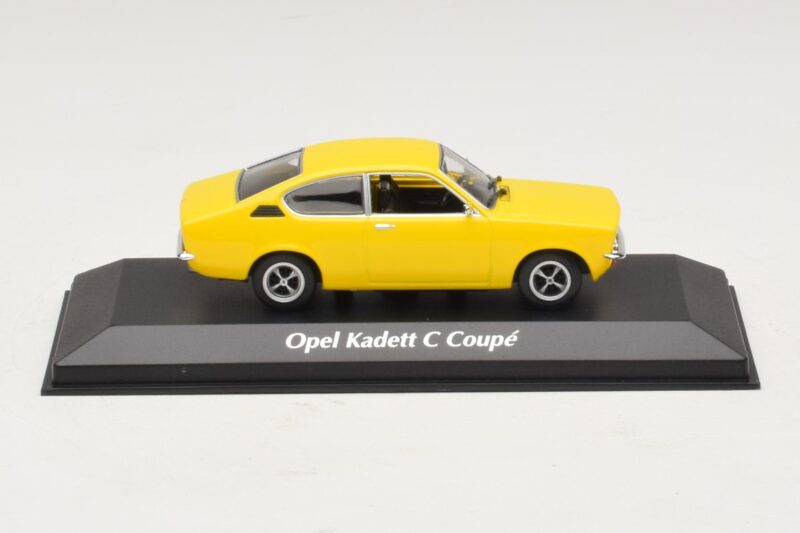
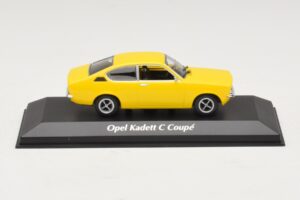
TL;DR: Maxichamps' 1:43 Opel Kadett C coupe reproduces the 1970s family coupe built on Opel's popular Kadett C platform, the same underpinnings later used across GM's global small-car range. Cast as a sealed diecast body in bright yellow with crisp shut lines, it suits a 1970s European coupe collection at an accessible price point.
Opel's Kadett C arrived in 1973 as a thoroughly conventional small family car, but its platform quietly became one of General Motors' most important global exports, reworked for markets from Brazil to Japan. The coupe body, lower and leaner than the saloon, gave the range a genuinely sporty option, and Maxichamps' bright yellow finish suits its cheerful, unpretentious character perfectly.
The Kadett C's rear-wheel-drive platform proved so versatile that General Motors exported it across the world, badged as the Chevrolet Chevette in the Americas, built under licence in Brazil, Japan and beyond, and sold in various guises well into the 1980s in some markets. That global reach makes the Kadett C a genuinely significant chapter in GM's history, even though the car itself never courted attention through performance or exotic engineering. In Europe it was simply Opel's competitively priced family car, built to be practical, cheap to run and easy to fix, and it sold in huge numbers precisely because it asked so little of its owners and delivered exactly what it promised.
Within that unglamorous range, the coupe body offered a genuine change of character, a lower roofline, sleeker rear glass and two doors instead of the saloon's practical four, aimed at younger buyers who wanted a sportier silhouette without stepping up to a more expensive class of car. It never carried serious performance pretensions, but the coupe's proportions still hold up as a neat, well-balanced shape, and Maxichamps' casting keeps that lower stance and tapered tail accurate against the saloon and estate versions built on the same underpinnings.
Maxichamps casts this Kadett C as a single sealed body, doors and boot fixed rather than hinged, standard practice at 1:43 and particularly suited to a value-focused range like Maxichamps, where tooling a moving panel would add cost without adding much visible benefit. The shut lines run as single, even grooves the length of each door rather than jointed seams, and the wheel arches sit correctly tight around the tyres. Ride height and stance track the real car's proportions rather than sitting artificially high, and the coupe's lower roofline and shorter rear deck read clearly against other 1970s European coupes on the same shelf.
The bright yellow paint carries decent depth for a value-tier diecast, and chrome window surrounds, bumpers and door handles separate cleanly from the body colour rather than bleeding into it. Badge script on the boot lid stays legible under close inspection, and the glazing sits reasonably flush in its aperture. Maxichamps sits as Minichamps' more accessible sister range, and this casting reflects that positioning honestly, simpler tooling and fewer finishing flourishes than a full-price Minichamps release, but entirely sufficient for a subject collectors are buying for character rather than showroom-grade fidelity.
This Kadett C makes a genuinely affordable way into a 1970s European coupe shelf, sitting comfortably alongside Ford Capris, Fiat 128 coupes and other unpretentious small coupes of the same decade without demanding a premium price for the privilege. At 1:43 the footprint stays small enough to build a whole run of 1970s small coupes across several manufacturers on one shelf level. Given the sealed body and Maxichamps' accessible tier positioning, this is not a piece for a collector chasing showroom-grade detail, but it is an honest, characterful record of a genuinely important small car, and the cheerful yellow finish gives it more shelf presence than its modest price would suggest.