Last one
Used
Back in stock
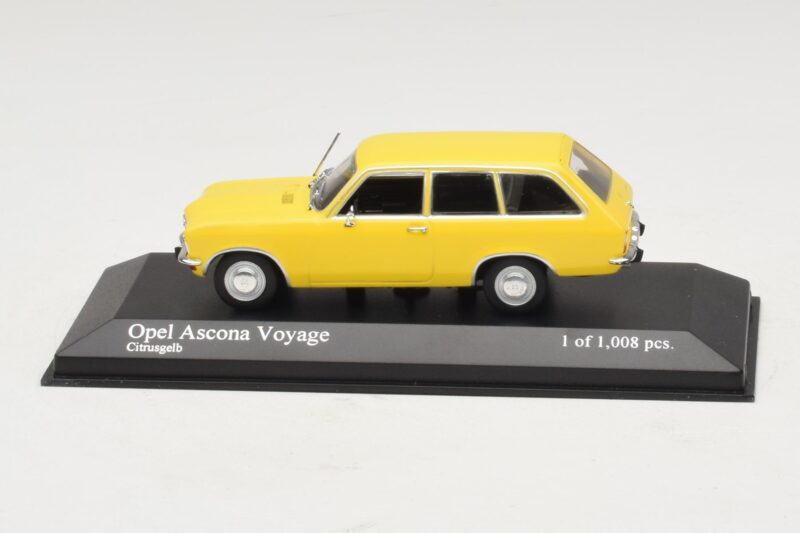
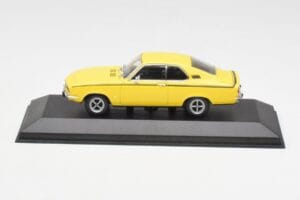
TL;DR: Minichamps' 1:43 Opel Ascona A Voyage reproduces the estate version of Opel's 1970s compact saloon, cast as a sealed diecast body in bright yellow. Launched to extend the Ascona A range into load-carrying practicality, it suits collectors tracing Opel's move into the European family car market.
Opel launched the Ascona A in 1970 to compete directly with the Ford Cortina and Escort across Europe's booming family car segment, and the Voyage estate followed to give it wagon-buyer appeal. Minichamps casts that estate variant in 1:43 diecast, finished in a bright yellow that was common on the era's more adventurous colour charts. It's a compact, honest piece of Opel's 1970s expansion story.
Opel introduced the Ascona A in 1970 as a mid-size saloon positioned to take on the Ford Cortina and, in smaller form, the Escort, part of a wider European push to build cars that could compete on both price and practicality rather than novelty. The Voyage name was Opel's estate designation for the range, extending the saloon's mechanical package into a load-carrying body that appealed to buyers who needed more than a boot. Estate versions of family saloons carried real commercial importance through the 1970s, often outselling their saloon counterparts among small business and family buyers who valued the flat load area over a formal boot lid. The Ascona A ran until 1975, when the Ascona B replaced it with sharper, more angular styling that moved away from this generation's rounder lines. Because the Voyage variant is less commonly reproduced in diecast than the saloon, this casting fills a gap for collectors assembling a fuller picture of Opel's early 1970s range rather than just its best-selling body style. The bright yellow finish was one of several strong colours Opel offered on the Ascona A, a period habit of using bold paint to differentiate an otherwise conservative shape, and it remains one of the more recognisable colour choices from the car's original catalogue.
This casting has no opening doors, tailgate or bonnet, which means every judgement about its accuracy has to be made from the outside, and that is not a limitation so much as a different kind of test for the manufacturer. A one-piece diecast shell removes the assembly tolerances a hinged tailgate would introduce along the rear pillar, letting the roofline run as a single, continuous curve down to the bumper without a visible seam interrupting it. Zinc alloy construction gives the model real density in the hand, a weight that resin cannot replicate at this scale and one that signals proper diecast build quality the moment it is lifted from its case. Minichamps applies its yellow finish over that sealed shell with an even gloss depth, the kind that shows the paint's true saturation under a directed light rather than flattening it the way a thinner coat would. Because there is no panel to open, the chrome window surrounds, badge placement and wheel design carry the full weight of the model's authenticity, and Minichamps' attention to those fixed elements is what separates a well-judged sealed casting from a plain shell with paint on it. This construction suits the Voyage's boxy estate shape particularly well, since flat panels hold a paint edge more cleanly than curved ones.
Judging a 1970s estate casting starts with proportion rather than paint. The Ascona A Voyage has a longer roofline than the saloon and a near-vertical tailgate, and getting that roof pitch right is the first thing an experienced eye checks before looking at any smaller detail. Wheel size and stance matter almost as much: an Ascona sitting too high on its axles reads as a toy rather than a scale reproduction, while a stance that is too low loses the slightly upright, practical character the real estate carried. At 1:43, the model measures under ten centimetres, small enough that a full run of period Opel estates, Ascona, Kadett, Rekord, sits comfortably along a single cabinet shelf without needing a large display case. That compactness is one of the scale's genuine advantages for anyone building a themed collection rather than a handful of hero pieces. Glazing clarity is worth checking too, since the estate's larger rear window area is more visually prominent than on the saloon, and any cloudiness there is more noticeable as a result.
This Ascona A Voyage works well as a mid-point piece in a chronological run of Opel estates, sitting between older Rekord-based wagons and the sharper-edged Kadett C Caravan that followed later in the decade. Its bright yellow finish gives it genuine shelf presence next to the more common silver and beige estates from the same period, without straying into fantasy colour territory since the shade was a real factory option. At an accessible price for 1:43 diecast, it rewards a collector who wants the fuller Ascona A story rather than just the saloon, and its sealed body keeps that story focused on proportion, paint and trim. For anyone tracing how Opel's practical estates evolved through the 1970s, this Voyage marks a distinct, slightly underrepresented chapter worth including.

Save £33.00


Save £14.00