{"ajaxurl":"https:\/\/models118.co.uk\/wp-admin\/admin-ajax.php?lang=en_GB","nonce":"e6722dab45","homeUrl":"https:\/\/models118.co.uk\/","shopUrl":"https:\/\/models118.co.uk\/shop\/","cartUrl":"https:\/\/models118.co.uk\/cart-en-gb\/","checkoutUrl":"https:\/\/models118.co.uk\/checkout\/","skipCart":true,"collectionLimit":12,"i18n":{"addedToCart":"Added to basket","addToWishlist":"Add to wishlist","addedToWishlist":"Added to wishlist","removeFromWishlist":"Remove from wishlist","removedFromWishlist":"Removed from wishlist","undo":"Undo","error":"Something went wrong","loading":"Loading...","outOfStock":"Out of stock","viewCart":"View basket","proceedToCheckout":"Proceed to checkout","addedToCollection":"Added to your collection","reserved":"Added to your collection","soldOut":"Sold out","invalidEmail":"Please enter a valid email address","connectionError":"Connection error. Please try again.","tocToggle":"On this page","close":"Close","inCartTooltip":"Already in your basket \u2013 open your basket to check out","loginToSave":"Sign in to save this model","waitlistNotify":"Notify me","waitlistOnList":"On the waiting list \u2713","waitlistJoined":"You're on the waiting list. We'll email you the moment this model is available again.","waitlistRemoved":"Done \u2014 you're off the waiting list for this model.","waitlistRateLimit":"Too many attempts \u2014 please try again shortly","waitlistTurnstile":"We couldn't complete the check \u2014 please try again","waitlistError":"Sorry, something went wrong. Please try again in a moment."},"wishlist":{"loggedIn":false,"loginUrl":"https:\/\/models118.co.uk\/my-account\/","addAction":"models118_wishlist_add","removeAction":"models118_wishlist_remove"},"waitlist":{"loggedIn":false,"subscribeAction":"models118_waitlist_subscribe","toggleAction":"models118_waitlist_toggle","stateAction":"models118_waitlist_state"},"stats":{"models":2418,"brands":213,"manufacturers":128,"collectors":10000},"product":{"id":1657276,"sku":"08306F","condition":"used","availability":"in_stock","name":"Lancia 037 #2 A. Bettega \/ M. Perissinot Rally San Marino 1984 Kyosho 1:18","brand":"Lancia","manufacturer":"Kyosho","scale":"1:18","material":"Diecast","price":154.17,"regularPrice":154.17,"isOnSale":false,"savingsAmount":0,"stockQty":1,"stockStatus":"very_low","isDiscontinued":false,"image":"https:\/\/models118.co.uk\/wp-content\/uploads\/2026\/08\/lancia-037-2-a-bettega-m-perissinot-rally-san-marino-1984-kyosho-1-18-08306f-1-1-300x200.jpg","permalink":"https:\/\/models118.co.uk\/lancia-037-2-a-bettega-m-perissinot-rally-san-marino-1984-kyosho-1-18-08306f\/"}}
Cookies on Models118
We use cookies to remember your preferences, understand how the shop is used and show you models and offers that suit your interests. What you allow is up to you, and you can change it at any time.
Always active
The technical storage or access is strictly necessary for the legitimate purpose of enabling the use of a specific service explicitly requested by the subscriber or user, or for the sole purpose of carrying out the transmission of a communication over an electronic communications network.
The technical storage or access is necessary for the legitimate purpose of storing preferences that are not requested by the subscriber or user.
The technical storage or access that is used exclusively for statistical purposes.
The technical storage or access is required to create user profiles to send advertising, or to track the user on a website or across several websites for similar marketing purposes.
Lancia 037 #2 A. Bettega / M. Perissinot Rally San Marino 1984 Kyosho 1:18
1/8
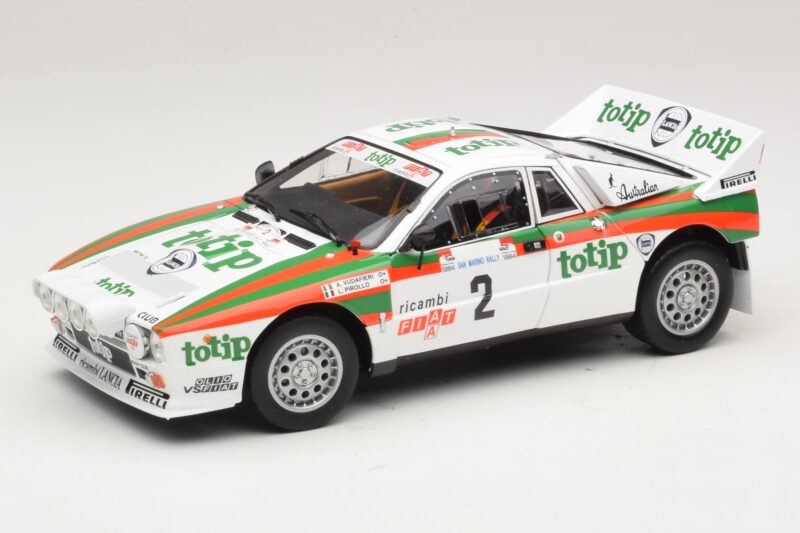
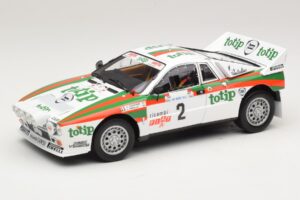
Kyosho's 1:18 diecast Lancia 037 reproduces car #2, driven by Attilio Bettega and Maurizio Perissinot at the 1984 San Marino Rally in the rear-wheel-drive Group B homologation special that won Lancia the 1983 manufacturers' title. Cast in zinc alloy with opening doors, bonnet and boot, it displays the roll cage, rally-spec cabin and supercharged four-cylinder engine bay behind a correctly registered Martini factory livery. The decal placement matches period photography of the works team. A compact, well-detailed piece for any Group B rally shelf.
About the Lancia 037 #2 A. Bettega / M. Perissinot Rally San Marino 1984 Kyosho 1:18
TL;DR: Kyosho's 1:18 diecast reproduces the Lancia 037 #2 driven by Attilio Bettega and Maurizio Perissinot at the 1984 San Marino Rally, the supercharged rear-wheel-drive Group B homologation special. Cast in zinc alloy with opening doors, bonnet and boot, it carries the full rally livery and roll cage detail for a mid-premium tier rally shelf piece.
Group B lasted barely four seasons before the FIA banned it, but the Lancia 037 spent that whole window proving a rear-wheel-drive car could still beat four-wheel-drive rivals on loose gravel. This San Marino Rally livery, campaigned by Attilio Bettega and co-driver Maurizio Perissinot, captures the works Martini colours at a rally where the 037 still mattered against the incoming Audi Quattro and Peugeot 205 T16.
The Lancia 037 in Group B Rallying
The Last Rear-Wheel-Drive World Champion
Lancia built the 037 specifically to counter the coming wave of four-wheel-drive Group B machinery, and for one season it worked. The 1983 manufacturers' title went to Lancia with a car driven only through its rear wheels, a distinction the 037 still holds as the last rear-drive car to take that crown. Abarth developed the mechanical package around a supercharged 2.0-litre inline-four mounted midships, wrapped in a Pininfarina-styled glassfibre body over a steel and tubular structure. By 1984, the Audi Quattro and the arriving Peugeot 205 T16 had shifted the balance toward all-wheel drive, and Lancia's works cars fought a rearguard action where a lighter, more agile rear-driven car could still exploit the terrain.
Bettega and Perissinot at San Marino
Attilio Bettega drove for the factory Martini Racing team through the peak Group B years, and the San Marino Rally sat within the domestic Italian championship where Lancia fielded its strongest driver lineups. Paired with co-driver Maurizio Perissinot, Bettega carried car number 2, one of the factory-liveried entries that distinguished the works cars from privateer 037s running similar specification. That partnership and that number are what this Kyosho casting reproduces, down to the sponsor decal placement that period photography confirms for the works team.
Kyosho's Diecast Approach to This Livery
Zinc Alloy Weight and Rally Graphics
Kyosho casts the body in zinc alloy, and the heft is immediately obvious lifting it from a display stand: rally cars in miniature benefit from that mass because it grounds the wide box-arch stance the 037 wears at this scale. The Martini livery depends on crisp decal registration far more than a plain factory colour would, since the sponsor stripes have to line up across the bonnet, doors and roof in one continuous run. Getting that register right, panel to panel, is one of the clearer signals of a well-executed rally livery casting, and it is where a lesser reproduction usually shows its seams first.
Opening Panels and Cabin Detail
The doors, bonnet and boot open on this casting, giving access to a cabin built for the stage rather than the road: a stripped-out interior, roll cage tubing and a rally-spec dashboard sit behind the opened doors, while the bonnet reveals the supercharged four-cylinder layout that defined the car's handling balance. Lifting the bonnet on a Group B casting like this rewards the buyer who wants to see the mechanical packaging that made the 037 competitive rather than just its livery.
Display Considerations for a Group B Rally Car
At 1:18 the 037's compact rally proportions come out close to 21 centimetres nose to tail, smaller than most Group B contemporaries because Lancia built the car on a shortened Beta Monte Carlo platform rather than a full-size saloon base. That compact footprint means it slots easily into a standard cabinet row without dominating the shelf the way a Quattro or 205 T16 casting can. Displayed with the doors and bonnet left open, the model reads as a service-park exhibit rather than a static toy, showing the roll cage and stripped cabin that a closed casting would hide entirely. Rally liveries also reward angled lighting more than road-car paint does: the mix of matte decal stripes against gloss white bodywork shows best under a raking light that catches the edge of each stripe rather than flooding the whole body evenly. Positioned beside other Martini-liveried rally cars from the same works era, this 037 anchors a factory-team display that spans the marque's Group B campaign, and the number 2 identification keeps it distinct from sister cars run under different numbers that same season.
Where the 037 Fits a Rally Collection
Group B's four-year lifespan before its 1986 ban makes every faithfully liveried casting from that period a record of a rally era that ended abruptly rather than fading out. Buyers assembling a Group B shelf tend to chase the works liveries first, Lancia, Audi and Peugeot side by side, because the technical contrast between rear-drive and four-wheel-drive approaches is the era's defining story. This Bettega and Perissinot San Marino livery fills the Lancia side of that comparison with a specific, dated entry rather than a generic factory repaint. At a mid-premium diecast price point, it sits comfortably below the hand-built resin tier while still delivering opening panels, cabin detail and decal accuracy that a basic mass-market casting would skip. For anyone building a rally chronology on 1980s works cars, it is a reasonably priced way to close the Lancia gap.
Create a free account and claim 10% off your first order — from hundreds of collectible 1:18, 1:43 and 1:12 models by Porsche, Mercedes-Benz, BMW and more.
{"id":1657276,"name":"Lancia 037 #2 A. Bettega \/ M. Perissinot Rally San Marino 1984 Kyosho 1:18","price":"£<\/span>154.17<\/bdi><\/span>","image":"https:\/\/models118.co.uk\/wp-content\/uploads\/2026\/08\/lancia-037-2-a-bettega-m-perissinot-rally-san-marino-1984-kyosho-1-18-08306f-1-1-400x400.jpg","permalink":"https:\/\/models118.co.uk\/lancia-037-2-a-bettega-m-perissinot-rally-san-marino-1984-kyosho-1-18-08306f\/","brand":"Lancia"}