{"ajaxurl":"https:\/\/models118.co.uk\/wp-admin\/admin-ajax.php?lang=en_GB","nonce":"a2e6fbeffa","homeUrl":"https:\/\/models118.co.uk\/","shopUrl":"https:\/\/models118.co.uk\/shop\/","cartUrl":"https:\/\/models118.co.uk\/cart-en-gb\/","checkoutUrl":"https:\/\/models118.co.uk\/checkout\/","skipCart":true,"collectionLimit":12,"i18n":{"addedToCart":"Added to basket","addToWishlist":"Add to wishlist","addedToWishlist":"Added to wishlist","removeFromWishlist":"Remove from wishlist","removedFromWishlist":"Removed from wishlist","undo":"Undo","error":"Something went wrong","loading":"Loading...","outOfStock":"Out of stock","viewCart":"View basket","proceedToCheckout":"Proceed to checkout","addedToCollection":"Added to your collection","reserved":"Added to your collection","soldOut":"Sold out","invalidEmail":"Please enter a valid email address","connectionError":"Connection error. Please try again.","tocToggle":"On this page","close":"Close","inCartTooltip":"Already in your basket \u2013 open your basket to check out","loginToSave":"Sign in to save this model","waitlistNotify":"Notify me","waitlistOnList":"On the waiting list \u2713","waitlistJoined":"You're on the waiting list. We'll email you the moment this model is available again.","waitlistRemoved":"Done \u2014 you're off the waiting list for this model.","waitlistRateLimit":"Too many attempts \u2014 please try again shortly","waitlistTurnstile":"We couldn't complete the check \u2014 please try again","waitlistError":"Sorry, something went wrong. Please try again in a moment."},"wishlist":{"loggedIn":false,"loginUrl":"https:\/\/models118.co.uk\/my-account\/","addAction":"models118_wishlist_add","removeAction":"models118_wishlist_remove"},"waitlist":{"loggedIn":false,"subscribeAction":"models118_waitlist_subscribe","toggleAction":"models118_waitlist_toggle","stateAction":"models118_waitlist_state"},"stats":{"models":2369,"brands":214,"manufacturers":129,"collectors":10000},"product":{"id":302517,"sku":"08438B","condition":"new","availability":"out_of_stock","name":"Ferrari 250 GTO #22 24 Hours of Le Mans 1962 Kyosho 1:18","brand":"Ferrari","manufacturer":"Kyosho","scale":"1:18","material":"Diecast","price":240,"regularPrice":240,"isOnSale":false,"savingsAmount":0,"stockQty":0,"stockStatus":"out_of_stock","isDiscontinued":true,"image":"https:\/\/models118.co.uk\/wp-content\/uploads\/2026\/03\/ferrari-250-gto-n22-le-mans-1962-kyosho-1-18-300x200.jpg","permalink":"https:\/\/models118.co.uk\/ferrari-250-gto-22-24-hours-of-le-mans-1962-kyosho-1-18-08438b\/"}}
Cookies on Models118
We use cookies to remember your preferences, understand how the shop is used and show you models and offers that suit your interests. What you allow is up to you, and you can change it at any time.
Always active
The technical storage or access is strictly necessary for the legitimate purpose of enabling the use of a specific service explicitly requested by the subscriber or user, or for the sole purpose of carrying out the transmission of a communication over an electronic communications network.
The technical storage or access is necessary for the legitimate purpose of storing preferences that are not requested by the subscriber or user.
The technical storage or access that is used exclusively for statistical purposes.
The technical storage or access is required to create user profiles to send advertising, or to track the user on a website or across several websites for similar marketing purposes.
Ferrari 250 GTO #22 24 Hours of Le Mans 1962 Kyosho 1:18
Sold out
1/10
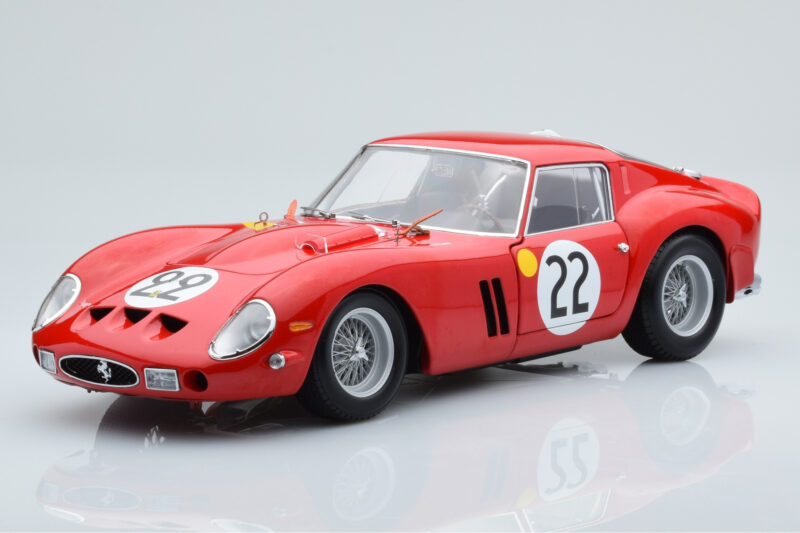
Kyosho's 1:18 diecast Ferrari 250 GTO wears the #22 race livery from the 1962 24 Hours of Le Mans, the year the GTO began a three-year run of GT class victories. Correct competition number graphics, aero-driven Scaglietti bodywork and diecast opening doors make this a strong anchor for a historic Le Mans GT display alongside period Jaguar and Aston Martin rivals.
About the Ferrari 250 GTO #22 24 Hours of Le Mans 1962 Kyosho 1:18
TL;DR: Kyosho's 1:18 diecast Ferrari 250 GTO reproduces the #22 competition livery from the 1962 24 Hours of Le Mans, the year the GTO began three consecutive GT class victories. Race number graphics, opening doors and correctly proportioned Scaglietti bodywork make this a genuine anchor for a historic endurance racing shelf.
The 250 GTO's competition reputation was forged at Le Mans, where it won its class three years running from 1962. Kyosho's #22 diecast places this specific entry within that opening, defining season.
Kyosho's 1:18 Ferrari 250 GTO in #22 Le Mans Livery
Race Number Graphics and Livery Registration
The number 22 sits within a roundel on the doors and roof, tampo-printed so the numerals stay crisp rather than thickening at the edges, and Kyosho keeps the surrounding trim and any period sponsor markings registered cleanly against the body colour. Race liveries live or die on this kind of registration accuracy, since a car covered mostly in bodywork rather than graphics needs every applied number and stripe to sit exactly where photographs show it, and this model holds that line well across every panel.
Opening Doors Over Competition-Correct Bodywork
Doors open on metal hinges to reveal a stripped, competition-style cabin rather than the plush trim a road car version would carry, and the diecast body keeps the aerodynamic details, the covered headlamps, the ducktail rear, that Bizzarrini's design relied on for high-speed stability at Le Mans. Weight in the hand confirms solid zinc alloy construction, giving the model real shelf presence.
1962 and the Start of the GTO's Le Mans Record
A Class-Winning Debut for Bizzarrini's Design
1962 was the year the 250 GTO made its competition debut in earnest, and Ferrari's Le Mans GT class victory that season proved the car could match its striking looks with genuine endurance-racing pace. Giotto Bizzarrini's aerodynamic work under the bodywork, low drag, high-speed stability, was validated directly by that result, turning what could have been simply an elegant homologation special into a genuinely dominant competition car from its very first major outing.
Three Consecutive Years at the Top of the GT Class
That 1962 win opened a run that continued through 1963 and 1964, giving the 250 GTO three consecutive Le Mans class victories before Ferrari shifted its competition focus toward purpose-built prototypes. Few road-derived GT cars have matched that sustained a run of success at the same event, and it's precisely this record that gives any race-liveried 250 GTO diecast, including this #22 car, genuine historical weight.
Reading a Race Liveried Diecast Correctly
Reading a race liveried model well means checking the details a period photograph would show rather than assuming the manufacturer got creative with the graphics. Compare the number placement, any visible sponsor markings and the wheel and tyre detailing against genuine 1962 Le Mans photography where possible, since accuracy on these points separates a documented recreation from a generic race-car interpretation wearing a number for effect. This diecast's panel gaps stay tight around the opening doors even with the additional livery printed across them, a harder tolerance to hold than on a plain-coloured street car, since any misalignment shows up immediately against the graphics. At 1:18, that level of registration accuracy is genuinely difficult to achieve consistently, and it's a fair test to apply before buying any race liveried subject at this scale.
This #22 GTO Within an Endurance Racing Collection
This #22 GTO sits naturally within a historic Le Mans GT display alongside period rivals like the Jaguar E-Type Lightweight or an Aston Martin DB4 GT, cars that competed in the same class during the same era, giving a shelf genuine competitive context rather than a scattered assortment of unrelated racing liveries. For a collector focused specifically on endurance racing history rather than road cars, a well-executed 250 GTO race livery like this one is close to essential, representing the opening chapter of one of sports car racing's most celebrated winning streaks.
Create a free account and claim 5% off your first order — from hundreds of collectible 1:18, 1:43 and 1:12 models by Porsche, Mercedes-Benz, BMW and more.
{"id":302517,"name":"Ferrari 250 GTO #22 24 Hours of Le Mans 1962 Kyosho 1:18","price":"£<\/span>240.00<\/bdi><\/span>","image":"https:\/\/models118.co.uk\/wp-content\/uploads\/2026\/03\/ferrari-250-gto-n22-le-mans-1962-kyosho-1-18-400x400.jpg","permalink":"https:\/\/models118.co.uk\/ferrari-250-gto-22-24-hours-of-le-mans-1962-kyosho-1-18-08438b\/","brand":"Ferrari"}