{"ajaxurl":"https:\/\/models118.co.uk\/wp-admin\/admin-ajax.php?lang=en_GB","nonce":"2f305ce5e4","homeUrl":"https:\/\/models118.co.uk\/","shopUrl":"https:\/\/models118.co.uk\/shop\/","cartUrl":"https:\/\/models118.co.uk\/cart-en-gb\/","checkoutUrl":"https:\/\/models118.co.uk\/checkout\/","skipCart":true,"collectionLimit":12,"i18n":{"addedToCart":"Added to basket","addToWishlist":"Add to wishlist","addedToWishlist":"Added to wishlist","removeFromWishlist":"Remove from wishlist","removedFromWishlist":"Removed from wishlist","undo":"Undo","error":"Something went wrong","loading":"Loading...","outOfStock":"Out of stock","viewCart":"View basket","proceedToCheckout":"Proceed to checkout","addedToCollection":"Added to your collection","reserved":"Added to your collection","soldOut":"Sold out","invalidEmail":"Please enter a valid email address","connectionError":"Connection error. Please try again.","tocToggle":"On this page","close":"Close","inCartTooltip":"Already in your basket \u2013 open your basket to check out","loginToSave":"Sign in to save this model","waitlistNotify":"Notify me","waitlistOnList":"On the waiting list \u2713","waitlistJoined":"You're on the waiting list. We'll email you the moment this model is available again.","waitlistRemoved":"Done \u2014 you're off the waiting list for this model.","waitlistRateLimit":"Too many attempts \u2014 please try again shortly","waitlistTurnstile":"We couldn't complete the check \u2014 please try again","waitlistError":"Sorry, something went wrong. Please try again in a moment."},"wishlist":{"loggedIn":false,"loginUrl":"https:\/\/models118.co.uk\/my-account\/","addAction":"models118_wishlist_add","removeAction":"models118_wishlist_remove"},"waitlist":{"loggedIn":false,"subscribeAction":"models118_waitlist_subscribe","toggleAction":"models118_waitlist_toggle","stateAction":"models118_waitlist_state"},"stats":{"models":2335,"brands":214,"manufacturers":129,"collectors":10000},"product":{"id":330212,"sku":"08432B","condition":"used","availability":"out_of_stock","name":"Ferrari 250 GTO #22 24 Hours of Le Mans 1962 Kyosho 1:18","brand":"Ferrari","manufacturer":"Kyosho","scale":"1:18","material":"Diecast","price":198.33,"regularPrice":198.33,"isOnSale":false,"savingsAmount":0,"stockQty":0,"stockStatus":"out_of_stock","isDiscontinued":true,"image":"https:\/\/models118.co.uk\/wp-content\/uploads\/2026\/04\/ferrari-250-gto-n22-le-mans-1962-old-version-kyosho-1-18-300x200.jpg","permalink":"https:\/\/models118.co.uk\/ferrari-250-gto-22-24-hours-of-le-mans-1962-kyosho-1-18-08432b\/"}}
Cookies on Models118
We use cookies to remember your preferences, understand how the shop is used and show you models and offers that suit your interests. What you allow is up to you, and you can change it at any time.
Always active
The technical storage or access is strictly necessary for the legitimate purpose of enabling the use of a specific service explicitly requested by the subscriber or user, or for the sole purpose of carrying out the transmission of a communication over an electronic communications network.
The technical storage or access is necessary for the legitimate purpose of storing preferences that are not requested by the subscriber or user.
The technical storage or access that is used exclusively for statistical purposes.
The technical storage or access is required to create user profiles to send advertising, or to track the user on a website or across several websites for similar marketing purposes.
Ferrari 250 GTO #22 24 Hours of Le Mans 1962 Kyosho 1:18
Sold out
1/8
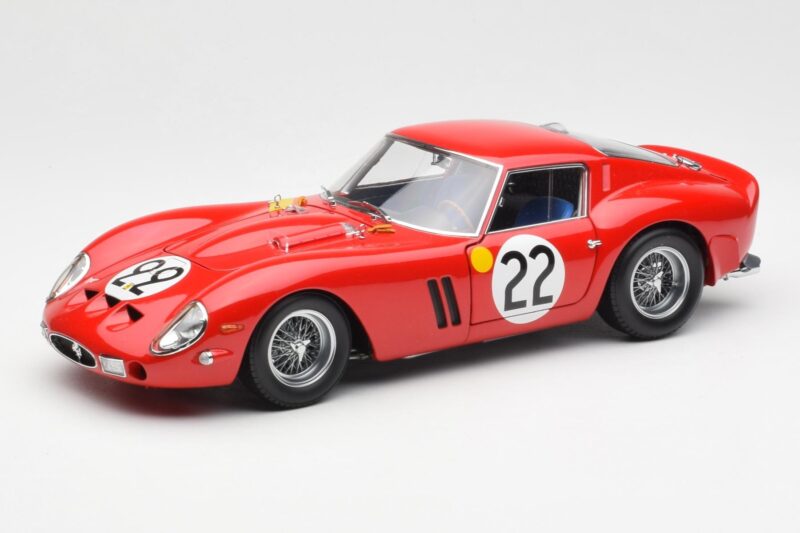
Kyosho's 1:18 diecast Ferrari 250 GTO reproduces race number 22 from the same 1962 24 Hours of Le Mans grid as other factory entries, correct period livery and opening doors included. A natural pairing piece for collectors comparing diecast and resin approaches to the same legendary GT racer.
About the Ferrari 250 GTO #22 24 Hours of Le Mans 1962 Kyosho 1:18
TL;DR: Kyosho's 1:18 diecast reproduces a second Ferrari 250 GTO from the 1962 24 Hours of Le Mans grid, race number 22, in correct period livery alongside the model's usual opening doors and bonnet. Diecast construction offers an accessible way to build a multi-car GTO display without resin-tier pricing.
Ferrari rarely sent a single GTO to Le Mans when several could compete for class honours, and Kyosho's number 22 car represents that depth of factory effort. Set beside another liveried GTO from the same grid, the differences in decal placement and sponsor markings become genuinely interesting to compare.
Kyosho's 1:18 Ferrari 250 GTO, Race Number 22
A Second Le Mans Livery From the Same 1962 Grid
Ferrari and its allied entrants regularly fielded multiple GTOs at the same Le Mans weekend, spreading the risk of mechanical failure across several cars while maximising the chance of a class win. This model wears race number 22, a livery distinct from other 1962 GTO entries in its decal placement and sponsor detailing even though the underlying bodywork is identical. Kyosho tools each livery separately rather than simply reprinting a shared casting, so the number panels, roundels and stripe work sit exactly where period photographs show them rather than approximated for convenience.
Diecast Weight and Panel Fit on This Casting
Lifted from its box, the zinc alloy body has real presence, noticeably heavier than a resin piece of the same size, and that weight comes with opening doors and a bonnet that lifts to reveal a simplified but legible engine bay. Shut lines around the doors sit close and even, and the wire-style wheels fill the arches at a stance consistent with the real car's ride height. It is not the razor-edged panel work a sealed resin body can achieve, but the trade is opening features and a lower price, both worth having on a race car built to be examined from every angle.
Diecast or Resin: Choosing How to Collect the GTO
What Kyosho's Diecast Trades Away, and What It Keeps
Specialist resin producers building GTO tributes typically seal the body entirely, which frees them to chase sharper shut lines and finer paint depth without the tolerances an opening door or bonnet demands. Kyosho's diecast approach accepts slightly wider gaps around the panels in exchange for doors that genuinely open, a bonnet that lifts, and a body that survives handling better thanks to its metal construction. Neither approach is objectively better; they serve different collecting priorities. A collector chasing museum-grade paint accuracy across a handful of hero GTOs will likely prefer resin, while a collector building a broader Le Mans display across several liveries, several years and several marques will find diecast's lower per-model cost lets that collection grow further. This number 22 car sits confidently in the second category: an accurate, handleable GTO built to be one of several rather than the single expensive centrepiece of a shelf. Handling one alongside a sealed resin GTO makes that difference immediately obvious: the diecast feels more substantial in the hand, while the resin body shows a marginally cleaner line where door meets sill.
Building a Multi-Car Le Mans 1962 Display
Pairing Multiple GTOs From the Same Race
At roughly 24 centimetres long, this GTO occupies the same footprint as other 1:18 examples, which makes lining up several liveries from the same Le Mans weekend a genuinely rewarding display exercise rather than a repetitive one. Set beside a differently numbered GTO from the same 1962 entry list, this car highlights how much variation existed within what looks, at a glance, like an identical field of cars. Kyosho's diecast pricing makes that kind of multi-car build realistic in a way that assembling three or four resin GTOs rarely is. For a collector interested in the depth of Ferrari's factory effort at Le Mans rather than just its winning car, this is where the interesting comparisons start. Displayed under even lighting, the subtle livery differences between two GTOs from the same weekend reward the kind of close inspection that a single hero car cannot offer.
Create a free account and claim 5% off your first order — from hundreds of collectible 1:18, 1:43 and 1:12 models by Porsche, Mercedes-Benz, BMW and more.
{"id":330212,"name":"Ferrari 250 GTO #22 24 Hours of Le Mans 1962 Kyosho 1:18","price":"£<\/span>198.33<\/bdi><\/span>","image":"https:\/\/models118.co.uk\/wp-content\/uploads\/2026\/04\/ferrari-250-gto-n22-le-mans-1962-old-version-kyosho-1-18-400x400.jpg","permalink":"https:\/\/models118.co.uk\/ferrari-250-gto-22-24-hours-of-le-mans-1962-kyosho-1-18-08432b\/","brand":"Ferrari"}