On sale:
-35%
Used
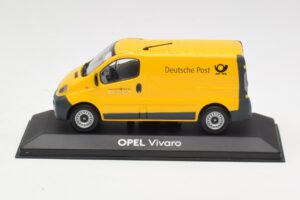
Opel Vivaro A Deutsche Post Minichamps 1:43
Only 2 left
Sale ends in: 00d 00h 00m
Price:
was
£40.00
£26.00
Save £14.00
VAT included
Save £47.00
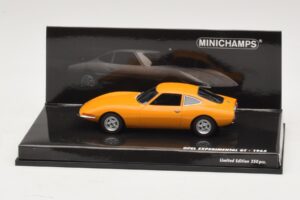
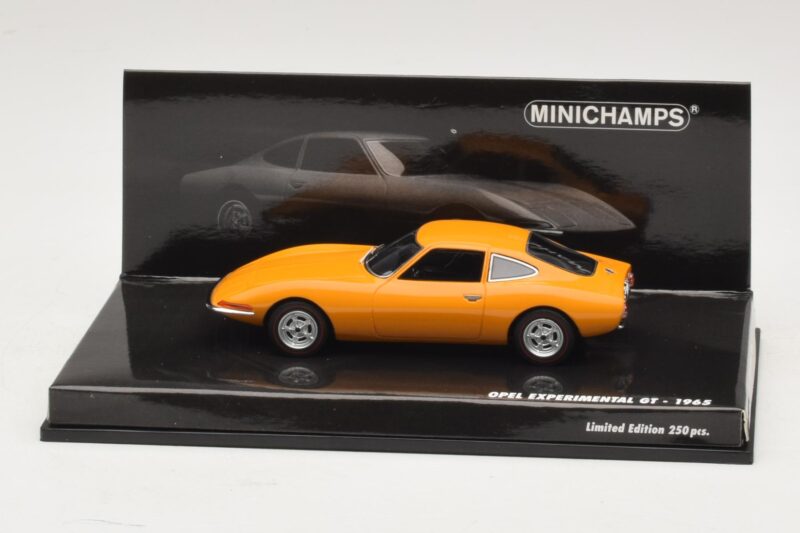
TL;DR: Minichamps' 1:43 diecast Opel Experimental GT reproduces the 1965 design study in orange, the concept that previewed the styling Opel put into production as the Opel GT three years later. The sealed zinc alloy body captures its long bonnet, tapered tail, and show-car proportions rather than any production-spec detailing.
Concept cars rarely make it to production largely unchanged, which is what makes the Experimental GT worth collecting in miniature: shown at a mid-1960s motor show, it carried the silhouette that Opel put into series production almost intact. Minichamps' orange rendering leans into that show-car boldness, a colour choice that suits a design study built to draw attention on a stand rather than blend into everyday traffic.
Opel revealed the Experimental GT in 1965, a low, long-nosed coupe study built to test public and press reaction to a genuinely sporting Opel, a category the brand had not seriously occupied before. Its long bonnet, tapering tail, and low glasshouse were unusually close to what Opel actually put into production in 1968 as the Opel GT, a rare case of a show car surviving the transition to a genuine production model with its core silhouette essentially intact. Most concept studies are diluted heavily before reaching a showroom, but this one shows how directly a well-received design study could shape a manufacturer's actual product line in the 1960s, which is exactly why it remains an interesting subject to collect on its own rather than only as a footnote to the GT that followed.
Minichamps casts the Experimental GT in zinc alloy, and the sealed one-piece body suits a subject that never had production doors, bonnet, or boot to worry about matching in the first place, since it existed purely as a styling exercise. The casting captures the long, sloping bonnet line and the tightly wrapped glasshouse with clean, consistent surfacing, and the metal shell gives the model real weight for its size, denser than the fibreglass or hand-formed metal the actual show car would have been built from. Because there is no factory production specification to match against, faithfulness here is judged purely against period photographs of the actual 1965 show car, and the model holds up well under that comparison.
Orange is exactly the kind of colour a manufacturer would choose to make a concept car impossible to miss on a crowded show stand, and Minichamps' finish carries that same confident, attention-seeking quality. The paint holds an even gloss across the long bonnet and low tail, with the coupe's tightly integrated lighting and grille treatment picked out in contrasting chrome and black rather than left in the body colour. Because this is a design study rather than a production car, there is no factory trim level to reference, and the model's job is simply to convince as a faithful record of a specific, well-documented show car.
The Experimental GT's proportions, a low nose, a short rear deck, and a glasshouse pulled tightly over the cabin, translate at 1:43 into a genuinely compact, purposeful shape that stands out clearly against the more conventional saloon and coupe silhouettes common in a general Opel or GM-era collection. Its low, wide stance holds its own on a shelf even next to larger production sports cars from the same decade, and the scale keeps a run of 1960s concept and show cars manageable within a single display case rather than demanding disproportionate space for one unusual subject.
For a collector interested in design history rather than only production models, the Experimental GT offers something genuinely rare: a concept car whose styling can be checked directly against the production model it inspired, since the Opel GT that followed kept so much of this study's silhouette. Displayed alongside an actual Opel GT model, the pairing tells a complete design story in a way that most concept-to-production comparisons cannot manage, given how heavily most show cars get reworked before reaching a showroom. The sealed zinc alloy body asks nothing beyond routine dusting, and the orange finish keeps the piece visually distinct from more conservative period Opel saloons on the same shelf. It is a considered choice for a collection built around automotive design history rather than one assembled purely around racing or tuning subjects.
Save £14.00
Save £71.00

Save £14.00
Save £6.00
Save £14.00

Save £14.00
Save £51.00
Save £17.00
Save £2.00
Save £41.00
Save £44.00
Save £28.00
Save £28.00
Save £44.00
Save £30.00