{"ajaxurl":"https:\/\/models118.co.uk\/wp-admin\/admin-ajax.php?lang=en_GB","nonce":"094d7f3a7d","homeUrl":"https:\/\/models118.co.uk\/","shopUrl":"https:\/\/models118.co.uk\/shop\/","cartUrl":"https:\/\/models118.co.uk\/cart-en-gb\/","checkoutUrl":"https:\/\/models118.co.uk\/checkout\/","skipCart":true,"collectionLimit":12,"i18n":{"addedToCart":"Added to basket","addToWishlist":"Add to wishlist","addedToWishlist":"Added to wishlist","removeFromWishlist":"Remove from wishlist","removedFromWishlist":"Removed from wishlist","undo":"Undo","error":"Something went wrong","loading":"Loading...","outOfStock":"Out of stock","viewCart":"View basket","proceedToCheckout":"Proceed to checkout","addedToCollection":"Added to your collection","reserved":"Added to your collection","soldOut":"Sold out","invalidEmail":"Please enter a valid email address","connectionError":"Connection error. Please try again.","tocToggle":"On this page","close":"Close","inCartTooltip":"Already in your basket \u2013 open your basket to check out","loginToSave":"Sign in to save this model","waitlistNotify":"Notify me","waitlistOnList":"On the waiting list \u2713","waitlistJoined":"You're on the waiting list. We'll email you the moment this model is available again.","waitlistRemoved":"Done \u2014 you're off the waiting list for this model.","waitlistRateLimit":"Too many attempts \u2014 please try again shortly","waitlistTurnstile":"We couldn't complete the check \u2014 please try again","waitlistError":"Sorry, something went wrong. Please try again in a moment."},"wishlist":{"loggedIn":false,"loginUrl":"https:\/\/models118.co.uk\/my-account\/","addAction":"models118_wishlist_add","removeAction":"models118_wishlist_remove"},"waitlist":{"loggedIn":false,"subscribeAction":"models118_waitlist_subscribe","toggleAction":"models118_waitlist_toggle","stateAction":"models118_waitlist_state"},"stats":{"models":2425,"brands":214,"manufacturers":129,"collectors":10000},"product":{"id":303118,"sku":"08130D","condition":"used","availability":"out_of_stock","name":"Lancia Stratos HF #1 Hunsruck Rally 1978 Kyosho 1:18","brand":"Lancia","manufacturer":"Kyosho","scale":"1:18","material":"Diecast","price":159.17,"regularPrice":159.17,"isOnSale":false,"savingsAmount":0,"stockQty":0,"stockStatus":"out_of_stock","isDiscontinued":true,"image":"https:\/\/models118.co.uk\/wp-content\/uploads\/2026\/03\/lancia-stratof-hf-n1-hunsruck-1978-kyosho-1-18-300x200.jpg","permalink":"https:\/\/models118.co.uk\/lancia-stratos-hf-1-hunsruck-rally-1978-kyosho-1-18-08130d\/"}}
Cookies on Models118
We use cookies to remember your preferences, understand how the shop is used and show you models and offers that suit your interests. What you allow is up to you, and you can change it at any time.
Always active
The technical storage or access is strictly necessary for the legitimate purpose of enabling the use of a specific service explicitly requested by the subscriber or user, or for the sole purpose of carrying out the transmission of a communication over an electronic communications network.
The technical storage or access is necessary for the legitimate purpose of storing preferences that are not requested by the subscriber or user.
The technical storage or access that is used exclusively for statistical purposes.
The technical storage or access is required to create user profiles to send advertising, or to track the user on a website or across several websites for similar marketing purposes.
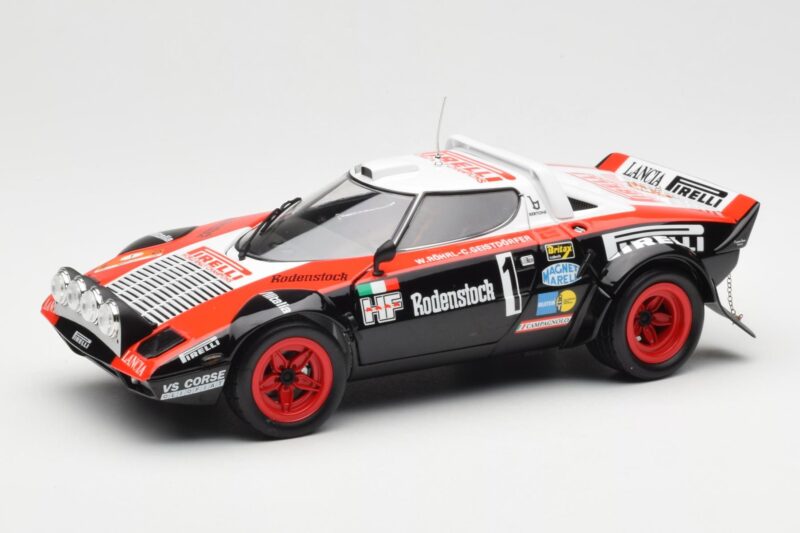
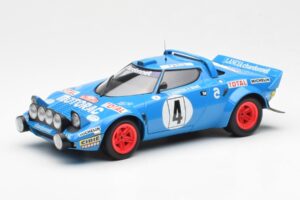
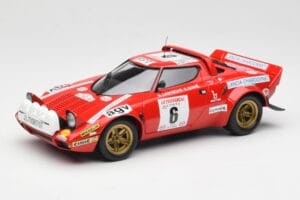
Kyosho's 1:18 diecast Lancia Stratos HF reproduces car number 1's 1978 Hunsrück Rally livery over the wedge-shaped body of Lancia's Ferrari-engined Group 4 icon, three-time WRC manufacturers' champion. Sharp decal registration and correctly flared arches suit a compact, high-impact 1970s rally display at mid-tier diecast pricing.
About the Lancia Stratos HF #1 Hunsruck Rally 1978 Kyosho 1:18
TL;DR: Kyosho's 1:18 diecast Lancia Stratos HF reproduces car number 1 from the 1978 Hunsrück Rally, carrying full period rally graphics over the wedge-shaped body of Lancia's Ferrari-engined Group 4 icon. A compact but visually striking piece for a 1970s WRC-era rally display.
No rally car looks quite like the Stratos, and few have a championship record to match its shape. This numbered example carries the car into its later competition years, well past Lancia's factory-backed peak.
The Stratos and Three Rally Championships
A Wedge Shape Built Around a Ferrari Engine
Bertone's wedge-shaped design, credited to Marcello Gandini, was built specifically for rallying rather than adapted from a road car, and it housed a Ferrari Dino V6 engine mounted amidships for balance no conventional hatchback could match. That combination of purpose-built shape and borrowed exotic power made the Stratos genuinely unlike anything else on a special stage, and it delivered results to match: Lancia won the World Rally Championship manufacturers' title in three consecutive years through the mid-1970s, a run that remains one of the sport's defining stretches.
Life After the Works Programme Ended
By the time this car's number 1 livery from the 1978 Hunsrück Rally in Germany was applied, Lancia's official works effort had wound down and the Stratos had largely passed to private and national-level teams still exploiting the car's competitiveness on European rally stages. That later career, less documented than the factory glory years but no less genuine, is where a great many Stratos liveries actually come from, giving collectors a wider, more varied field of authentic period graphics to choose from.
Kyosho's Rendering of a Numbered Rally Livery
Decal Registration Across a Sharp-Edged Body
The Stratos's flat panels and hard creases are, in one sense, easier ground for decals than a curved body, and Kyosho takes advantage of that with crisp, well-registered graphics across the bonnet, doors, and rear haunches. The number 1 roundel sits square and correctly sized rather than oversized for visual effect, and sponsor and rally-plate details follow the same restraint. Shut lines around the distinctive lift-up front and rear body sections stay tight despite the busy livery layered across them.
Wheels, Arches and Rally-Spec Detail
The wide arches that housed the Stratos's fat competition tyres are reproduced with the correct aggressive flare, and the wheels sit properly within them rather than looking undersized, a common failing on lesser rally tooling. Auxiliary lamps, mounted for night stages, are present as applied pieces rather than moulded lumps, and the roof-mounted air intake, a distinctive Stratos feature, is shaped accurately.
A Compact, High-Impact Rally Subject
At barely 20 centimetres long, the Stratos takes up very little shelf space for how much visual impact its shape and livery deliver, making it easy to fit several rally subjects into a compact display without overcrowding a cabinet. This is diecast at a mid-tier price point, sharp enough to do the livery justice without chasing sealed-resin precision, and that trade feels right for a subject whose appeal was always more about drama than showroom polish. Rally liveries printed as tampo decals hold their edge sharpness far longer than waterslide transfers, but both benefit from indirect lighting rather than direct sun, which slowly bleaches even well-applied graphics over years on an open shelf. A numbered Stratos like this one earns its place through shape and history rather than sheer size.
Create a free account and claim 5% off your first order — from hundreds of collectible 1:18, 1:43 and 1:12 models by Porsche, Mercedes-Benz, BMW and more.