Last one
Used
This model is currently sold out. Enter your email and we'll let you know when it's back in stock. We'll also send you news about new models. You can unsubscribe at any time.
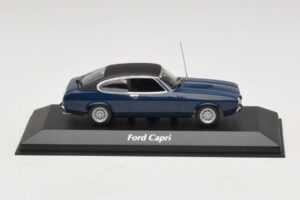
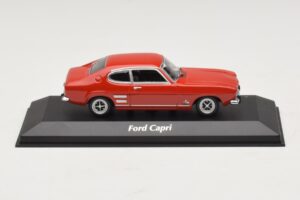
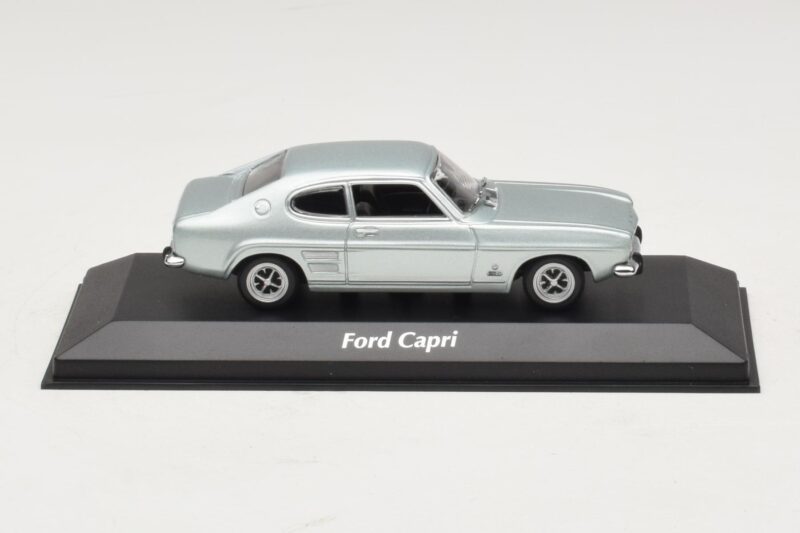
TL;DR: Maxichamps' 1:43 Ford Capri Mk1 reproduces the 1969 coupe in light blue metallic, the car Ford famously marketed to British buyers as the one they had always promised themselves. The sealed diecast body holds the Capri's long bonnet and fastback profile accurately, with even metallic paint depth throughout.
Few British advertising lines have outlasted their era as well as 'the car you always promised yourself', and the Capri Mk1 it sold was styled deliberately to echo the American pony car formula on a scale British roads and budgets could actually accommodate. Maxichamps' light blue metallic diecast keeps that long-bonnet, fastback silhouette intact.
Ford launched the Capri in 1969 with a marketing campaign built entirely around aspiration, positioning an affordable, sporty coupe as a genuine object of desire rather than just another family car with two fewer doors. The long bonnet, short rear deck and fastback roofline borrowed the pony car formula wholesale, but engineered it around four-cylinder engines and running costs that made the aspiration achievable for a far wider range of buyers than any genuine muscle car ever reached. That accessibility, more than any single styling detail, is why the Capri became such a fixture of British roads through the 1970s.
Maxichamps casts the Capri as a sealed one-piece body, holding that long-bonnet, fastback proportion accurately without the added cost a multi-part opening build would bring at this price point. Light blue metallic paint sits evenly across the bonnet and roof, the flake reading clearly under direct light rather than looking flat, and the chrome bumpers and grille surround stay crisp against the lighter body colour. The wheels sit correctly within the arches, an important detail on a car whose entire visual appeal depends on that long, low bonnet-to-cabin ratio reading true at any scale.
Ford deliberately built the Capri as Europe's answer to cars like the Mustang, a formula that worked on American roads and budgets translated for a market where fuel, insurance and purchase costs all demanded a smaller, more efficient package. The Mk1's success across Britain and continental Europe proved the approach worked, and the Capri went on to spawn multiple generations and countless special editions through the 1970s and into the early 1980s. Its cultural footprint in Britain specifically, reinforced by decades of use as an affordable, aspirational coupe, gives this early Mk1 a significance that outlasts its comparatively modest performance figures.
Light blue metallic was a genuinely common Capri colour through the early 1970s, part of a period palette that favoured clean, confident tones over anything too understated. On a coupe with proportions this dependent on a long, unbroken bonnet line, a lighter metallic shade helps that length read clearly under typical display lighting, where a darker colour can visually shorten the same panel. It is a period-honest choice that suits the car's optimistic, aspirational marketing rather than working against it.
For a collection built around British motoring culture, a Capri Mk1 is close to a non-negotiable entry, a car whose advertising slogan is arguably as well remembered in Britain as the coupe itself. At 1:43, it sits naturally alongside contemporary Ford and British Leyland coupes of the same period without demanding significant shelf space. Judge this model on bonnet proportion and metallic paint evenness, both genuine strengths of a sealed diecast build, rather than expecting opening features that a car this accessibly priced was never going to offer at this scale, leaving the tooling's attention firmly on the silhouette that made the car famous in the first place.