{"ajaxurl":"https:\/\/models118.co.uk\/wp-admin\/admin-ajax.php?lang=en_GB","nonce":"1bbaa8ccd4","homeUrl":"https:\/\/models118.co.uk\/","shopUrl":"https:\/\/models118.co.uk\/shop\/","cartUrl":"https:\/\/models118.co.uk\/cart-en-gb\/","checkoutUrl":"https:\/\/models118.co.uk\/checkout\/","skipCart":true,"collectionLimit":12,"i18n":{"addedToCart":"Added to basket","addToWishlist":"Add to wishlist","addedToWishlist":"Added to wishlist","removeFromWishlist":"Remove from wishlist","removedFromWishlist":"Removed from wishlist","undo":"Undo","error":"Something went wrong","loading":"Loading...","outOfStock":"Out of stock","viewCart":"View basket","proceedToCheckout":"Proceed to checkout","addedToCollection":"Added to your collection","reserved":"Added to your collection","soldOut":"Sold out","invalidEmail":"Please enter a valid email address","connectionError":"Connection error. Please try again.","tocToggle":"On this page","close":"Close","inCartTooltip":"Already in your basket \u2013 open your basket to check out","loginToSave":"Sign in to save this model","waitlistNotify":"Notify me","waitlistOnList":"On the waiting list \u2713","waitlistJoined":"You're on the waiting list. We'll email you the moment this model is available again.","waitlistRemoved":"Done \u2014 you're off the waiting list for this model.","waitlistRateLimit":"Too many attempts \u2014 please try again shortly","waitlistTurnstile":"We couldn't complete the check \u2014 please try again","waitlistError":"Sorry, something went wrong. Please try again in a moment."},"wishlist":{"loggedIn":false,"loginUrl":"https:\/\/models118.co.uk\/my-account\/","addAction":"models118_wishlist_add","removeAction":"models118_wishlist_remove"},"waitlist":{"loggedIn":false,"subscribeAction":"models118_waitlist_subscribe","toggleAction":"models118_waitlist_toggle","stateAction":"models118_waitlist_state"},"stats":{"models":2712,"brands":215,"manufacturers":129,"collectors":10000},"product":{"id":1701326,"sku":"940081201","condition":"new","availability":"in_stock","name":"Ford Capri II Dark Blue Maxichamps 1:43","brand":"Ford","manufacturer":"Maxichamps","scale":"1:43","material":"Diecast","price":42,"regularPrice":42,"isOnSale":false,"savingsAmount":0,"stockQty":2,"stockStatus":"very_low","isDiscontinued":false,"image":"https:\/\/models118.co.uk\/wp-content\/uploads\/2026\/10\/ford-capri-ii-dark-blue-maxichamps-1-43-940081201-1-1-300x200.jpg","permalink":"https:\/\/models118.co.uk\/ford-capri-ii-dark-blue-maxichamps-1-43-940081201\/"}}
Cookies on Models118
We use cookies to remember your preferences, understand how the shop is used and show you models and offers that suit your interests. What you allow is up to you, and you can change it at any time.
Always active
The technical storage or access is strictly necessary for the legitimate purpose of enabling the use of a specific service explicitly requested by the subscriber or user, or for the sole purpose of carrying out the transmission of a communication over an electronic communications network.
The technical storage or access is necessary for the legitimate purpose of storing preferences that are not requested by the subscriber or user.
The technical storage or access that is used exclusively for statistical purposes.
The technical storage or access is required to create user profiles to send advertising, or to track the user on a website or across several websites for similar marketing purposes.
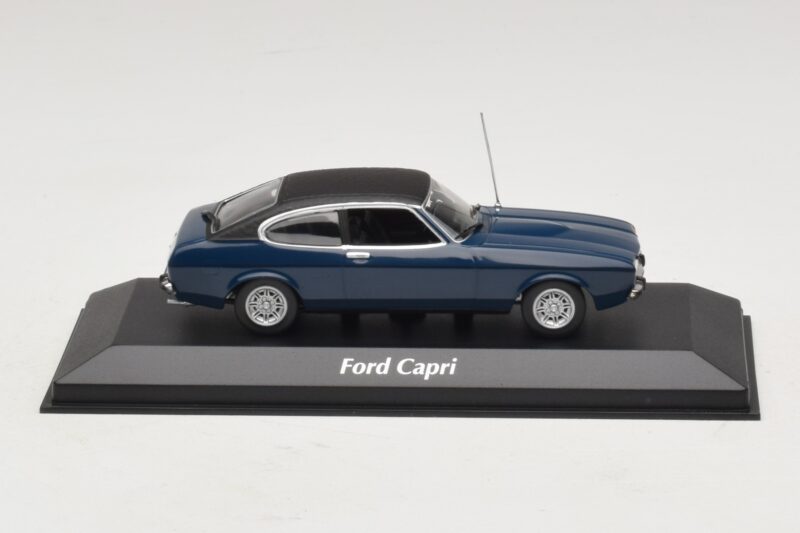
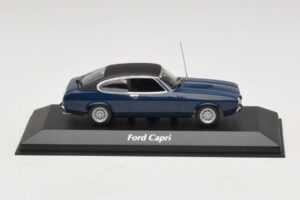
Maxichamps' 1:43 Ford Capri II in dark blue is a diecast liftback coupe built around the 1974 car, cast as a sealed one-piece body. The long bonnet, low roofline and wide stance are the proportions that matter, and dark paint shows casting quality plainly. At roughly 10 cm it sits well beside other 1970s coupes, with zinc alloy weight in the hand.
TL;DR: The Maxichamps Ford Capri II Dark Blue is a 1:43 diecast model of the 1974 liftback coupe, cast as a sealed one-piece body. Its long bonnet and low, wide stance are the proportions to judge, and the dark paint rewards a close look under a lamp.
Maxichamps' Ford Capri II at 1:43 is a long-bonnet coupe in a colour that rewards patience: dark blue hides nothing and flatters everything. The 1974 update gave the Capri a hatchback-style tailgate, which changed how the car was used, though not how it looks from the front. It is a quietly confident shape for a shelf.
Maxichamps Ford Capri II in Dark Blue
The 1974 Hatchback Update
The Capri was launched at the end of the 1960s as an affordable, long-bonnet coupe, and the second generation arrived in 1974 with a tailgate that opened to include the rear glass, a first for the line. That practical change gave the car a more usable rear end without altering its fast roofline. On a model, the sloping rear glass and the tailgate cut are worth studying, because they are where the shape turns from roof to tail. They should flow without a step.
Dark Blue and Reflections
Dark paint is the honest test of a diecast body. Light travels along the wing, over the bonnet and down the flank, and any waviness in the casting shows as a distorted reflection. On a good example the highlights run in clean, unbroken lines. The long bonnet is the largest single surface, so start your inspection there. Zinc alloy is a rigid base for that, because the metal does not flex the way thin plastic does. Slight orange-peel texture is the usual limit at this scale; it should be fine rather than coarse. Look at the colour in different light: dark blue can lean towards black in a cabinet and show its true depth by a window. Check the glazing for the same clarity, since dark bodywork makes any smearing obvious.
Building a Long-Bonnet Shape in Metal
Proportion Is the Whole Game
A Capri lives or dies on its proportions: a long nose, a short rear deck, a low roofline and a wide track. Get the front overhang or the wheel position wrong by a millimetre at 1:43 and the model looks like a different car. Compare the wheelbase against the overall length and the height of the roof against the width. Those ratios are easier to read than any single detail, and they are why collectors who know the real car can spot a good casting from across the room. Look at the car side-on first, then from above, where the stance shows best.
What a Fixed Body Reveals
Nothing on this model opens, which keeps attention on surfaces. The shut lines are fine engraved grooves, the bonnet line stays uninterrupted, and the glass sits flush. That makes a sealed casting a good test of manufacturing consistency: every feature is either right or visibly wrong. It is also physically robust, with no hinged parts to snap during handling. Weighed against a resin cast, diecast gives you a little more heft and a little less edge sharpness, an honest trade at this price level.
Pairing the Capri II With Its Successor
Collectors often work through the Capri in generations, with the second-generation hatchback sitting between the original coupe and the later, reworked cars. At roughly 10 cm, a row of three takes up barely more room than one 1:18 model. Dark blue also gives variety against brighter colours, so a shelf of orange, red and blue Capris looks deliberate rather than repetitive. This is an accessible diecast, so expect solid casting and tidy printing rather than hand-fitted parts, and treat the fixed body as a strength for handling. A closed case and a soft brush keep the paint clean over time. For a 1970s British coupe in a restrained colour, it is a sound choice.
Create a free account and claim 5% off your first order — from hundreds of collectible 1:18, 1:43 and 1:12 models by Porsche, Mercedes-Benz, BMW and more.
{"id":1701326,"name":"Ford Capri II Dark Blue Maxichamps 1:43","price":"£<\/span>42.00<\/bdi><\/span>","image":"https:\/\/models118.co.uk\/wp-content\/uploads\/2026\/10\/ford-capri-ii-dark-blue-maxichamps-1-43-940081201-1-1-400x400.jpg","permalink":"https:\/\/models118.co.uk\/ford-capri-ii-dark-blue-maxichamps-1-43-940081201\/","brand":"Ford"}