{"ajaxurl":"https:\/\/models118.co.uk\/wp-admin\/admin-ajax.php?lang=en_GB","nonce":"221e9a437f","homeUrl":"https:\/\/models118.co.uk\/","shopUrl":"https:\/\/models118.co.uk\/shop\/","cartUrl":"https:\/\/models118.co.uk\/cart-en-gb\/","checkoutUrl":"https:\/\/models118.co.uk\/checkout\/","skipCart":true,"collectionLimit":12,"i18n":{"addedToCart":"Added to basket","addToWishlist":"Add to wishlist","addedToWishlist":"Added to wishlist","removeFromWishlist":"Remove from wishlist","removedFromWishlist":"Removed from wishlist","undo":"Undo","error":"Something went wrong","loading":"Loading...","outOfStock":"Out of stock","viewCart":"View basket","proceedToCheckout":"Proceed to checkout","addedToCollection":"Added to your collection","reserved":"Added to your collection","soldOut":"Sold out","invalidEmail":"Please enter a valid email address","connectionError":"Connection error. Please try again.","tocToggle":"On this page","close":"Close","inCartTooltip":"Already in your basket \u2013 open your basket to check out","loginToSave":"Sign in to save this model","waitlistNotify":"Notify me","waitlistOnList":"On the waiting list \u2713","waitlistJoined":"You're on the waiting list. We'll email you the moment this model is available again.","waitlistRemoved":"Done \u2014 you're off the waiting list for this model.","waitlistRateLimit":"Too many attempts \u2014 please try again shortly","waitlistTurnstile":"We couldn't complete the check \u2014 please try again","waitlistError":"Sorry, something went wrong. Please try again in a moment."},"wishlist":{"loggedIn":false,"loginUrl":"https:\/\/models118.co.uk\/my-account\/","addAction":"models118_wishlist_add","removeAction":"models118_wishlist_remove"},"waitlist":{"loggedIn":false,"subscribeAction":"models118_waitlist_subscribe","toggleAction":"models118_waitlist_toggle","stateAction":"models118_waitlist_state"},"stats":{"models":2328,"brands":213,"manufacturers":128,"collectors":10000},"product":{"id":614008,"sku":"08422R","condition":"used","availability":"out_of_stock","name":"Ferrari Testarossa Red Kyosho 1:18","brand":"Ferrari","manufacturer":"Kyosho","scale":"1:18","material":"Diecast","price":248.33,"regularPrice":248.33,"isOnSale":false,"savingsAmount":0,"stockQty":0,"stockStatus":"out_of_stock","isDiscontinued":true,"image":"https:\/\/models118.co.uk\/wp-content\/uploads\/2026\/06\/ferrari-testarossa-red-kyosho-1-18-300x200.jpg","permalink":"https:\/\/models118.co.uk\/ferrari-testarossa-red-kyosho-1-18-08422r\/"}}
Cookies on Models118
We use cookies to remember your preferences, understand how the shop is used and show you models and offers that suit your interests. What you allow is up to you, and you can change it at any time.
Always active
The technical storage or access is strictly necessary for the legitimate purpose of enabling the use of a specific service explicitly requested by the subscriber or user, or for the sole purpose of carrying out the transmission of a communication over an electronic communications network.
The technical storage or access is necessary for the legitimate purpose of storing preferences that are not requested by the subscriber or user.
The technical storage or access that is used exclusively for statistical purposes.
The technical storage or access is required to create user profiles to send advertising, or to track the user on a website or across several websites for similar marketing purposes.
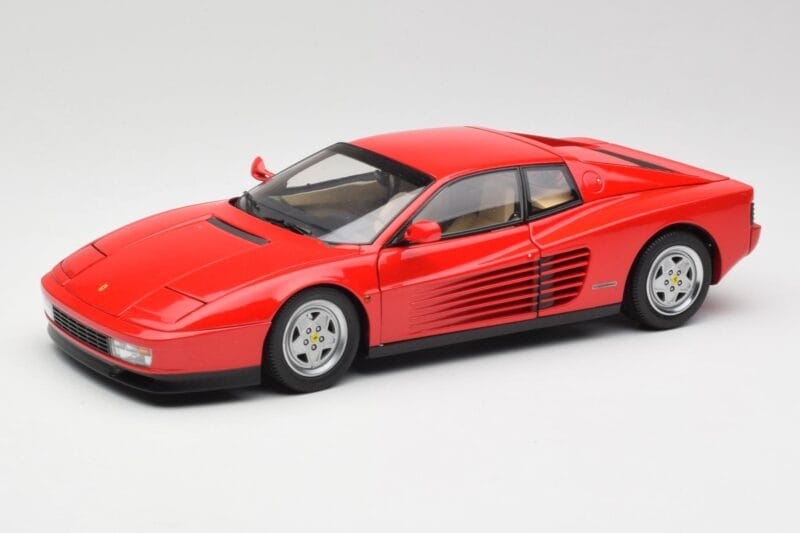
Kyosho's 1:18 diecast Ferrari Testarossa reproduces the 1990 flat-12 supercar in red, with Pininfarina's signature side strakes rendered as genuinely raised louvres rather than a flat printed pattern. Opening doors, luggage compartment, and engine cover reveal further detail beneath the strakes. A recognisable Supercars centrepiece for any 1980s-90s Ferrari display.
TL;DR: Kyosho's 1:18 diecast Ferrari Testarossa reproduces the 1990 flat-12 supercar in red, complete with Pininfarina's signature side strakes that cool the engine bay. A pop-culture icon of the era through its Miami Vice association, this remains a strong Supercars anchor piece for any 1980s-90s display.
Few silhouettes say 1980s supercar quite as directly as the Testarossa's side strakes, and Kyosho renders that shape in a red that suits the car's dramatic wedge better than almost any other colour Ferrari offered.
Pininfarina's Strakes and the Testarossa's Signature Shape
Cooling the Flat-12 Through Bodywork Design
Ferrari built the Testarossa around a flat-12, or Boxer, engine mounted amidships, and the wide rear track needed to cool that engine's side-mounted radiators became the car's most defining visual feature. Pininfarina answered the packaging challenge with horizontal strakes running along the doors and rear flanks, functional intake louvres that also happened to create one of the most photographed profiles of the entire decade. Produced from 1984 through the early 1990s, the Testarossa this casting represents comes from near the end of that original run, in 1990, just before Ferrari updated the model into the 512 TR. That the Testarossa remained in production for the better part of a decade, largely unchanged in silhouette, is itself unusual for a supercar era defined by rapid model turnover, and it speaks to how completely Pininfarina's original design solved the car's engineering brief.
Red Paint Against a Wedge-Shaped Body
Rosso Corsa red on a Testarossa reads differently to how it reads on Ferrari's more curvaceous earlier models, since the Testarossa's flat panels and hard creases give the colour large, uninterrupted planes to sit across rather than compound curves to wrap around. Kyosho's paintwork holds its depth across the long, flat door panels and the strake louvres, an area where thin or inconsistent paint would show immediately given how directly light hits those horizontal ridges.
Kyosho's Diecast Execution of an Angular 1980s Supercar
This casting opens at the doors, the front luggage compartment, and the rear engine cover, the latter revealing the flat-12 beneath a body-coloured lid that on the real car lifted to show off the engine to exactly the kind of admiring crowd a supercar owner expects. The strake louvres are moulded as genuinely separate ridges rather than a printed pattern on a flat surface, giving them real depth under direct light, and the pop-up headlamps sit correctly flush when closed. Diecast construction suits this angular body well, since the Testarossa's flat surfaces were never going to hide the wider panel gaps that hinge tolerances demand the way a curved resin body might need to.
Interior Detail and Cabin Layout
The cabin carries the Testarossa's period-correct low-slung dashboard and the distinctive door pockets built into the wide sills, along with seat detailing that reflects the car's leather-trimmed but still driver-focused interior. These cabin details are visible through the glazing even with the doors closed, rewarding a closer look beyond the exterior strakes alone.
A Supercar With Cultural Reach Beyond the Enthusiast Shelf
Positioning Against Later 512 TR Castings
Collectors sometimes weigh an original Testarossa against a later 512 TR model of the same basic car, and the choice usually comes down to the smoother nose and different wheel design Ferrari introduced with the update. This earlier casting captures the purer, more strake-dominant original shape before those revisions softened the car's edges.
The Testarossa's fame extends well past dedicated Ferrari collectors, largely thanks to its association with Miami Vice, where the car became a visual shorthand for 1980s style on television screens worldwide, and that recognition makes a well-executed model genuinely approachable to newer collectors rather than only the deeply initiated. At roughly 24cm, it commands real presence on a shelf without overwhelming a Supercars display built around similarly scaled contemporaries like the Countach or the 288 GTO.
Create a free account and claim 10% off your first order — from hundreds of collectible 1:18, 1:43 and 1:12 models by Porsche, Mercedes-Benz, BMW and more.
{"id":614008,"name":"Ferrari Testarossa Red Kyosho 1:18","price":"£<\/span>248.33<\/bdi><\/span>","image":"https:\/\/models118.co.uk\/wp-content\/uploads\/2026\/06\/ferrari-testarossa-red-kyosho-1-18-400x400.jpg","permalink":"https:\/\/models118.co.uk\/ferrari-testarossa-red-kyosho-1-18-08422r\/","brand":"Ferrari"}