{"ajaxurl":"https:\/\/models118.co.uk\/wp-admin\/admin-ajax.php?lang=en_GB","nonce":"8a70d40d00","homeUrl":"https:\/\/models118.co.uk\/","shopUrl":"https:\/\/models118.co.uk\/shop\/","cartUrl":"https:\/\/models118.co.uk\/cart-en-gb\/","checkoutUrl":"https:\/\/models118.co.uk\/checkout\/","skipCart":true,"collectionLimit":12,"i18n":{"addedToCart":"Added to basket","addToWishlist":"Add to wishlist","addedToWishlist":"Added to wishlist","removeFromWishlist":"Remove from wishlist","removedFromWishlist":"Removed from wishlist","undo":"Undo","error":"Something went wrong","loading":"Loading...","outOfStock":"Out of stock","viewCart":"View basket","proceedToCheckout":"Proceed to checkout","addedToCollection":"Added to your collection","reserved":"Reserved!","soldOut":"Sold out","invalidEmail":"Please enter a valid email address","connectionError":"Connection error. Please try again.","loginToSave":"Sign in to save this model","waitlistNotify":"Notify me","waitlistOnList":"On the waiting list \u2713","waitlistJoined":"You're on the waiting list. We'll email you the moment this model is available again.","waitlistRemoved":"Done \u2014 you're off the waiting list for this model.","waitlistRateLimit":"Too many attempts \u2014 please try again shortly","waitlistTurnstile":"We couldn't complete the check \u2014 please try again","waitlistError":"Sorry, something went wrong. Please try again in a moment."},"wishlist":{"loggedIn":false,"loginUrl":"https:\/\/models118.co.uk\/my-account\/","addAction":"models118_wishlist_add","removeAction":"models118_wishlist_remove"},"waitlist":{"loggedIn":false,"subscribeAction":"models118_waitlist_subscribe","toggleAction":"models118_waitlist_toggle","stateAction":"models118_waitlist_state"},"stats":{"models":2167,"brands":205,"manufacturers":127,"collectors":10000},"product":{"id":133530,"sku":"08348G","condition":"new","name":"Lancia Delta HF Integrale Evoluzione Test Car Kyosho 1:18","brand":"Lancia","manufacturer":"Kyosho","scale":"1:18","material":"Diecast","price":157.5,"regularPrice":157.5,"isOnSale":false,"savingsAmount":0,"stockQty":0,"stockStatus":"out_of_stock","isDiscontinued":true,"image":"https:\/\/models118.co.uk\/wp-content\/uploads\/2026\/03\/lancia-delta-hf-integrale-evoluzione-test-car-kyosho-1-18-300x200.jpg","permalink":"https:\/\/models118.co.uk\/lancia-delta-hf-integrale-evoluzione-test-car-kyosho-1-18-08348g\/"}}
Lancia Delta HF Integrale Evoluzione Test Car Kyosho 1:18
Sold out
1/9
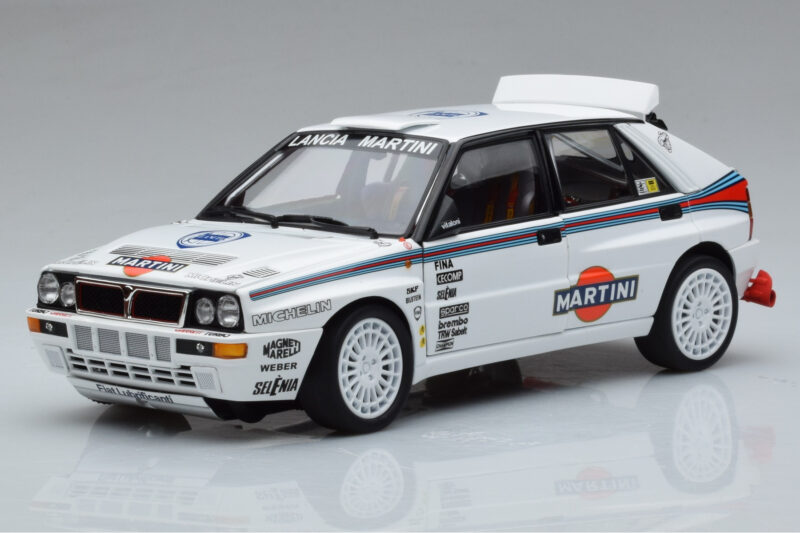
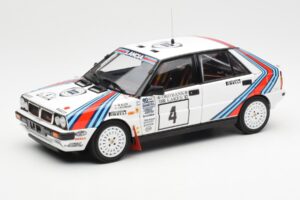
Kyosho's 1:18 diecast Lancia Delta HF Integrale Evoluzione wears a factory test-car livery rather than the familiar Martini rally scheme, keeping the model's widened arches and aggressive homologation styling in focus. Diecast construction and opening panels suit collectors who want the Group A story without another rally-liveried repeat.
About the Lancia Delta HF Integrale Evoluzione Test Car Kyosho 1:18
TL;DR: Kyosho's 1:18 diecast reproduces the Lancia Delta HF Integrale Evoluzione in factory test-car livery, a plainer development scheme rather than a Martini rally colour, keeping the model's widened arches and aggressive aero intact. Diecast construction suits collectors who want the homologation hatchback's engineering without an oft-repeated rally livery.
Most Delta Integrale models on a shelf wear the same Martini rally stripes, which makes a factory test-car livery like this one a genuinely different way to display the same homologation special. Kyosho's diecast keeps the Evoluzione's aggressive bodywork intact while swapping the familiar rally graphics for a plainer development scheme.
Kyosho's 1:18 Delta Integrale Evoluzione Test Livery
What a Factory Test Car Livery Actually Shows
Before a rally car reaches its sponsor-liveried competition form, manufacturers run development mules through testing in far plainer schemes, often carrying minimal branding, test-team markings or simple factory colours rather than full sponsor graphics. This model represents that earlier stage of the Evoluzione's life, and Kyosho renders it without the Martini stripes most collectors associate with Lancia's works rally cars, letting the hatchback's genuinely aggressive shape stand on its own. For a shelf already crowded with liveried rally Deltas, a test-car scheme reads as a quieter but arguably more honest way to display the same engineering.
Judging a Test Livery Against Production Cars
Checking a test-car scheme against reference photographs is less about matching an exact stripe pattern and more about proportion and stance, since development liveries varied car to car and rarely followed a fixed template. What stays consistent is the Evoluzione's wide-arch silhouette, and that shape is what to compare first: arch flare width, ride height and the depth of the front bumper splitter are the details that separate a well-tooled Integrale from a generic hot-hatch casting wearing similar decals.
The Integrale Evoluzione's Rally Homologation Story
Built to Legalise a World Rally Champion
The Delta HF Integrale Evoluzione existed because international rally regulations required manufacturers to sell a road-going version of any car they wanted to compete with, and Lancia needed a homologation base capable of carrying the wider wheels, bigger brakes and more aggressive aerodynamics its Group A rally cars demanded. The result was one of the most successful rally programmes in the sport's history, with Lancia's Delta taking multiple manufacturers' World Rally Championship titles through the late 1980s and into the early 1990s, a run few other manufacturers have matched before or since. That competition dominance is why the Integrale carries such weight among collectors today: the road car existed purely to make the rally car legal, and displaying a well-detailed model of one connects directly to that championship-winning lineage rather than to a marketing exercise dressed up as a homologation special.
Collecting the Evoluzione Beyond the Obvious Rally Colours
Wide Arches and Hatchback Proportions in Diecast
The Evoluzione's flared wheel arches, deep front bumper and prominent rear spoiler all carry through accurately, giving the model the squat, purposeful stance that separated the Integrale from an ordinary family hatchback. Diecast construction gives the body real heft, and the doors, bonnet and tailgate open on hinges firm enough to hold position for display. The cabin shows a simplified rally-style interior rather than a plush road-car trim, appropriate for a car whose entire purpose was homologating a competition specification rather than comfort. Wheel arch extensions sit flush against the body, avoiding the gappy look cheaper tooling sometimes produces.
Pairing a Test Car With a Rally-Liveried Sibling
At roughly 20 centimetres long, the Evoluzione's compact hatchback footprint fits easily on a shelf shared with larger 1:18 supercars or GT racers, and its distinctive stance still stands out despite the smaller scale of the real car. Kyosho's diecast sits at an accessible mid-tier price point, with opening panels and a detailed cabin rather than the sealed-resin approach used for ultra-limited liveries. Placed next to a Martini-liveried rally Delta from the same era, this test-car version tells the quieter half of the Evoluzione's story, the development work that happened before the podiums, making the pairing genuinely more informative than either model alone.
Create a free account and claim 10% off your first order — from hundreds of collectible 1:18, 1:43 and 1:12 models by Porsche, Mercedes-Benz, BMW and more.
{"id":133530,"name":"Lancia Delta HF Integrale Evoluzione Test Car Kyosho 1:18","price":"£<\/span>157.50<\/bdi><\/span>","image":"https:\/\/models118.co.uk\/wp-content\/uploads\/2026\/03\/lancia-delta-hf-integrale-evoluzione-test-car-kyosho-1-18-400x400.jpg","permalink":"https:\/\/models118.co.uk\/lancia-delta-hf-integrale-evoluzione-test-car-kyosho-1-18-08348g\/","brand":"Lancia"}
Cookies on Models118
We use cookies to remember your preferences, understand how the shop is used and show you models and offers that suit your interests. What you allow is up to you, and you can change it at any time.
Functional
Always active
The technical storage or access is strictly necessary for the legitimate purpose of enabling the use of a specific service explicitly requested by the subscriber or user, or for the sole purpose of carrying out the transmission of a communication over an electronic communications network.
Preferences
The technical storage or access is necessary for the legitimate purpose of storing preferences that are not requested by the subscriber or user.
Statistics
The technical storage or access that is used exclusively for statistical purposes.The technical storage or access that is used exclusively for anonymous statistical purposes. Without a subpoena, voluntary compliance on the part of your Internet Service Provider, or additional records from a third party, information stored or retrieved for this purpose alone cannot usually be used to identify you.
Marketing
The technical storage or access is required to create user profiles to send advertising, or to track the user on a website or across several websites for similar marketing purposes.
We use cookies to remember your preferences, understand how the shop is used and show you models and offers that suit your interests. What you allow is up to you, and you can change it at any time.
Functional
Always active
The technical storage or access is strictly necessary for the legitimate purpose of enabling the use of a specific service explicitly requested by the subscriber or user, or for the sole purpose of carrying out the transmission of a communication over an electronic communications network.
Preferences
The technical storage or access is necessary for the legitimate purpose of storing preferences that are not requested by the subscriber or user.
Statistics
The technical storage or access that is used exclusively for statistical purposes.The technical storage or access that is used exclusively for anonymous statistical purposes. Without a subpoena, voluntary compliance on the part of your Internet Service Provider, or additional records from a third party, information stored or retrieved for this purpose alone cannot usually be used to identify you.
Marketing
The technical storage or access is required to create user profiles to send advertising, or to track the user on a website or across several websites for similar marketing purposes.