Used
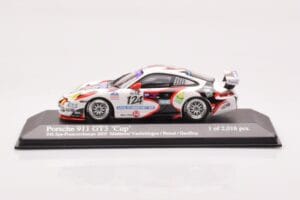
Porsche 911 997 GT3 Cup #124 Mattheus / Geoffroy / Vanbellingen / Fumal 24 Hours of Spa 2005 Minichamps 1:43
Only 3 left
Price:
£29.00
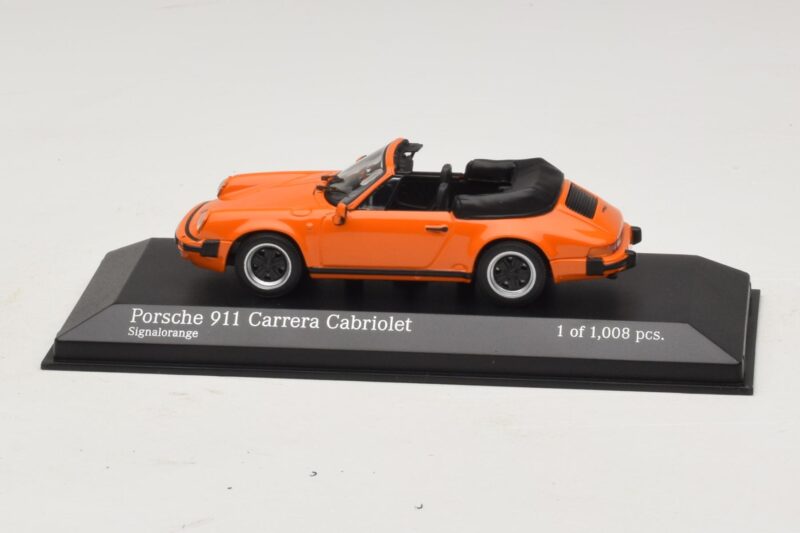
TL;DR: Minichamps' 1:43 diecast Porsche 911 930 Carrera Cabriolet in Orange reproduces a bold factory shade on the wide-body soft-top 911 that Porsche brought back to its range in 1983. The body is a sealed, one-piece casting, with the folded roof and flared arches rendered as fixed exterior detail rather than moving hardware.
Colour choice on an air-cooled 911 says as much about the era as the body style does, and 1983's Carrera Cabriolet offered buyers a genuinely wide palette to work with. Orange sits at the bolder end of that range, a period shade that suits the wide-arch 930-series body's already assertive stance rather than fighting against it.
Orange on this casting sits on a hard zinc alloy shell, and bright factory shades like this one benefit most from that material: the gloss reads deep and saturated under direct light rather than flattening out the way a lighter resin sometimes can. Because the body is a single fixed casting, the colour runs continuously from the nose to the rear deck with no gap where a hinge would otherwise interrupt the surface. That continuity matters more on a bright colour than a muted one, since any inconsistency in the paint would be far more visible under close inspection than it would be on a darker or metallic finish.
The soft-top sits permanently folded behind the seats as moulded, painted surface rather than a separate lifting piece, with the fabric-look creasing and the roll-over hoop cast in as part of the shell. The flared rear arches that came with the 930-series wide body are equally fixed, giving the car its correct stance without needing a wheel or panel to move to prove it. At 1:43 those arch edges are worth checking closely: a crisp, well-defined line where the arch meets the door is one of the clearest signs the casting has held its tooling detail rather than softened it in production.
Set beside a Grey Metallic Cabriolet on the same casting, this orange version tells a different story with identical tooling underneath. The metallic finish reads as texture, subtly shifting under light, and suits a more reserved, understated shelf; the orange reads as flat, saturated colour that draws the eye first regardless of what sits near it. Neither is more accurate than the other, both were genuine factory options in this period, but they serve different roles in a display: one is a background piece that rewards close inspection, the other is a statement piece that anchors a shelf from across the room. Buyers assembling a colour study of the era's Cabriolet often want both, precisely because the contrast between them says something real about how differently 1980s Porsche buyers specified their cars.
The wide, flared-arch body that this Cabriolet wears was itself a relatively recent development by 1983, borrowed from the Turbo's visual language and applied more broadly across the 911 range as the decade progressed. A buyer using body width as a dating cue on 911 models from this era should treat the flared arches as a strong indicator of a later, wide-body specification rather than an early, narrow-bodied car, regardless of which colour the casting wears. That detail holds true whether the shade is a quiet metallic or a shout of orange, since the body itself carries the dating information, not the paint.
An orange Cabriolet works best as the statement piece in an air-cooled 911 line-up, the model that draws a visitor's eye first and starts a conversation about 1980s colour choices most collectors do not associate with a marque known for its restraint. Paired with a Grey Metallic sibling on the same casting, it becomes a genuine colour study rather than a duplicate purchase. The sealed body needs no adjustment before display, arriving ready to place directly on the shelf. At the 1:43 diecast tier, both colourways cost the same to collect, so the decision comes down to which mood a buyer wants their 911 shelf to carry, and there is a genuine case for owning both rather than choosing.
Save £14.00