Used
Porsche 911 997 GT3 Cup #124 Mattheus / Geoffroy / Vanbellingen / Fumal 24 Hours of Spa 2005 Minichamps 1:43
Only 3 left
Price:
£29.00
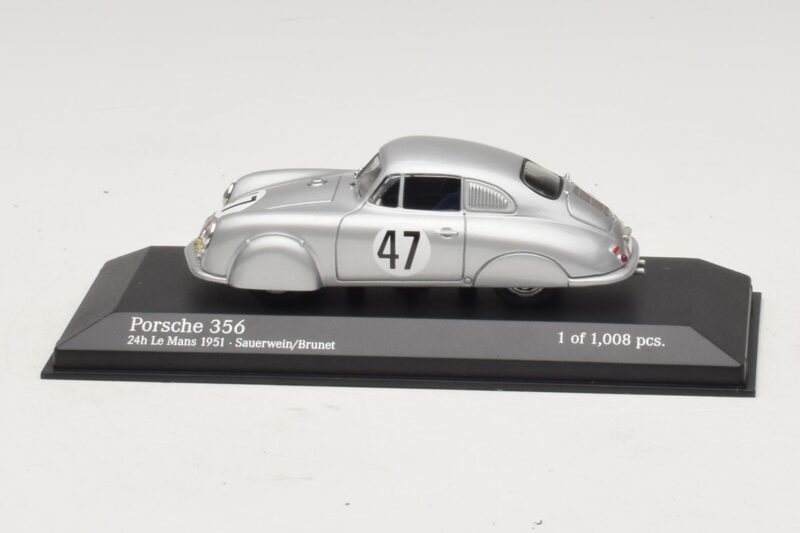
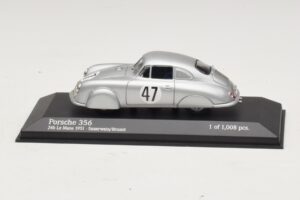
TL;DR: Minichamps' 1:43 diecast Porsche 356 reproduces car #47, driven by Sauerwein and Brunet at the 1951 24 Hours of Le Mans, the year Porsche first entered the race. Sealed body, streamlined 356 SL shape, crisp race number detail.
Porsche's relationship with Le Mans began in 1951, a modest first step from a company that had only recently started building its own cars in earnest. This 356, entered as car #47 and driven by Sauerwein and Brunet, is a direct piece of that debut season.
Porsche's first works effort at the 24 Hours of Le Mans came in 1951, built around lightweight, streamlined 356 SL coupes designed to exploit low drag rather than raw power against far larger rivals. This car, numbered 47 and crewed by Sauerwein and Brunet, was part of that early Porsche presence at the Circuit de la Sarthe, a race the small German manufacturer approached with careful preparation rather than outright pace. Minichamps captures the 356 SL's distinctively smooth, enclosed bodywork, shaped specifically for that low-drag endurance running rather than shared with the standard road car's more upright screen and bumpers.
This casting has no opening doors or boot, a one-piece sealed body appropriate to a car whose entire design brief was minimising aerodynamic drag over 24 hours of running. The smooth, enclosed wheel arches and low, tapered tail read cleanly without any hinge gap breaking the surfacing, and the race number 47 sits crisply within its roundel on the door and bonnet. Painted period liveries at this scale depend heavily on registration accuracy, and the numbering here stays sharp under close inspection.
The 356 SL's narrow track and low roofline are easy to lose at small scale, but this casting holds the proportions honestly rather than bulking them out for shelf presence. Race numbers and any period sponsor or club markings sit flat and legible, a genuine test of tooling precision on a car this compact.
Zinc alloy gives this small casting a reassuring density, and the sealed body means the tooling investment goes entirely into the exterior surfacing that carries the livery. Paint sits deep and even on the metal shell, holding its tone under a shelf spotlight without the flattening some smaller castings show.
This 356 suits a collector tracing Porsche's earliest competition history, a quieter but genuinely significant companion to later 904 and 906 race cars from the same marque. Its compact 1:43 footprint fits easily within a broader early-1950s Le Mans display, and the specific driver pairing gives it a documented story worth having on the shelf rather than a generic period racer.
Save £14.00