{"ajaxurl":"https:\/\/models118.co.uk\/wp-admin\/admin-ajax.php?lang=en_GB","nonce":"639ff23817","homeUrl":"https:\/\/models118.co.uk\/","shopUrl":"https:\/\/models118.co.uk\/shop\/","cartUrl":"https:\/\/models118.co.uk\/cart-en-gb\/","checkoutUrl":"https:\/\/models118.co.uk\/checkout\/","skipCart":true,"collectionLimit":12,"i18n":{"addedToCart":"Added to basket","addToWishlist":"Add to wishlist","addedToWishlist":"Added to wishlist","removeFromWishlist":"Remove from wishlist","removedFromWishlist":"Removed from wishlist","undo":"Undo","error":"Something went wrong","loading":"Loading...","outOfStock":"Out of stock","viewCart":"View basket","proceedToCheckout":"Proceed to checkout","addedToCollection":"Added to your collection","reserved":"Added to your collection","soldOut":"Sold out","invalidEmail":"Please enter a valid email address","connectionError":"Connection error. Please try again.","tocToggle":"On this page","close":"Close","inCartTooltip":"Already in your basket \u2013 open your basket to check out","loginToSave":"Sign in to save this model","waitlistNotify":"Notify me","waitlistOnList":"On the waiting list \u2713","waitlistJoined":"You're on the waiting list. We'll email you the moment this model is available again.","waitlistRemoved":"Done \u2014 you're off the waiting list for this model.","waitlistRateLimit":"Too many attempts \u2014 please try again shortly","waitlistTurnstile":"We couldn't complete the check \u2014 please try again","waitlistError":"Sorry, something went wrong. Please try again in a moment."},"wishlist":{"loggedIn":false,"loginUrl":"https:\/\/models118.co.uk\/my-account\/","addAction":"models118_wishlist_add","removeAction":"models118_wishlist_remove"},"waitlist":{"loggedIn":false,"subscribeAction":"models118_waitlist_subscribe","toggleAction":"models118_waitlist_toggle","stateAction":"models118_waitlist_state"},"stats":{"models":2665,"brands":215,"manufacturers":129,"collectors":10000},"product":{"id":1697589,"sku":"430062391","condition":"new","availability":"in_stock","name":"Porsche 356C Cabriolet Polizei Dusseldorf Minichamps 1:43","brand":"Porsche","manufacturer":"Minichamps","scale":"1:43","material":"Diecast","price":58,"regularPrice":58,"isOnSale":false,"savingsAmount":0,"stockQty":2,"stockStatus":"very_low","isDiscontinued":false,"image":"https:\/\/models118.co.uk\/wp-content\/uploads\/2026\/10\/porsche-356c-cabriolet-polizei-dusseldorf-minichamps-1-43-430062391-1-1-300x200.jpg","permalink":"https:\/\/models118.co.uk\/porsche-356c-cabriolet-polizei-dusseldorf-minichamps-1-43-430062391\/"}}
Cookies on Models118
We use cookies to remember your preferences, understand how the shop is used and show you models and offers that suit your interests. What you allow is up to you, and you can change it at any time.
Always active
The technical storage or access is strictly necessary for the legitimate purpose of enabling the use of a specific service explicitly requested by the subscriber or user, or for the sole purpose of carrying out the transmission of a communication over an electronic communications network.
The technical storage or access is necessary for the legitimate purpose of storing preferences that are not requested by the subscriber or user.
The technical storage or access that is used exclusively for statistical purposes.
The technical storage or access is required to create user profiles to send advertising, or to track the user on a website or across several websites for similar marketing purposes.
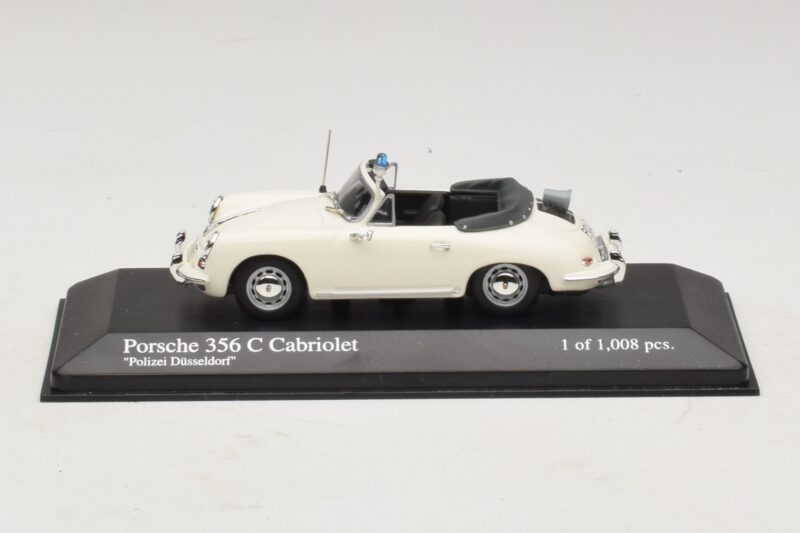
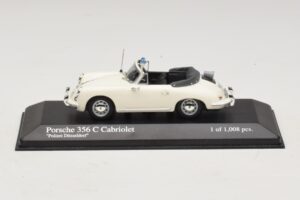
Minichamps' 1:43 diecast Porsche 356C Cabriolet in Polizei Dusseldorf livery brings a 1965 sports car in service colours to the cabinet as a sealed one-piece casting. Rounded 356 curves, clean livery registration and zinc alloy weight make it a characterful addition to 1960s German themes and service-vehicle displays.
About the Porsche 356C Cabriolet Polizei Dusseldorf Minichamps 1:43
TL;DR: The Minichamps Porsche 356C Cabriolet Polizei Dusseldorf 1:43 is a sealed diecast service-vehicle model dated 1965. It pairs the final 356 series with a police livery, so the appeal lies in clean exterior paint, period proportions and a compact shelf footprint, since the body is one piece with no opening panels.
Police liveries turn a sports car into a period document. A 356C in Polizei colours recalls a time when even the service fleets of West Germany looked purposeful, and in 1:43 it makes a compact, characterful addition to any 1960s shelf. Minichamps casts it in diecast with a one-piece body.
Minichamps Porsche 356C Polizei Detail
Livery Registration on a Small Body
A police livery depends on clean separation between colours, and a 1:43 body gives very little room for error. Check where the body colour meets any contrasting panel, how any lettering reads and whether the edges are sharp rather than furred. The cabriolet shape adds a further test: the beltline should run in one unbroken curve from the front wing to the tail, because the 356's rounded, bathtub-like profile has no hard edges to hide a bad cast. The body is sealed, so every surface judgement happens on the outside, where a single casting keeps the shut lines even.
Weight, Wheels and Finish at This Tier
Lift it and the zinc alloy heft is obvious for such a small car; that mass keeps the piece stable on a shelf and ages well, with no softening of the casting over decades. The wheels and hubcaps should sit squarely in the arches with a believable ride height, since a 356 looks wrong if it stands too tall. Chrome-effect trim is printed or finely moulded at this scale, so judge it for crispness of edge from arm's length. Mid-tier diecast like this trades the fine separate parts of larger models for robustness and an approachable price.
The Last 356 in Service Colours
The 356C Behind the Livery
The 356C was the final evolution of Porsche's first production car, a rear-engined, air-cooled flat-four coupe and cabriolet that gave way to the 911 in the mid-1960s. It brought disc brakes all round, a feature that made the late 356 a more serious road car. The 1965 date in the listing places this model right at the end of that story, which gives the livery added interest. A cabriolet in police colours is a curious pairing, and that curiosity is much of its charm on a themed shelf.
Service Vehicles as a Collecting Theme
Emergency and service vehicles form a distinct strand in the hobby, and German police cars of the 1960s are a natural subject within it. This model sits comfortably with other 1:43 street cars from the same decade, where its livery stands out among civilian colours. British collectors who prize completeness will appreciate a theme that can be built row by row, from patrol cars to fire engines, without needing huge cabinet space. The Dusseldorf name in the title ties it to a specific police livery rather than a generic one, giving the piece a defined place in a display.
Shelf Position and Handling
At roughly nine centimetres, the 356C Cabriolet is among the smaller cars in a typical 1:43 run, so it sits happily at the front of a shelf where its livery can be seen. Keep it out of direct sun, which can fade livery printing over time, and dust it with a soft brush rather than a cloth that might snag fine trim. Handle it by the body sides, not the glazing. For a themed display, a glass case with warm lighting brings out the paint depth without glare. As a sealed diecast, it needs no special care beyond a clean, stable cabinet, and it suits collectors who want a characterful 1960s subject at an accessible price point.
Create a free account and claim 5% off your first order — from hundreds of collectible 1:18, 1:43 and 1:12 models by Porsche, Mercedes-Benz, BMW and more.