{"ajaxurl":"https:\/\/models118.co.uk\/wp-admin\/admin-ajax.php?lang=en_GB","nonce":"639ff23817","homeUrl":"https:\/\/models118.co.uk\/","shopUrl":"https:\/\/models118.co.uk\/shop\/","cartUrl":"https:\/\/models118.co.uk\/cart-en-gb\/","checkoutUrl":"https:\/\/models118.co.uk\/checkout\/","skipCart":true,"collectionLimit":12,"i18n":{"addedToCart":"Added to basket","addToWishlist":"Add to wishlist","addedToWishlist":"Added to wishlist","removeFromWishlist":"Remove from wishlist","removedFromWishlist":"Removed from wishlist","undo":"Undo","error":"Something went wrong","loading":"Loading...","outOfStock":"Out of stock","viewCart":"View basket","proceedToCheckout":"Proceed to checkout","addedToCollection":"Added to your collection","reserved":"Added to your collection","soldOut":"Sold out","invalidEmail":"Please enter a valid email address","connectionError":"Connection error. Please try again.","tocToggle":"On this page","close":"Close","inCartTooltip":"Already in your basket \u2013 open your basket to check out","loginToSave":"Sign in to save this model","waitlistNotify":"Notify me","waitlistOnList":"On the waiting list \u2713","waitlistJoined":"You're on the waiting list. We'll email you the moment this model is available again.","waitlistRemoved":"Done \u2014 you're off the waiting list for this model.","waitlistRateLimit":"Too many attempts \u2014 please try again shortly","waitlistTurnstile":"We couldn't complete the check \u2014 please try again","waitlistError":"Sorry, something went wrong. Please try again in a moment."},"wishlist":{"loggedIn":false,"loginUrl":"https:\/\/models118.co.uk\/my-account\/","addAction":"models118_wishlist_add","removeAction":"models118_wishlist_remove"},"waitlist":{"loggedIn":false,"subscribeAction":"models118_waitlist_subscribe","toggleAction":"models118_waitlist_toggle","stateAction":"models118_waitlist_state"},"stats":{"models":2665,"brands":215,"manufacturers":129,"collectors":10000},"product":{"id":1701257,"sku":"940044100","condition":"new","availability":"in_stock","name":"Opel Kadett D Blue Maxichamps 1:43","brand":"Opel","manufacturer":"Maxichamps","scale":"1:43","material":"Diecast","price":50,"regularPrice":50,"isOnSale":false,"savingsAmount":0,"stockQty":2,"stockStatus":"very_low","isDiscontinued":false,"image":"https:\/\/models118.co.uk\/wp-content\/uploads\/2026\/10\/opel-kadett-d-blue-maxichamps-1-43-940044100-1-1-300x200.jpg","permalink":"https:\/\/models118.co.uk\/opel-kadett-d-blue-maxichamps-1-43-940044100\/"}}
Cookies on Models118
We use cookies to remember your preferences, understand how the shop is used and show you models and offers that suit your interests. What you allow is up to you, and you can change it at any time.
Always active
The technical storage or access is strictly necessary for the legitimate purpose of enabling the use of a specific service explicitly requested by the subscriber or user, or for the sole purpose of carrying out the transmission of a communication over an electronic communications network.
The technical storage or access is necessary for the legitimate purpose of storing preferences that are not requested by the subscriber or user.
The technical storage or access that is used exclusively for statistical purposes.
The technical storage or access is required to create user profiles to send advertising, or to track the user on a website or across several websites for similar marketing purposes.
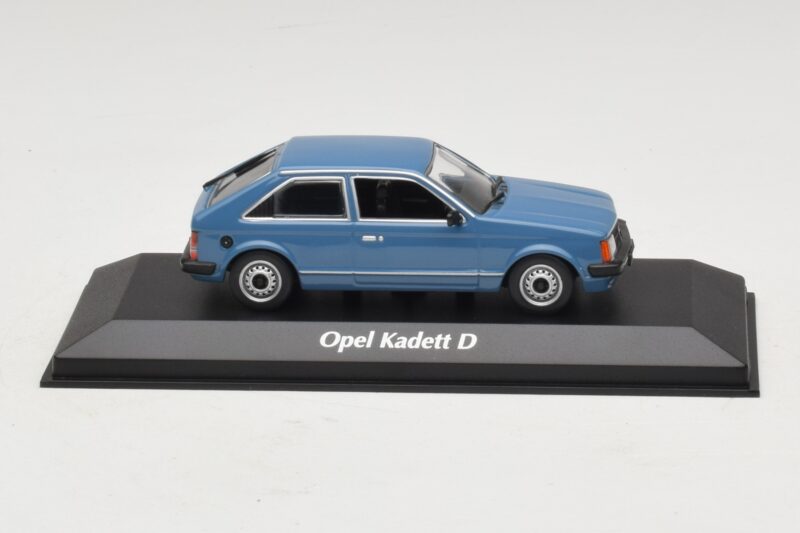
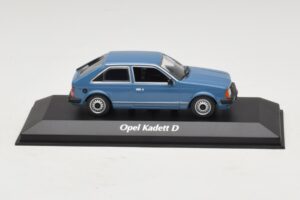
Maxichamps' 1:43 diecast Opel Kadett D in blue recreates the 1979 front-wheel-drive hatchback that gave the Kadett its modern shape. The body is a sealed one-piece casting, so the appeal sits in the outline, shut lines and paint finish. A tidy, accessible piece for anyone building a late 1970s and early 1980s European hatchback shelf.
TL;DR: The Maxichamps Opel Kadett D 1:43 is a blue diecast hatchback from 1979, the first front-wheel-drive Kadett. Its body is a sealed one-piece casting, so the detail lives in the outline, shut lines and paint. It suits collectors assembling a European hatchback shelf or a run of late 1970s family cars.
The Kadett D marked a clean break for Opel: a transverse engine, front-wheel drive and a hatchback shape that looked thoroughly modern in 1979. Maxichamps reproduces that outline in 1:43 diecast, and the blue paint suits the car's plain, honest lines. It is an everyday classic, which is exactly why it rewards a slower look at the details.
Maxichamps Opel Kadett D 1:43 Cast in Zinc Alloy
A Sealed Body Judged From the Outside
This casting has no opening parts, and for a car this plain that works in its favour. With no hinge clearances to accommodate, the door cuts and tailgate line can run as clean single grooves, and the roof pillars, glasshouse and sloping tail read as one continuous form. Hold it at arm's length under a lamp and judge the stance first: the Kadett D should sit squarely on its wheels with an even gap between tyre and arch. Then check the glazing, which ought to sit flush with the pillars rather than stand proud, and the grille and lamp openings, where printed detail should stay sharp at the edges. A sealed shell is a collecting priority like any other: surface precision over interior access.
Diecast Weight and Blue Paint
Lift it from its tray and the mass is the first thing you register, a dense, cool weight that lighter materials do not match at this scale. Zinc alloy also holds its geometry across the years, so the roofline and sills stay true on a long-term shelf. Paint sits on a hard metal shell, which lets the blue read deep and even rather than thin at the corners. At 1:43 the whole car is about palm-sized, so detail is selective by necessity. The wheels, badges and lamps are where finishing effort shows, and they are the parts worth turning toward the light.
The Kadett D in Its Own Decade
From Rear-Drive Kadett to Front-Drive Hatchback
Earlier Kadetts drove their rear wheels. The D moved to front-wheel drive with the engine mounted transversely, the layout most small hatchbacks have used ever since, and it arrived in a body that put practicality first. Upright and unfussy, with generous glass and a squared-off tail, it reflected what European families wanted from a compact car at the turn of the 1980s. That makes it a useful marker on a shelf: the point where the small family car stopped looking like a shrunken saloon and started looking like what we now expect. Collectors who enjoy tracing a layout change through shapes will find the profile tells the story.
The Vauxhall Connection
British collectors will recognise the platform under another badge. Vauxhall sold the same basic car in this country as the Astra, which makes the Opel Kadett D a handy continental counterpart on a UK shelf. The grille and badging are what set it apart, so those are the details to check on the model. It is a quiet bit of provenance, the sort that turns a plain hatchback into a conversation piece at a model fair or around the cabinet.
Placing the Kadett D in a 1:43 Cabinet
At 1:43 a row of hatchbacks takes remarkably little room, and the Kadett D makes a good humble anchor beside sportier neighbours. Line it up with other 1970s and 1980s European family cars and the move to front-wheel drive shows in the profiles. Keep it in a closed display case away from direct sun, which dulls paint and clouds glazing over the years, and dust it with a soft brush rather than a cloth. When comparing it with other versions of the same car, check stance, wheel fit and badge crispness before anything else. Keep the box too; British collectors value complete presentation, and it protects the finish. An accessible, honest buy for an early-1980s cabinet.
Create a free account and claim 5% off your first order — from hundreds of collectible 1:18, 1:43 and 1:12 models by Porsche, Mercedes-Benz, BMW and more.
{"id":1701257,"name":"Opel Kadett D Blue Maxichamps 1:43","price":"£<\/span>50.00<\/bdi><\/span>","image":"https:\/\/models118.co.uk\/wp-content\/uploads\/2026\/10\/opel-kadett-d-blue-maxichamps-1-43-940044100-1-1-400x400.jpg","permalink":"https:\/\/models118.co.uk\/opel-kadett-d-blue-maxichamps-1-43-940044100\/","brand":"Opel"}