Last one
Used
Back in stock
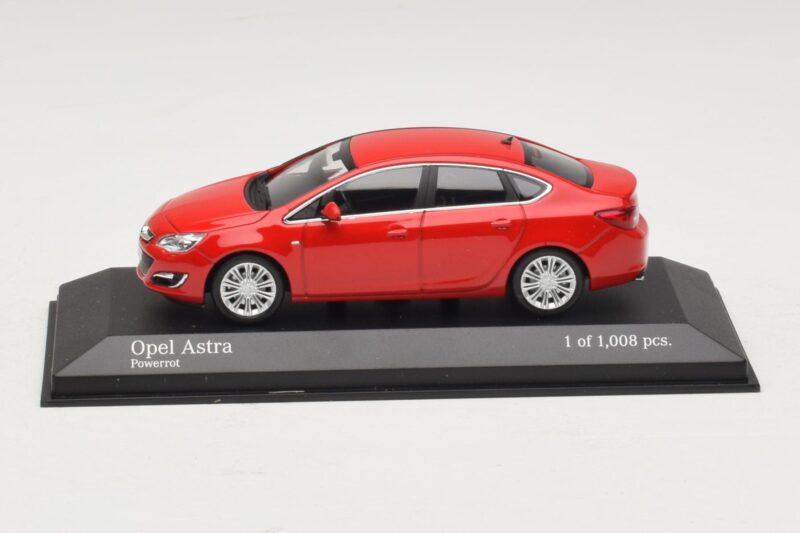
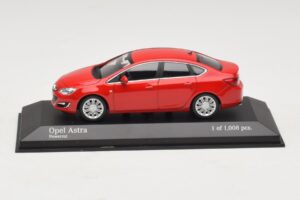
TL;DR: Minichamps' 1:43 Opel Astra J reproduces the hatchback generation that won European Car of the Year honours, cast here as a 2012-specification model in a sealed red diecast body. As a contemporary piece rather than a vintage classic, it gives a modern shelf contrast against older Opel saloons and estates.
Opel's Astra J arrived for 2009 as a genuinely competitive answer to the Volkswagen Golf and Ford Focus, sharp enough in its execution to take European Car of the Year honours in 2010. This 2012 example carries that generation's settled, mid-cycle specification. Minichamps casts it in red 1:43 diecast, a modern hatchback shape that reads very differently from the boxy Opels of the 1960s and 1970s sharing a collector's shelf.
When Opel launched the Astra J in 2009, it was competing in the most contested segment in European motoring, against the Volkswagen Golf, Ford Focus and a crowded field of capable rivals, and the car's reception was strong enough that it took European Car of the Year honours in 2010, a rare result for Opel against that level of competition. The design moved away from the softer, rounder look of the previous Astra H toward sharper creases and a more sculpted flank, a styling language Opel carried across much of its range through the following decade. This 2012 example represents the generation partway through its run, after initial reception had settled but before the mid-life facelift that arrived a couple of years later, giving it the original, unrevised specification most closely associated with the car's launch reputation. Collecting a modern hatchback like this alongside genuinely vintage Opels, Kadetts, Rekords and Ascona models from decades earlier, is a less common approach than building a single-era shelf, but it does something a purely vintage collection cannot: it shows how directly Opel's small and medium car philosophy carried through from the 1970s Kadett to a car still on sale within recent memory.
A modern hatchback's surfaces are a different test for a diecast manufacturer than a 1960s saloon's flatter panels: contemporary body design relies on sculpted creases and subtly compound curves rather than straight lines, and reproducing those curves accurately in a sealed, one-piece shell takes a different kind of tooling precision. Nothing opens on this Astra J casting, so the model's accuracy rests on how faithfully it captures those modern surface details, the crease running from the headlamp back through the door, and the more aggressive wheel arch flaring that defines the car's stance compared with anything from Opel's earlier decades. Zinc alloy construction still gives the model real weight for its size, the same density collectors expect from any properly built diecast regardless of the era the subject represents. Red paint on modern bodywork like this tends to show off sharper reflections than the same colour would on a flatter 1960s panel, since contemporary surfacing is designed with exactly that kind of light play in mind, and Minichamps' finish should track those reflections cleanly along the character line. The wheel design, typically a more contemporary multi-spoke alloy rather than the wheel covers common on older Opels, is one of the clearest visual markers separating this casting's era from anything else on the same shelf.
Judging this Astra J starts with the details that mark it as unmistakably modern rather than a generically updated old shape: the sweep of the headlamp units back into the front wing, the depth of the door crease running toward the rear light cluster, and the more pronounced rear spoiler integrated into the tailgate rather than bolted on as an accessory. Red paint holds particular importance on a car like this, since it was a genuinely popular factory colour on the Astra J and one that photographed well in period marketing precisely because of how the paint caught those sculpted surfaces. Under directed light, the finish should show crisp, well-defined highlights along the character line rather than a soft, diffuse gloss. Badge placement, the Opel roundel on the grille and boot, along with model-specific trim details, should sit exactly where the real car carried them, since a modern hatchback offers less forgiving surface area to hide a slightly misplaced badge than a large flat 1960s boot lid would.
This Astra J earns its place less as a headline piece and more as a deliberate contrast against older Opels on the same shelf, the modern conclusion to a story that started with cars like the Kadett C and Ascona A decades earlier. Its red diecast body and contemporary styling give a themed collection a clear sense of chronology, showing just how far Opel's small and medium car design moved without losing the underlying focus on value and competent engineering. At an accessible price point typical of Minichamps' mainstream 1:43 range, it is not a rare or investment-driven purchase, and it doesn't need to be. Displayed at the end of a generational run, it does honest work as the modern bookend, closing out a lineage rather than opening one, exactly what a collection built around decades of a single marque needs somewhere on the shelf.



Save £14.00