{"ajaxurl":"https:\/\/models118.co.uk\/wp-admin\/admin-ajax.php?lang=en_GB","nonce":"2bd8ec74fc","homeUrl":"https:\/\/models118.co.uk\/","shopUrl":"https:\/\/models118.co.uk\/shop\/","cartUrl":"https:\/\/models118.co.uk\/cart-en-gb\/","checkoutUrl":"https:\/\/models118.co.uk\/checkout\/","skipCart":true,"collectionLimit":12,"i18n":{"addedToCart":"Added to basket","addToWishlist":"Add to wishlist","addedToWishlist":"Added to wishlist","removeFromWishlist":"Remove from wishlist","removedFromWishlist":"Removed from wishlist","undo":"Undo","error":"Something went wrong","loading":"Loading...","outOfStock":"Out of stock","viewCart":"View basket","proceedToCheckout":"Proceed to checkout","addedToCollection":"Added to your collection","reserved":"Added to your collection","soldOut":"Sold out","invalidEmail":"Please enter a valid email address","connectionError":"Connection error. Please try again.","tocToggle":"On this page","close":"Close","inCartTooltip":"Already in your basket \u2013 open your basket to check out","loginToSave":"Sign in to save this model","waitlistNotify":"Notify me","waitlistOnList":"On the waiting list \u2713","waitlistJoined":"You're on the waiting list. We'll email you the moment this model is available again.","waitlistRemoved":"Done \u2014 you're off the waiting list for this model.","waitlistRateLimit":"Too many attempts \u2014 please try again shortly","waitlistTurnstile":"We couldn't complete the check \u2014 please try again","waitlistError":"Sorry, something went wrong. Please try again in a moment."},"wishlist":{"loggedIn":false,"loginUrl":"https:\/\/models118.co.uk\/my-account\/","addAction":"models118_wishlist_add","removeAction":"models118_wishlist_remove"},"waitlist":{"loggedIn":false,"subscribeAction":"models118_waitlist_subscribe","toggleAction":"models118_waitlist_toggle","stateAction":"models118_waitlist_state"},"stats":{"models":2615,"brands":213,"manufacturers":128,"collectors":10000},"product":{"id":1672065,"sku":"100601205","condition":"used","availability":"in_stock","name":"Maserati Tipo 61 #5 S. Moss \/ D. Gurney Camoradi ADAC 1000km Nurburgring Winner 1960 Minichamps 1:18","brand":"Maserati","manufacturer":"Minichamps","scale":"1:18","material":"Diecast","price":203.33,"regularPrice":203.33,"isOnSale":false,"savingsAmount":0,"stockQty":1,"stockStatus":"very_low","isDiscontinued":false,"image":"https:\/\/models118.co.uk\/wp-content\/uploads\/2026\/09\/maserati-tipo-61-5-s-moss-d-gurney-camoradi-adac-1000km-nurburgring-winner-1960-minichamps-1-18-100601205-1-1-300x200.jpg","permalink":"https:\/\/models118.co.uk\/maserati-tipo-61-5-s-moss-d-gurney-camoradi-adac-1000km-nurburgring-winner-1960-minichamps-1-18-100601205\/"}}
Cookies on Models118
We use cookies to remember your preferences, understand how the shop is used and show you models and offers that suit your interests. What you allow is up to you, and you can change it at any time.
Always active
The technical storage or access is strictly necessary for the legitimate purpose of enabling the use of a specific service explicitly requested by the subscriber or user, or for the sole purpose of carrying out the transmission of a communication over an electronic communications network.
The technical storage or access is necessary for the legitimate purpose of storing preferences that are not requested by the subscriber or user.
The technical storage or access that is used exclusively for statistical purposes.
The technical storage or access is required to create user profiles to send advertising, or to track the user on a website or across several websites for similar marketing purposes.
Maserati Tipo 61 #5 S. Moss / D. Gurney Camoradi ADAC 1000km Nurburgring Winner 1960 Minichamps 1:18
1/8
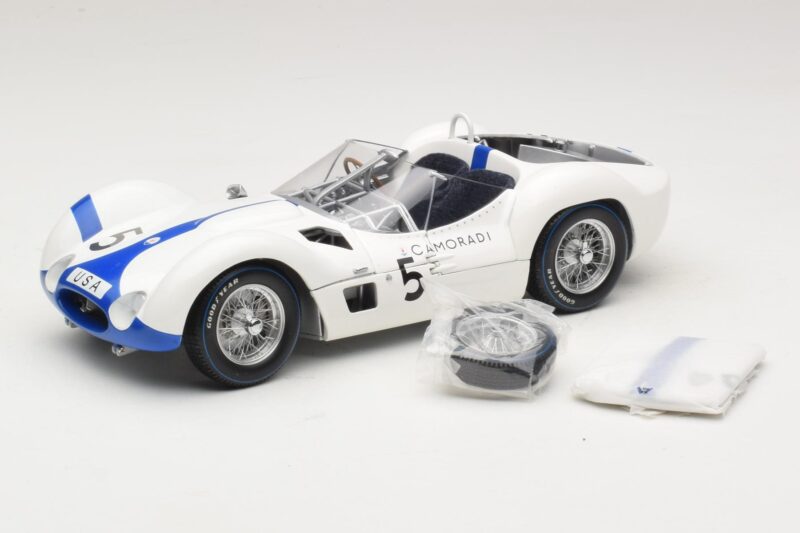
Minichamps' 1:18 diecast Maserati Tipo 61 reproduces the #5 Camoradi Birdcage that Stirling Moss and Dan Gurney drove to outright victory at the 1960 ADAC 1000km Nürburgring. The doors and bonnet open on this casting, exposing the welded tubular space-frame chassis that gave the Tipo 61 its nickname and its exceptional strength for so little weight.
About the Maserati Tipo 61 #5 S. Moss / D. Gurney Camoradi ADAC 1000km Nurburgring Winner 1960 Minichamps 1:18
TL;DR: Minichamps' 1:18 diecast reproduces the #5 Maserati Tipo 61 Birdcage that Stirling Moss and Dan Gurney drove to victory in the 1960 ADAC 1000km Nürburgring for Camoradi Racing. The doors and bonnet open on this casting, exposing the tubular space-frame chassis that gave the Tipo 61 its nickname.
Lloyd Casner's Camoradi team built its reputation on taking outside chances against factory-backed rivals, and the 1960 Nürburgring 1000km was where that gamble paid off spectacularly. Minichamps casts the winning #5 car exactly as Moss and Gurney drove it, doors open to reveal the tightly welded tubular frame that made the Tipo 61 unlike anything else on the grid.
Moss, Gurney and Camoradi's Nürburgring Victory
The 1960 ADAC 1000km Nürburgring ran over the full 22-kilometre Nordschleife, a circuit that punished mechanical fragility more than almost any other on the calendar, and it was here that Lloyd Casner's independent Camoradi team beat the factory Porsche and Ferrari entries outright. Stirling Moss, already established as one of the fastest and most versatile drivers of his generation, shared the #5 Tipo 61 with Dan Gurney, an American driver building his own formidable reputation in sports cars before his later Formula One and Indianapolis successes. Casner ran Camoradi as a privateer outfit rather than a factory team, buying cars from Maserati and campaigning them with genuine professionalism against manufacturers with far larger budgets, and the Nürburgring win stood as validation of that approach. The Nordschleife's length and its mix of long straights with tight, technical sections rewarded both outright pace and mechanical reliability in equal measure, exactly the combination the Tipo 61's chassis and Moss and Gurney's driving delivered that day. Beating factory teams on their home ground remains one of the signature results of the early 1960s sports car era, and it's the result this specific casting commemorates rather than a generic Tipo 61 livery.
The Birdcage Chassis and Minichamps' Opening Bodywork
Giulio Alfieri's space-frame design earned the Tipo 61 its nickname for a simple reason: the chassis is built from dozens of small-diameter steel tubes welded into a dense, cage-like lattice rather than the fewer, larger tubes most contemporary racers used. That structure delivered exceptional torsional stiffness for very little weight, a genuine engineering advantage at a time when most rivals still leaned on heavier, simpler frames. Minichamps' opening doors and bonnet on this casting exist specifically to show that structure off, since the birdcage is the single most distinctive thing about this car and hiding it behind a sealed body would miss the point of the model entirely. Lifting the bonnet reveals the front-mounted 2.9-litre inline-four, an unusual choice for a sports racer of this class when six-cylinder and V12 engines dominated the field, but one that suited the lightweight philosophy running through the whole design. Diecast construction gives the model real heft, and the panel gaps around the opening bodywork stay proportionate to a car whose real panels were thin aluminium skins draped loosely over that tubular frame rather than structural members in their own right.
Livery, Number 5 and Race-Accurate Detail
Camoradi's cars ran in the team's distinctive blue with a white or cream nose band, a livery scheme that needs to be reproduced precisely for a model to read as this specific entry rather than a generic period racer. The #5 numbering and the driver pairing of Moss and Gurney distinguish this casting from Camoradi's other Tipo 61 entered in the same race, since the team often ran multiple cars under slightly different liveries and numbers across a season. Getting the wire wheels, the cycle-style front wings and the low, curved windscreen right matters as much as the paint here, since the Tipo 61's overall silhouette is one of the most visually distinctive shapes in early 1960s sports car racing. Reference photography from the actual 1960 Nürburgring weekend shows a car with minimal aerodynamic addenda by later standards, and a faithful reproduction should reflect that period-correct simplicity rather than adding details the real car never carried.
An Anchor Piece for Early 1960s Racing
This Nürburgring winner works as a genuine anchor for a collection built around early 1960s sports car racing, a period when privateer teams could still realistically beat factory efforts on raw engineering and driving talent. Diecast construction and the fully opening bodywork put this model at a premium tier reflecting both the historical significance of the subject and the complexity of reproducing a birdcage chassis convincingly at 1:18. Displayed beside contemporary Ferrari or Porsche prototypes from the same races, the Tipo 61's slender proportions and exposed tubular structure create an immediate visual contrast that tells the story of how differently manufacturers approached sports car design in this era. For collectors who value documented race history over generic period liveries, a specific winning car like this one carries more long-term interest than an unnamed period entry ever could.
Create a free account and claim 10% off your first order — from hundreds of collectible 1:18, 1:43 and 1:12 models by Porsche, Mercedes-Benz, BMW and more.