Used
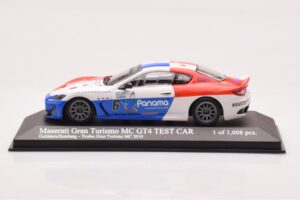
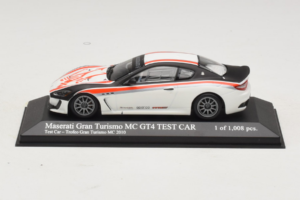
Maserati GranTurismo MC GT4 #6 Goldstein / Sumberg Trofeo GranTurismo 2010 Minichamps 1:43
Only 2 left
Price:
£32.00
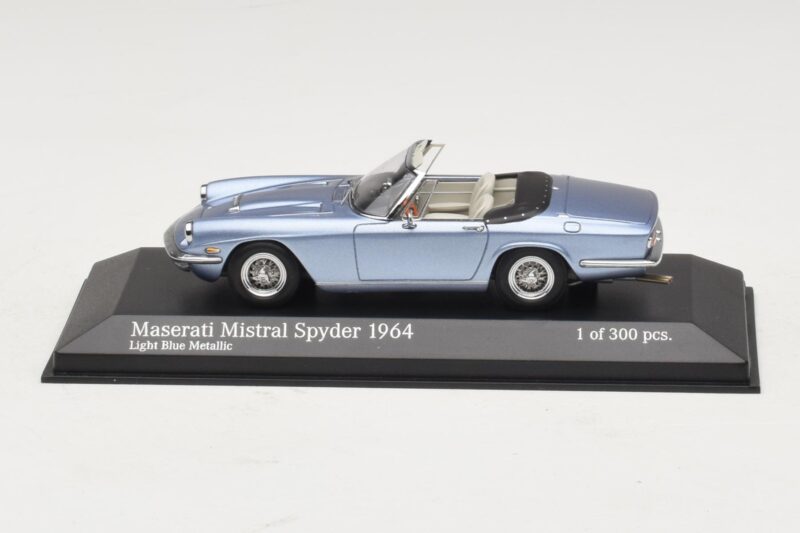
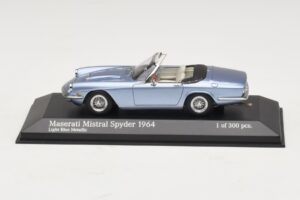
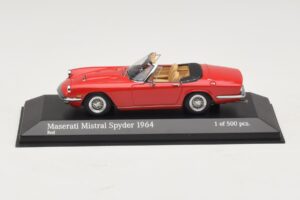
TL;DR: Minichamps' 1:43 Maserati Mistral Spyder reproduces Frua's open-top take on Maserati's last straight-six GT, cast as a sealed diecast body in light blue metallic. Built from 1964, the Spyder was rarer than the coupe it shared its mechanicals with, and this casting represents that scarcer, more coveted body style.
Pietro Frua's design for the Mistral gave Maserati one of its cleanest, most controlled shapes just as the company was preparing to move on to V8 power. The Spyder, an open-top version of the coupe, appeared a year after the closed car and sold in far smaller numbers. Minichamps reproduces that rarer convertible in 1:43 diecast, finished in a light blue metallic that suits the car's understated, Frua-drawn lines.
Maserati commissioned Pietro Frua to design the Mistral in the early 1960s, and the result, produced from 1963, became the last Maserati GT built around the company's long-serving straight-six engine before V8 power took over the range with the Ghibli that followed. Frua's shape was notably restrained for a Maserati of the period, favouring a low, tapering tail and a fastback roofline over the more aggressive detailing some contemporary Italian GTs carried, and that restraint has aged well, giving the Mistral a reputation among Maserati specialists as one of the marque's more elegantly resolved designs rather than its most dramatic. The Spyder, an open-top version of the coupe, followed roughly a year after the closed car's introduction and was built in noticeably smaller numbers throughout the model's run, since convertible bodies typically commanded a price premium that fewer buyers of an already expensive GT were willing to pay. That relative rarity is exactly why the Spyder carries more weight among today's Maserati collectors than the coupe, despite sharing the same straight-six engine and much of the same mechanical specification underneath. Minichamps' decision to cast this open-top version rather than defaulting to the more common coupe gives collectors access to the scarcer half of the Mistral story.
There is a particular challenge in casting an open-top car as a sealed, one-piece diecast body: the model has to convince the eye that the top is genuinely absent, rather than simply looking like a coupe with the roof edited out. Getting the windscreen frame, the door cut line and the rear deck's proportions right matters more on a Spyder casting than on almost any closed body, because there is no roofline to draw the eye away from those details. Minichamps' zinc alloy shell gives the model real weight, and on a shape this curved, a compound curve running continuously from the front wing over the door and into the rear deck, that solid metal construction holds the shape with a rigidity a lighter material would not offer at this scale. The sealed body also means there is no opening bonnet or boot to interrupt Frua's clean flank, letting the light blue metallic paint run as one unbroken surface along the car's most distinctive line, the crease running from just behind the front wheel arch to the tail. That continuity is arguably more valuable on this open car than on the coupe, since the Spyder's cabin, visible from above on the real thing, would otherwise be the obvious place to look for hinge tolerances this construction never needed.
Light blue metallic is a colour that rewards Frua's design specifically, because the shade's reflectivity tracks the Mistral's long, low curves in a way a flatter, matte finish would not, showing the tapering tail and the gently rising beltline as continuous highlights rather than flat panels. Under directed light, the metallic flake should sit evenly across the bonnet and along the doors, with no patchiness where the paint pools slightly thicker near a body seam, a risk that increases on curved surfaces compared with a flat-sided saloon. The Mistral's grille, a simple, narrow oval that Frua kept deliberately understated compared with some of his more flamboyant contemporary designs, is worth checking for crispness, since it is one of the few strong graphic elements on an otherwise clean nose. Wheels should sit with a stance low enough to match the real car's noticeably ground-hugging proportions, since the Mistral was built as a genuine high-speed tourer rather than a leisurely cruiser.
This Spyder earns its place as the rarer, more sought-after half of a Mistral pairing, particularly for a collector who already owns, or plans to own, the coupe cast in the same range. Displayed together, the two body styles make Frua's design flexibility obvious: the same fundamental proportions, reworked convincingly with and without a fixed roof. Light blue metallic gives this casting a distinct identity against a black coupe, avoiding any sense of duplication on a shelf holding both. At a price point that reflects the genuine rarity of the real Spyder relative to the coupe, this model rewards a collector building a considered Maserati GT lineage. For anyone tracing Maserati's transition away from the straight-six era, the Spyder is arguably the more interesting half to own first.


Save £33.00

Save £14.00