Used
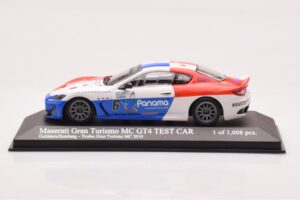
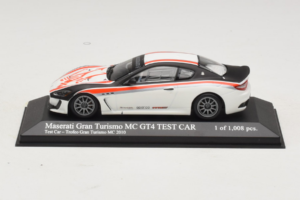
Maserati GranTurismo MC GT4 #6 Goldstein / Sumberg Trofeo GranTurismo 2010 Minichamps 1:43
Only 2 left
Price:
£32.00
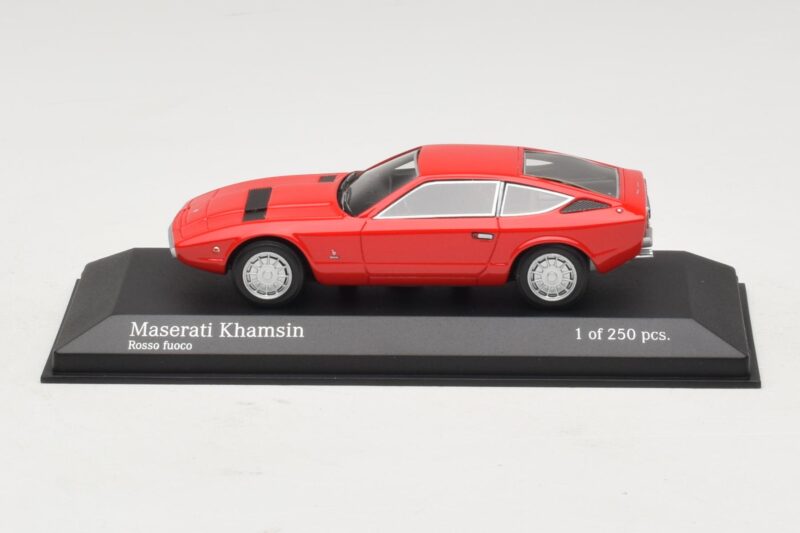
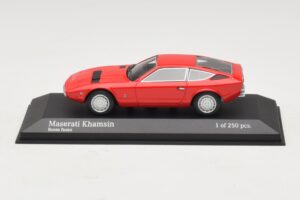
TL;DR: Minichamps' 1:43 Maserati Khamsin Red reproduces Marcello Gandini's Bertone-designed grand tourer from Maserati's Citroën-owned mid-1970s. The sealed diecast body carries the Kamm tail's glass rear panel and flat, angular surfacing in a bold red that reads far more dramatically than a restrained metallic. A mid-tier piece for collectors already chasing the Khamsin's design.
Red suits a Bertone design differently than grey does; where a quieter colour lets Gandini's flat surfacing carry the visual weight, red adds drama the shape was already capable of holding. Minichamps' 1:43 Khamsin in this bolder shade shows the Kamm tail's glass panel and the coupé's severe lines with none of the restraint a grey casting brings to the same body. Built during Maserati's years under Citroën ownership, the real car ran hydraulic steering and brakes borrowed directly from French engineering.
The Khamsin's rear treatment, a single glass panel covering the tail lights and number plate, is one of Bertone's boldest touches from the period, and red brings out the contrast between that dark glass and the surrounding painted metal more sharply than a lighter colour would. Minichamps has to hold a clean, precise edge where the glass-effect panel meets the red bodywork, since any softness there would blur a design detail the whole rear end depends on. The effect at 1:43 is a tail that reads as one deliberate shape rather than a collection of separate parts.
Maserati's ownership under Citroën through the late 1960s and early 1970s left a genuine mark on the Khamsin's engineering, most visibly in its hydraulic steering, brakes and pop-up headlight mechanism, all borrowed from Citroën's own systems. It is an unusual combination for an Italian V8 grand tourer, and one that sets the Khamsin apart from other Maseratis of the same era that relied on more conventional, purely Italian engineering. None of that hydraulic hardware shows on the outside, so the model's job is to get the closed nose and the hidden headlights right, which Minichamps does by keeping that panel flush and seamless. That closed nose, uninterrupted by the headlights lurking beneath it, is as much a Gandini signature as the tail glass.
Bertone's flat, angular surfacing leaves diecast's zinc alloy body little room to disguise any unevenness, since there is no deep curve to distract the eye from a wavering line. That rigidity is exactly what a design this severe needs: a flat bonnet has to stay flat, and a metal casting holds that discipline more reliably than a lighter material would across a body this size. The trade-off is a slightly wider tolerance in the panel gaps than resin allows, a fair exchange for the structural stability the Khamsin's flat surfaces demand.
With no bonnet, boot or door that opens, every line on this Khamsin is moulded into place rather than hinged, letting the waistline run unbroken from the front wing through the door and into the tail. That matters more on a Bertone design than most, because Gandini's whole approach depended on unbroken surfaces reading as single, deliberate planes rather than a set of separately styled panels. The red paint sits deep and even across those planes, with the glass-effect tail panel picked out in a distinct, glossier finish against the surrounding gloss red. Pop-up headlight covers close flush against the nose, part of the same fixed shell rather than a separate feature. That single-shell construction also protects the sharp shoulder line along the door, a detail that would soften quickly if built from a less rigid material.
Where the grey Khamsin lets the design speak quietly, this red version turns the volume up, and the Kamm tail's glass panel becomes the focal point of the whole casting under a display lamp. The metallic finish sits with real depth rather than a flat gloss, catching light differently across the bonnet's flat plane than across the more sculpted door skins, exactly the contrast the real car's paintwork would show. At roughly ten centimetres nose to tail in 1:43, the Khamsin's compact size means that red carries across a relatively small surface, but the flat panels give the colour more visual presence than a more curved body of the same length would manage. Set beside period rivals from Maserati's own range, a Ghibli or a Bora, the Khamsin's flat-planed severity reads as the most confrontational shape of the three, and red only sharpens that impression. Diecast holds the colour evenly across every panel, with no visible seam where the tail section meets the main body shell. For a collector drawn to Gandini's most uncompromising work rather than his more famous supercars, this red Khamsin is arguably the purest expression of that design language available at this scale.
Owning both colours of the same Khamsin casting is not redundant; it is closer to owning two different readings of the same Gandini design, one restrained and one confrontational. The red version suits a shelf built around drama and period Italian colour choices, while the grey suits one built around design purity and restraint. Minichamps' sealed diecast build treats both the same way structurally, holding the flat Bertone surfaces true regardless of shade, which means the choice between them comes down entirely to what story a collector wants that shelf to tell. That case gets stronger still once the Kamm tail's glass panel is seen catching light in two different colours side by side.




Save £14.00