Used

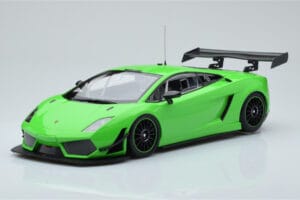
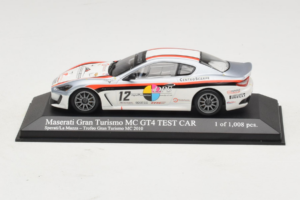
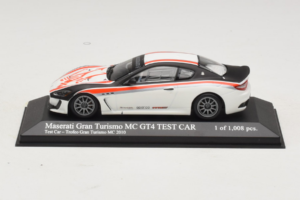
Maserati GranTurismo MC GT4 #6 Goldstein / Sumberg Trofeo GranTurismo 2010 Minichamps 1:43
Only 2 left
Price:
£32.00
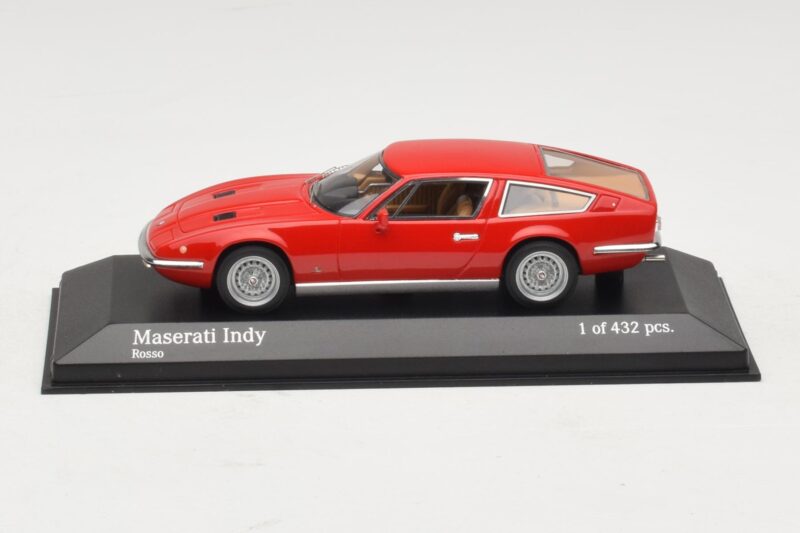
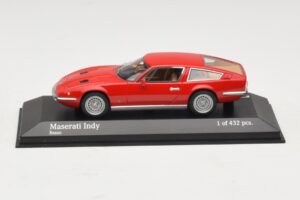
TL;DR: Minichamps' 1:43 Maserati Indy Red reproduces Vignale's 2+2 grand tourer, named for Maserati's Indianapolis 500 victories with driver Wilbur Shaw. The sealed diecast body captures the coupé's fastback profile in a bold red finish typical of period Italian GTs. A mid-tier piece for collectors tracing Maserati's motorsport-linked naming tradition.
Maserati named the Indy after two Indianapolis 500 victories, won in 1939 and 1940 with driver Wilbur Shaw at the wheel of the marque's 8CTF, a rare instance of a European road car carrying an American racing honour in its name. Minichamps' 1:43 rendering in red shows Vignale's practical 2+2 coupé body, built to carry that heritage into Maserati's everyday grand tourer range rather than a low-volume halo car.
Wilbur Shaw drove Maserati's 8CTF to victory at the Indianapolis 500 in both 1939 and 1940, a back-to-back win that remains one of the most significant results in Maserati's early competition history and one of the few times an Italian marque dominated America's biggest race. Decades later, Maserati borrowed that result directly for the Indy's name, a deliberate link between a 1930s racing triumph and a 1969 road car aimed at a very different kind of buyer. Minichamps' casting carries that name without any racing pretence in the body itself, since the Indy was always a road car first.
Where the contemporary Ghibli offered dramatic, low-slung two-seat styling, Vignale drew the Indy as a genuine 2+2, a taller, more practical coupé with usable rear seats and a fastback rear window that gave the car a distinctly different silhouette from its more famous sibling. That practicality made the Indy a sensible choice for buyers who wanted Maserati performance without sacrificing everyday usability, a compromise the model reflects in its slightly higher roofline and longer rear deck compared with the flatter Ghibli. The fastback glass, sweeping down toward the tail, was the Indy's clearest visual signature and the detail most likely to identify it at a glance.
The Indy's taller roofline and longer rear deck, compared with the lower Ghibli, give diecast's zinc alloy construction more surface area to hold true without sagging or bowing, a genuine advantage over a lighter material on a body this size. That structural confidence matters on a 2+2 coupé whose whole appeal rests on looking substantial and usable rather than low and dramatic, and the model's weight in the hand reinforces exactly that impression.
With the body sealed and no door, bonnet or boot that opens, the fastback glass runs as a single continuous curve from the roof down into the tail, precisely the effect Vignale's original design depended on to distinguish the Indy from a conventional notchback coupé. That fixed construction lets Minichamps hold a crisp, consistent line where the glass panel meets the surrounding red bodywork, a transition that would be far harder to keep sharp if built to open. The car's taller cabin also means slightly more visible interior detail through the glass, the seats and dashboard cast as part of the same fixed shell. That combination of height and glass gives the Indy a more upright, formal read than its lower Maserati siblings, a distinction the model preserves faithfully.
Red suits the Indy's more formal, upright proportions differently than it would a lower, more aggressive shape, giving the taller body a confident, substantial presence rather than a delicate one. Under direct light the metallic finish reads with real depth across the longer rear deck, a surface with more area to show off consistent paintwork than the Ghibli's flatter, lower body offers. At roughly ten and three-quarter centimetres nose to tail in 1:43, the Indy sits close in length to its more famous siblings but reads taller and more upright on a shelf, a proportion difference worth noticing when displayed alongside a Ghibli or Khamsin from the same decade. That practical stance, more grand tourer than sports coupé, is exactly what the Indy name and Vignale's design were built to deliver. Diecast holds the red evenly across the tall body, with no visible seam where the fastback glass panel meets the painted roof. For a collector drawn to Maserati's less celebrated 2+2 models rather than its lower, more famous two-seaters, the Indy in red is a genuinely distinctive addition.
The Indy rarely gets the attention its more dramatic siblings receive, yet its Indianapolis-derived name and Vignale's practical 2+2 body tell a genuinely different story about what a Maserati grand tourer could be through the early 1970s: usable, upright, and built for four rather than two. Minichamps' sealed diecast build keeps that story intact, holding the fastback's fixed glass line and the taller body's proportions faithfully at 1:43. For a collector already chasing the Ghibli or Khamsin, adding this red Indy fills a genuine gap in the range's story rather than repeating a shape already on the shelf. That combination of motorsport heritage and everyday practicality is difficult to find anywhere else in Maserati's catalogue.


Save £33.00



Save £14.00