Used
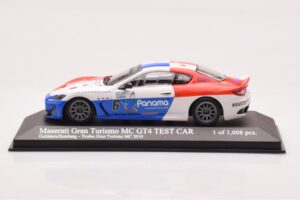
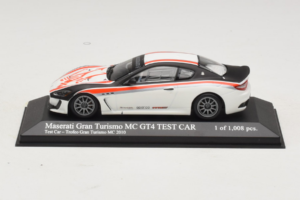
Maserati GranTurismo MC GT4 #6 Goldstein / Sumberg Trofeo GranTurismo 2010 Minichamps 1:43
Only 2 left
Price:
£32.00
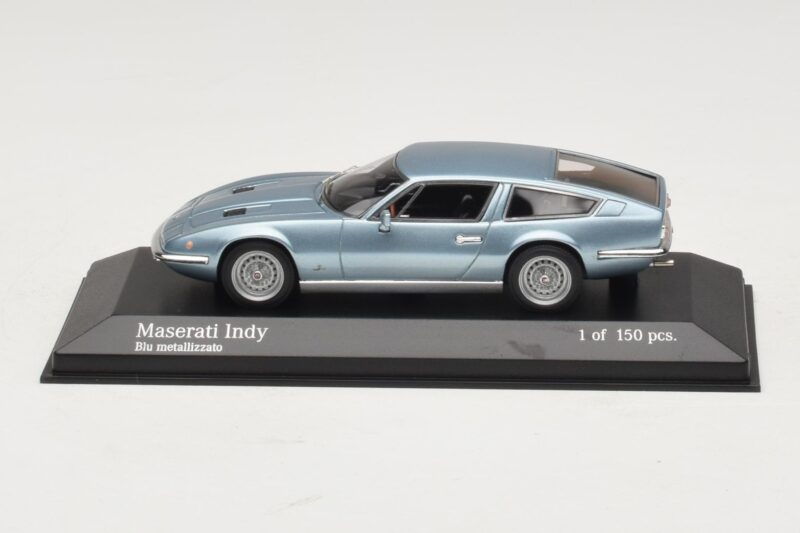
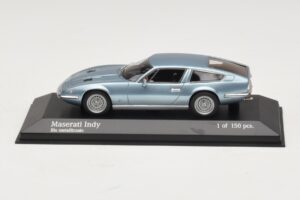
TL;DR: Minichamps' 1:43 Maserati Indy reproduces the 1969-1975 Vignale-styled 2+2 grand tourer in blue metallic diecast, cast as a sealed one-piece body with no opening panels. Named after Maserati's Indianapolis 500 victories, the Indy combined genuine four-seat practicality with the marque's own V8, a rarer proposition than the two-seat Ghibli it shared showrooms with.
Two Indianapolis 500 victories, decades apart from this car's 1969 launch, gave the Indy its name and its unusual burden: a grand tourer expected to carry racing prestige despite never once competing on an oval itself. Minichamps renders the shape in a deep metallic blue here, a finish that catches Vignale's flat bonnet and creased flanks rather differently to a solid colour, giving this particular example a cooler, more restrained character.
Maserati named the Indy to commemorate its back-to-back Indianapolis 500 wins, victories that belonged to a much earlier era of the marque's history and had nothing directly to do with this road car's engineering. The road car itself was pure grand touring: built for covering long distances at speed, in comfort, rather than for competition of any kind. That gap between a competition-derived name and a comfort-focused brief was common practice across the industry at the time, but it still gives the Indy a slightly unusual identity among Maserati's 1970s range, a name earned by association rather than by deed.
Unlike the two-seat Ghibli it shared a decade with, the Indy was designed as a genuine four-seater, with rear seats intended for real adult passengers rather than occasional children. Power came from Maserati's own V8, offered across the car's run in 4.2, 4.7 and 4.9-litre displacements, the same family of engines that powered the Ghibli and Quattroporte of the period. That combination, proper rear accommodation paired with genuine V8 performance, made the Indy a rarer and arguably more practical proposition than its flashier two-seat siblings, aimed at owners who wanted both space and pace in one car.
Vignale's bonnet on the Indy runs long and nearly flat, a surface that benefits enormously from a casting with no seams to interrupt it. Minichamps builds this model as a single fixed shell, with no doors, bonnet or boot that open, keeping the roofline and wing tops reading as one continuous line rather than a set of separately hinged panels chasing consistent gaps. That decision suits the Indy's slab-sided profile particularly well; zinc alloy diecast at this scale does its best work when the tooling can hold one uninterrupted surface across a body of this length, and a sealed casting delivers exactly that.
Metallic paint behaves quite differently from a solid shade under direct light, with the flake catching illumination unevenly across a body's curves rather than reflecting it as one flat sheet. On this Indy, that means the roofline and door tops should read slightly brighter than the lower flanks when lit from above, a subtlety the black version of the same casting cannot show. Compared side by side, the metallic blue gives this example a cooler, more contemporary feel than the black car's flatter, more severe presence, and choosing between the two often comes down to which character suits a given shelf.
Because Minichamps offers this Indy in both black and metallic blue from the same tooling, a collector has a genuine opportunity to display two distinct interpretations of Vignale's design without needing two different subjects. The black version emphasises the flatness and severity of the original shape, while this blue metallic example softens that same shape with a livelier, more reflective surface. Displayed together, the pair demonstrates how much a finish alone can change the character of an otherwise identical casting, a lesson that applies well beyond this one model.
At just over ten centimetres, either Indy fits comfortably into a dense shelf of 1970s Italian grand tourers, and owning both colours costs relatively little additional shelf space compared with adding an entirely different subject. For a collector building a coachbuilder-focused display around Vignale's late-1960s and early-1970s work, having both finishes of the same car offers a genuinely useful comparison point that a single example alone cannot provide.
Set beside the Ghibli it shared engines with, this Indy reads as the more practical, family-oriented choice within Maserati's early-1970s range, a role the metallic blue finish underlines rather than disguises. It suits a collector who wants Vignale's design language represented without the drama a brighter colour might invite.
Paired with the black version from the same tooling, or displayed alongside other Minichamps Italian coupes, this Indy earns its place through genuine mechanical substance, real V8 power and four-seat practicality, rather than through rarity for its own sake. That combination of usable space and honest performance remains the car's most convincing argument today.


Save £33.00



Save £14.00