{"ajaxurl":"https:\/\/models118.co.uk\/wp-admin\/admin-ajax.php?lang=en_GB","nonce":"3531226832","homeUrl":"https:\/\/models118.co.uk\/","shopUrl":"https:\/\/models118.co.uk\/shop\/","cartUrl":"https:\/\/models118.co.uk\/cart-en-gb\/","checkoutUrl":"https:\/\/models118.co.uk\/checkout\/","skipCart":true,"collectionLimit":12,"i18n":{"addedToCart":"Added to basket","addToWishlist":"Add to wishlist","addedToWishlist":"Added to wishlist","removeFromWishlist":"Remove from wishlist","removedFromWishlist":"Removed from wishlist","undo":"Undo","error":"Something went wrong","loading":"Loading...","outOfStock":"Out of stock","viewCart":"View basket","proceedToCheckout":"Proceed to checkout","addedToCollection":"Added to your collection","reserved":"Reserved!","soldOut":"Sold out","invalidEmail":"Please enter a valid email address","connectionError":"Connection error. Please try again.","loginToSave":"Sign in to save this model","waitlistNotify":"Notify me","waitlistOnList":"On the waiting list \u2713","waitlistJoined":"You're on the waiting list. We'll email you the moment this model is available again.","waitlistRemoved":"Done \u2014 you're off the waiting list for this model.","waitlistRateLimit":"Too many attempts \u2014 please try again shortly","waitlistTurnstile":"We couldn't complete the check \u2014 please try again","waitlistError":"Sorry, something went wrong. Please try again in a moment."},"wishlist":{"loggedIn":false,"loginUrl":"https:\/\/models118.co.uk\/my-account\/","addAction":"models118_wishlist_add","removeAction":"models118_wishlist_remove"},"waitlist":{"loggedIn":false,"subscribeAction":"models118_waitlist_subscribe","toggleAction":"models118_waitlist_toggle","stateAction":"models118_waitlist_state"},"stats":{"models":2657,"brands":213,"manufacturers":128,"collectors":10000},"product":{"id":1681067,"sku":"439141022","condition":"new","availability":"in_stock","name":"Magirus-Deutz S 7500 Jupiter Flatbed Truck White Red Minichamps 1:43","brand":"Magirus-Deutz","manufacturer":"Minichamps","scale":"1:43","material":"Diecast","price":90,"regularPrice":90,"isOnSale":false,"savingsAmount":0,"stockQty":8,"stockStatus":"in_stock","isDiscontinued":false,"image":"https:\/\/models118.co.uk\/wp-content\/uploads\/2026\/09\/magirus-deutz-s-7500-jupiter-flatbed-truck-white-red-minichamps-1-43-439141022-1-1-300x200.jpg","permalink":"https:\/\/models118.co.uk\/magirus-deutz-s-7500-jupiter-flatbed-truck-white-red-minichamps-1-43-439141022\/"}}
Cookies on Models118
We use cookies to remember your preferences, understand how the shop is used and show you models and offers that suit your interests. What you allow is up to you, and you can change it at any time.
Always active
The technical storage or access is strictly necessary for the legitimate purpose of enabling the use of a specific service explicitly requested by the subscriber or user, or for the sole purpose of carrying out the transmission of a communication over an electronic communications network.
The technical storage or access is necessary for the legitimate purpose of storing preferences that are not requested by the subscriber or user.
The technical storage or access that is used exclusively for statistical purposes.
The technical storage or access is required to create user profiles to send advertising, or to track the user on a website or across several websites for similar marketing purposes.
Magirus-Deutz S 7500 Jupiter Flatbed Truck White Red Minichamps 1:43
New arrival
1/6
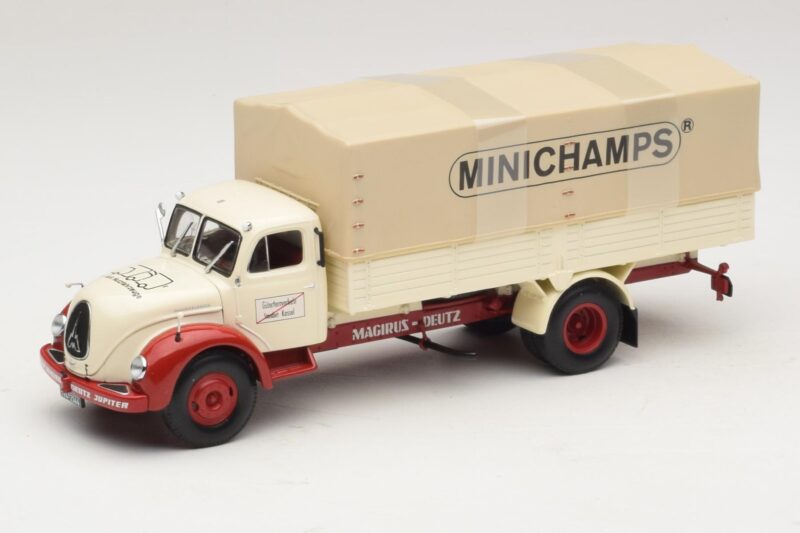
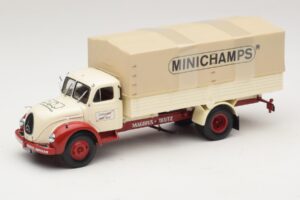
Minichamps' 1:43 diecast Magirus-Deutz S7500 Jupiter reproduces the 1950 flatbed truck in its white-and-red factory finish, a solid mid-century workhorse from a manufacturer better known for fire engines. The sealed zinc alloy body carries a cab-over layout, printed badge detail, and a load bed with visible chassis bracing. A strong addition for a heavy-truck section of a commercial-vehicle collection.
About the Magirus-Deutz S 7500 Jupiter Flatbed Truck White Red Minichamps 1:43
TL;DR: Minichamps' 1:43 diecast Magirus-Deutz S7500 Jupiter reproduces the 1950 flatbed truck in its white-and-red factory finish, a solid mid-century workhorse from a manufacturer better known internationally for fire engines. The sealed zinc alloy body carries a cab-over layout, printed badge detail, and a load bed with visible chassis bracing for a genuine heavy-haulage collectible.
Magirus-Deutz is a name most collectors associate with fire engines and turntable ladders, which makes this plain flatbed truck a useful reminder of the company's much broader output. The S7500 Jupiter was a straightforward workhorse chassis, built for haulage rather than emergency response, and Minichamps renders it in the honest white-and-red finish that suited a working truck rather than a showpiece.
Minichamps' 1:43 Magirus-Deutz S 7500 Jupiter
White-and-Red Cab-and-Flatbed Finish
The white cab and red chassis-and-flatbed combination is a classic period colour split, practical rather than promotional, chosen to keep the truck visible on the road rather than to advertise a brand. Minichamps applies a clean, even finish across both colours, with the split line between them running straight and true along the cab's waistline. Badge detail on the grille and cab sides is printed rather than moulded, holding its shape at this scale far better than a stamped-in equivalent would. There's no advertising livery competing for attention here, which lets the truck's own proportions, tall cab, flat load bed, exposed chassis rails, do the visual work instead.
Casting a Cab-Over Truck at 1:43
Magirus-Deutz built the S7500 with a cab-forward layout, engine partly beneath the driver's position rather than out in front, a configuration that maximised load length on a given wheelbase. Minichamps casts the whole truck as a single sealed shell, with no doors or bonnet section to open, which keeps the cab's compact proportions and the flatbed's long, flat deck reading cleanly without a seam interrupting either. Zinc alloy gives the model real heft, appropriate for a subject built to represent serious load-carrying capacity rather than a passenger vehicle. The wheel arches and mudguards sit correctly proportioned against the cab, avoiding the slightly toy-like stance a cheaper casting can fall into.
Magirus-Deutz and Germany's Heavy-Truck Recovery
A Fire-Engine Name Turned Truck Builder
Magirus built its early reputation on fire-fighting equipment, including the turntable ladders that carried its name across Europe, before the 1936 merger with Deutz's engine business created Magirus-Deutz and broadened the company into a full-line truck manufacturer. That fire-engine heritage tends to dominate the brand's popular image, but through the postwar decades Magirus-Deutz built a genuinely wide range of haulage trucks like the S7500, supplying the ordinary workhorses that kept German industry supplied as much as it supplied fire brigades.
The Jupiter Series in 1950s Haulage
The Jupiter name marked one of Magirus-Deutz's core haulage ranges through the 1950s, built for exactly the kind of general freight this flatbed represents: steel, timber, machinery, anything that needed a solid deck and a dependable chassis rather than specialist bodywork. It was a period when West German road haulage was expanding rapidly to support postwar reconstruction, and manufacturers like Magirus-Deutz, alongside Mercedes and Büssing, all competed for a share of that growing fleet. That competitive landscape is part of what makes assembling examples from each manufacturer worthwhile for a serious collection, and it explains why liveries and finishes varied so widely between otherwise similar trucks.
A Broader Side of a Fire-Engine Name
This Jupiter flatbed pairs naturally with other 1950s German commercial vehicles, including Mercedes and Büssing trucks from the same decade, building a genuine cross-manufacturer picture of postwar haulage rather than a single-brand shelf. It also works well as a contrast piece alongside a Magirus fire engine, showing two very different sides of the same manufacturer's output. The sealed diecast construction keeps the price sensible for a truck this size, and the plain, honest finish means the detail that's there, the cab proportions, the chassis bracing, the wheel stance, carries the model rather than a busy livery covering for weaker casting. For collectors who value substance over decoration, that's exactly the point.
Create a free account and claim 10% off your first order — from hundreds of collectible 1:18, 1:43 and 1:12 models by Porsche, Mercedes-Benz, BMW and more.
{"id":1681067,"name":"Magirus-Deutz S 7500 Jupiter Flatbed Truck White Red Minichamps 1:43","price":"£<\/span>90.00<\/bdi><\/span>","image":"https:\/\/models118.co.uk\/wp-content\/uploads\/2026\/09\/magirus-deutz-s-7500-jupiter-flatbed-truck-white-red-minichamps-1-43-439141022-1-1-400x400.jpg","permalink":"https:\/\/models118.co.uk\/magirus-deutz-s-7500-jupiter-flatbed-truck-white-red-minichamps-1-43-439141022\/","brand":"Magirus-Deutz"}