


New arrival
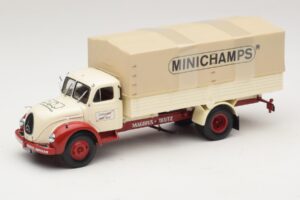
Magirus-Deutz built its reputation on air-cooled diesel engines, a technical signature that carried across the firm’s heavy trucks and its famous fire and rescue apparatus. This 1:43 scale diecast range, produced by Minichamps, brings that dual heritage to the shelf: haulage trucks built for German industry alongside the fire engines that made the Magirus name known well beyond its home market.
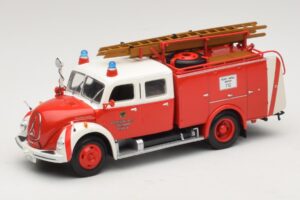
TL;DR: Magirus-Deutz diecast models in 1:43 scale cover 1950s German heavy trucks and fire and emergency vehicles, produced by Minichamps in diecast metal. The marque is known for air-cooled diesel engines, a distinctive engineering trait that set its trucks and fire apparatus apart from water-cooled rivals of the era.
Magirus-Deutz occupies a curious double identity in commercial vehicle history: half haulage truck manufacturer, half fire engine specialist, united by a shared commitment to air-cooled diesel power. The 1:43 scale diecast range from Minichamps reflects both sides of that story, giving collectors access to 1950s West German heavy trucks and the emergency vehicles that carried the Magirus name into fire stations across Europe. It is a marque built as much on engineering conviction as on commercial success.
Magirus-Deutz took its name from a merger between Magirus, an Ulm-based manufacturer already known for fire ladders and fire apparatus, and Deutz, the engine business behind Klockner-Humboldt-Deutz's air-cooled diesel technology. That combination gave the trucks and fire engines built under the Magirus-Deutz name a genuinely distinctive engineering signature: air-cooled diesel engines rather than the water-cooled units most German manufacturers favoured through the same period.
Air cooling brought real practical advantages for the vehicles this marque built. A fire engine or heavy truck without a water-filled cooling system was lighter, simpler to maintain in the field, and less vulnerable to freezing in cold weather or overheating during sustained heavy load. That reliability mattered enormously for fire apparatus, where a vehicle failing to start or overheating mid-callout was never acceptable. The same engines carried into the firm's haulage trucks, giving 1950s Magirus-Deutz commercial vehicles a mechanical identity as strong as their bodywork, and it is that identity the diecast range sets out to preserve for collectors today.
Fire apparatus and haulage trucks ask a scale model manufacturer to solve very different problems within a single marque, and that makes Magirus-Deutz an interesting case for assessing fidelity. A haulage truck model succeeds or fails on cab proportions, chassis stance and load bed accuracy, much like any commercial vehicle subject. A fire engine model carries a heavier burden, and a few details separate a convincing model from an approximate one:
Minichamps brings its 1:43 scale motorsport and passenger car discipline to both sides of the Magirus-Deutz range, and the test for a collector is largely the same regardless of vehicle type: does the model's stance and proportion match documented references, and do the fine fittings hold their shape under close inspection rather than reading as vague or simplified.
Diecast zinc alloy serves both halves of the Magirus-Deutz range for much the same reasons it serves any commercial vehicle subject at 1:43 scale. The flat, angular panels of a 1950s truck cab or a fire engine's boxy equipment locker hold their shape cleanly when cast in metal, and the material's weight gives even a modest-sized model genuine presence in the hand.
Fire engine models add a layer of complexity that pure haulage trucks do not carry. Ladder assemblies, pump fittings and roof-mounted equipment are frequently produced as separate cast or moulded components fitted to the main body, rather than as part of a single casting, since a single die could not resolve that level of fine detail cleanly. Whether a specific Magirus-Deutz model has any moving or opening features, a swinging ladder, an opening equipment locker, varies from piece to piece and is stated on the individual product listing rather than assumed from the vehicle type or material. Paint on both trucks and fire engines tends toward flat, working colours or the strong reds associated with fire apparatus, and a well-finished model holds that colour evenly across large panel surfaces.
Fire engines and heavy trucks share the same scale problem as any large commercial vehicle: at 1:18, the format many collectors default to for cars, a single fire engine with an extended ladder would dwarf anything else on the shelf and demand display space few collectors have available. At 1:43, both a Magirus-Deutz haulage truck and a fire engine settle into the same scale most collectors already use for saloon cars and racing subjects.
That consistency matters more here than with most marques, because the appeal of a Magirus-Deutz collection often comes from displaying trucks and fire apparatus side by side to show the shared engineering behind two very different jobs. A row of 1:43 scale commercial vehicles, some hauling freight and others equipped for emergency response, reads as a coherent slice of 1950s German road transport in a way that mixing scales never could. The format also keeps fine equipment details, ladders, hose reels, warning lights, at a size where they remain visible without needing an oversized model to carry them.
A Magirus-Deutz collection naturally splits into two directions, and most collectors end up choosing which one drives their shelf. Some focus on the haulage trucks, building a broader 1950s German commercial vehicle display alongside marques like Krupp, where Magirus-Deutz sits as one voice among several telling the story of post-war reconstruction. Others are drawn specifically to the fire and emergency vehicles, where Magirus-Deutz has a stronger claim to being a defining name, and build a dedicated emergency services theme that might extend to other countries and later decades.
Either approach benefits from period research, since liveries and equipment fittings on fire apparatus varied significantly between regions and fire brigades, and matching a model to a documented, real operator adds genuine collecting depth beyond simply owning the casting. For a new collector, a single fire engine subject makes a stronger anchor piece than a truck, since the equipment detail gives it more visual presence on a shelf, with haulage trucks added afterward to build out the wider commercial vehicle story.
Fire engine models bring specific display challenges that haulage trucks do not. Ladder assemblies and roof-mounted equipment are often the most fragile parts of the casting, more easily knocked or bent than a flat truck roof, so handling by the chassis rather than by any raised fitting protects the model during dusting or repositioning. A glass-fronted cabinet earns its place here particularly for fire apparatus, where fine ladder rungs and pump details collect dust faster than a smooth car body and are considerably more fiddly to clean once they do.
Strong red paintwork, common across fire apparatus, is just as vulnerable to fading in direct sunlight as any other colour, so positioning a display away from windows protects the vivid finish that makes these models visually striking in the first place. Original packaging is worth keeping for both trucks and fire engines in this range, since Magirus-Deutz draws a genuinely dedicated following among collectors interested in emergency service history specifically, and completeness matters to that audience. Keeping equipment models grouped by decade or livery, rather than scattered among unrelated marques, also helps a themed emergency services shelf read clearly to anyone viewing the collection.
Magirus-Deutz built its trucks and fire engines around air-cooled diesel engines rather than the water-cooled units most rivals used. That choice made vehicles lighter, simpler to maintain, and less prone to overheating or freezing, a genuine engineering distinction that the diecast range reflects in its focus on the marque.
Yes, the Magirus-Deutz range in this collection covers both heavy duty haulage trucks and service and emergency vehicles, reflecting the marque's dual identity. Collectors can build a display around commercial haulage, emergency response, or both together as a single themed 1950s German transport shelf.
Every Magirus-Deutz model in this range is 1:43 scale diecast, produced by Minichamps. That scale and material combination suits the flat panels and equipment fittings of both trucks and fire apparatus, giving each model genuine weight while keeping the footprint practical for a mixed vehicle display.
Magirus-Deutz pairs naturally with contemporaries such as Krupp for a broader post-war German commercial vehicle theme, or stands on its own within a dedicated fire and emergency services collection, since its fire apparatus heritage gives it a stronger identity than most haulage-only marques from the same decade.