Last one
Back in stock
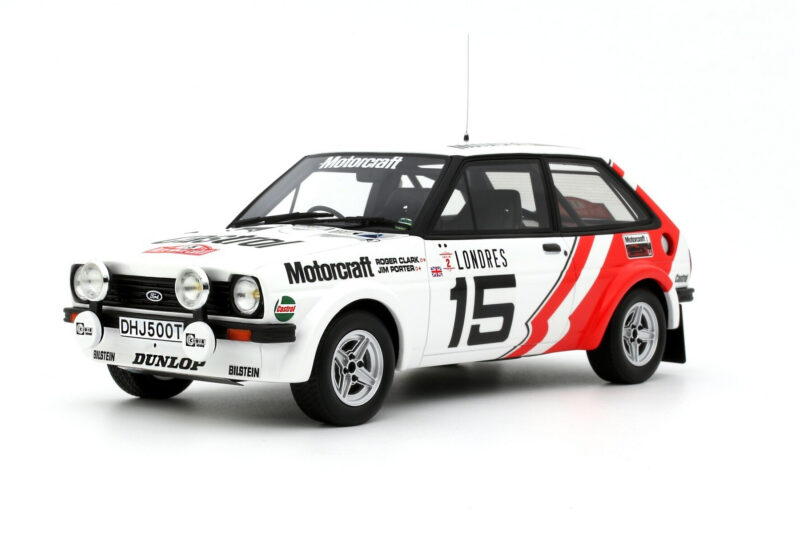
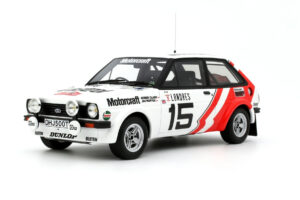
TL;DR: Otto's 1:18 Ford Fiesta 1600 reproduces a Group 2 rally entrant from the 1979 Monte Carlo Rally, cast as a sealed resin shell with fixed panels. Period livery and the Mk1 Fiesta's compact hatchback shape are told entirely through the exterior, marking one of the model's earliest competition appearances.
Ford launched the Fiesta in 1976 as its first front-wheel-drive small car, and it did not take long for privateer and works-supported crews to enter it into rallying under Group 2 regulations. The 1979 Monte Carlo Rally, one of the sport's most demanding events with its mix of ice, tarmac and altitude, gave this small hatchback an early proving ground against far larger, more established rally machinery.
When the Fiesta arrived in 1976, it represented a genuine departure for Ford, a compact, front-wheel-drive hatchback built to compete with the Fiat 127 and Renault 5 rather than anything else in Ford's existing range. Its light weight and simple mechanicals made it a plausible, if unglamorous, candidate for Group 2 rallying, where smaller-displacement cars competed in their own class rather than against outright works entries. The 1600 designation marks the larger of the period Fiesta engine options fitted for competition use, giving crews a reasonable balance of power and reliability for events that punished fragile machinery over long, demanding stages.
The Monte Carlo Rally has always demanded versatility from both car and crew, its route crossing everything from dry Mediterranean tarmac to icy Alpine passes within the same competitive stage, often within the same day. For a small-class Group 2 entrant like this Fiesta, finishing the event at all was a genuine achievement, since the car was never built with the outright pace of the larger Group 4 works cars that dominated the overall results. Its presence on the entry list represents the kind of grassroots competition history that rarely makes headlines but forms the backbone of period rallying.
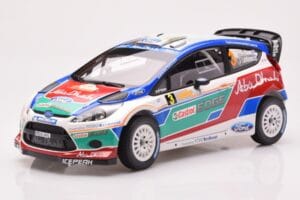
The Mk1 Fiesta's small, boxy hatchback body leaves little room to disguise an inconsistent panel line, and a rally livery only draws more attention to any flaw beneath it. Otto casts this Fiesta as a single sealed resin body, with no bonnet or tailgate built to open, holding tight, even shutlines around a compact shape where any gap would be immediately obvious. The wheel arches, filled with period-correct rally tyres and wheels, sit proportioned correctly against the Fiesta's short wheelbase.
Rally livery from this era typically combined sponsor decals, competition numbers and often understated colour schemes compared with the flamboyant works liveries of larger teams, and getting that period-correct restraint right matters as much as getting any single decal accurate. Resin holds fine tampo printing cleanly, keeping numbers and lettering sharp rather than blurred, which is essential on a livery where legibility at speed was originally the whole point. Under direct light, the base colour and applied graphics sit at a consistent depth, avoiding the slightly raised texture that lower-quality decal application can leave on a smaller-scale model.
A Group 2 Fiesta from the 1979 Monte Carlo Rally will never carry the name recognition of a works Escort or a Group 4 Lancia Stratos from the same era, and that is worth acknowledging honestly rather than overselling the subject. What it offers instead is a different, quieter kind of motorsport history, the story of a brand-new small car proving itself in genuine competition within three years of its launch, competing in its own class against similarly modest machinery rather than chasing outright victory. For collectors building a rallying display around the smaller classes rather than the headline works teams, this kind of entrant fills a gap the more famous cars simply cannot. The compact Fiesta shape, reproduced faithfully in this casting, also makes an interesting size comparison sitting beside a larger Group 4 rally car from the same year.
This Fiesta earns its place in a Monte Carlo Rally or 1970s motorsport display through context rather than headline results, sitting well alongside larger works entries to show the genuine breadth of a period entry list. Its sealed body keeps the livery presentation clean, with no panel gap to interrupt the graphics. At this tier, resin construction gives the tampo-printed livery sharper definition than a basic die-cast equivalent typically achieves on a subject this compact. For a collector assembling a genuine cross-section of late-1970s rallying rather than only its most famous machinery, this small-class Fiesta adds a layer of authenticity a shelf full of works Escorts alone would not provide.
Save £14.00
Save £11.00