{"ajaxurl":"https:\/\/models118.co.uk\/wp-admin\/admin-ajax.php?lang=en_GB","nonce":"639ff23817","homeUrl":"https:\/\/models118.co.uk\/","shopUrl":"https:\/\/models118.co.uk\/shop\/","cartUrl":"https:\/\/models118.co.uk\/cart-en-gb\/","checkoutUrl":"https:\/\/models118.co.uk\/checkout\/","skipCart":true,"collectionLimit":12,"i18n":{"addedToCart":"Added to basket","addToWishlist":"Add to wishlist","addedToWishlist":"Added to wishlist","removeFromWishlist":"Remove from wishlist","removedFromWishlist":"Removed from wishlist","undo":"Undo","error":"Something went wrong","loading":"Loading...","outOfStock":"Out of stock","viewCart":"View basket","proceedToCheckout":"Proceed to checkout","addedToCollection":"Added to your collection","reserved":"Added to your collection","soldOut":"Sold out","invalidEmail":"Please enter a valid email address","connectionError":"Connection error. Please try again.","tocToggle":"On this page","close":"Close","inCartTooltip":"Already in your basket \u2013 open your basket to check out","loginToSave":"Sign in to save this model","waitlistNotify":"Notify me","waitlistOnList":"On the waiting list \u2713","waitlistJoined":"You're on the waiting list. We'll email you the moment this model is available again.","waitlistRemoved":"Done \u2014 you're off the waiting list for this model.","waitlistRateLimit":"Too many attempts \u2014 please try again shortly","waitlistTurnstile":"We couldn't complete the check \u2014 please try again","waitlistError":"Sorry, something went wrong. Please try again in a moment."},"wishlist":{"loggedIn":false,"loginUrl":"https:\/\/models118.co.uk\/my-account\/","addAction":"models118_wishlist_add","removeAction":"models118_wishlist_remove"},"waitlist":{"loggedIn":false,"subscribeAction":"models118_waitlist_subscribe","toggleAction":"models118_waitlist_toggle","stateAction":"models118_waitlist_state"},"stats":{"models":2665,"brands":215,"manufacturers":129,"collectors":10000},"product":{"id":1695988,"sku":"8042","condition":"used","availability":"in_stock","name":"Fiat 500 Yellow Solido 1:18","brand":"Fiat","manufacturer":"Solido","scale":"1:18","material":"Diecast","price":33,"regularPrice":33,"isOnSale":false,"savingsAmount":0,"stockQty":1,"stockStatus":"very_low","isDiscontinued":false,"image":"https:\/\/models118.co.uk\/wp-content\/uploads\/2026\/10\/fiat-500-yellow-solido-1-18-8042-1-1-300x200.jpg","permalink":"https:\/\/models118.co.uk\/fiat-500-yellow-solido-1-18-8042\/"}}
Cookies on Models118
We use cookies to remember your preferences, understand how the shop is used and show you models and offers that suit your interests. What you allow is up to you, and you can change it at any time.
Always active
The technical storage or access is strictly necessary for the legitimate purpose of enabling the use of a specific service explicitly requested by the subscriber or user, or for the sole purpose of carrying out the transmission of a communication over an electronic communications network.
The technical storage or access is necessary for the legitimate purpose of storing preferences that are not requested by the subscriber or user.
The technical storage or access that is used exclusively for statistical purposes.
The technical storage or access is required to create user profiles to send advertising, or to track the user on a website or across several websites for similar marketing purposes.
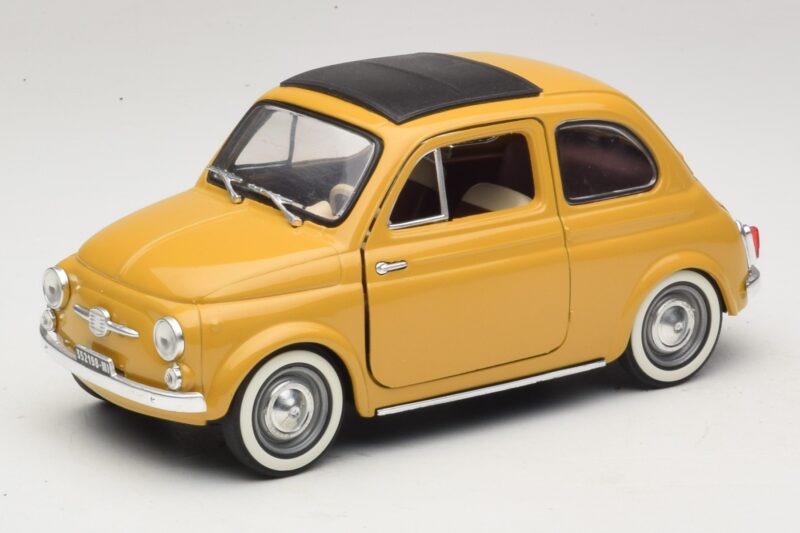
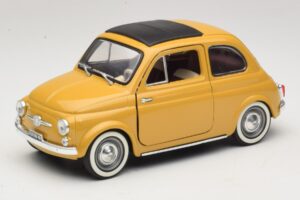
Solido's 1:18 diecast Fiat 500 in yellow reproduces the 1960 Italian city car with opening parts and the weight of a metal body. At roughly 16 to 17 centimetres long, it is a compact piece that sits comfortably in a standard display cabinet. The upright stance, rounded roofline and bright paint make it a cheerful counterpoint to grander cars, and the moving panels give it a hands-on side that sealed models lack. A practical choice for anyone building a retro city car or 1960s European shelf.
TL;DR: The Solido Fiat 500 Yellow 1:18 is a diecast replica of the 1960 Italian city car, built with opening parts and finished in yellow. Zinc alloy gives it real weight, and at roughly 16 to 17 centimetres long it suits a compact cabinet shelf. A practical pick for retro city car themes.
Few small cars look as cheerful on a shelf as a yellow Fiat 500. The real car arrived in 1957 as Italy's answer to affordable motoring, designed by Dante Giacosa around a tiny rear-mounted air-cooled engine. The Solido Fiat 500 1:18 brings that pint-sized shape to the cabinet in diecast, and its opening parts add a hands-on side that sealed models lack.
Solido Fiat 500 and the Car It Reproduces
A City Car Built Around Its Engine
The Nuova 500 reached showrooms in 1957 and was still a familiar sight on Italian streets through the 1960s, the decade this model represents. Giacosa kept everything small: a rear-mounted two-cylinder air-cooled engine, a short wheelbase and a cabin sized for little more than a couple of adults and their shopping. That packaging explains the stubby nose and the steep, upright tail, and both are the first things worth checking on a replica. On a good one the body sits upright on narrow wheels beneath small arches, exactly as the real car did. The car is so compact that even at 1:18 its whole shape is easy to take in at a glance.
Yellow as a Finish
Yellow suits the 500 well. Light colours flatter small cars because they show off every curve of the roof and wings, and a bright yellow lets the rounded shoulders catch light along their full length. Under a directed lamp, check how evenly the paint lies across the roof, since that wide, gently curved panel shows thin patches or orange peel before anywhere else. Gloss over a metal shell tends to read deep and consistent, which helps a colour like this look rich rather than flat.
Opening Parts and Zinc Alloy Weight in the Hand
How the Moving Panels Behave
This model has opening parts, and that changes how you handle it. Moving panels give the piece a tactile quality that a sealed casting cannot offer: lift it from its tray, work a panel with a fingertip and you see the body as a built object rather than a static shape. Handle it gently, particularly on first opening, and avoid levering against a panel edge. Because panels on any articulated body need a little clearance to swing, expect visible shut lines rather than the razor-thin seams a one-piece resin casting achieves. That is the honest trade for the movement, and most buyers of a city car like this accept it happily.
What Diecast Brings and Costs
Diecast is zinc alloy cast under pressure, and the first thing you notice is mass. Even a car this small feels dense and cool in the hand, well beyond what a resin body of the same size would weigh. The metal shell holds its dimensions over decades, takes paint with a hard, deep gloss and tolerates being moved between shelves. Its limit is finesse. Very fine details such as thin trim or delicate lettering cannot be cast as sharply as in resin, so judge the badges and lamp lenses at close range and keep expectations realistic for a model at accessible diecast pricing.
Judging Fidelity and Setting It Up on the Shelf
At 1:18 the 500 measures roughly 16 to 17 centimetres from bumper to bumper, which is small by the standards of the scale. A full-size saloon at 1:18 runs to 25 centimetres or more, so the Fiat looks like a pocket-sized sibling beside it. That compactness is useful: three or four of these fit on a shelf where two larger cars would. Against 1:43, the bigger scale leaves room for crisper badges, clearer glazing and wheels with visible depth, which is why many buyers choose 1:18 for a car whose charm lives in small details.
When you compare the model with reference photographs, start with stance and wheel position, then move to the glazing line, the grille and the badge on the nose. Display it away from direct sunlight, which can fade paint and age plastic parts over the years, and keep dust off with a soft brush rather than a cloth that might scratch the clear coat. Light from the side shows the roof curve best. A glass-fronted display case slows the dust and keeps curious fingers away from the panels.
Where a Yellow Fiat 500 Fits in a Collection
A yellow Fiat 500 works as a counterpoint on a shelf of grander cars. Set beside a sports coupe or a saloon from the same decade, it shows how differently Europe was motoring in the 1960s, and its bright paint breaks up a row of silver and red. It also anchors a small-car theme neatly, whether that means Italian city cars, 1960s European runabouts or a colour-led display built around one hue.
For a buyer wanting a friendly, handleable first 1:18 in the retro city car line, this is a sensible place to start, and anyone ready to buy Solido's Fiat 500 in yellow gets a model that rewards both handling and display. It is a diecast piece with honest expectations: good weight, opening parts and an approachable character, not a hand-finished showpiece. Keep the packaging if completeness matters to you, since British collectors in particular tend to prize it.
Create a free account and claim 5% off your first order — from hundreds of collectible 1:18, 1:43 and 1:12 models by Porsche, Mercedes-Benz, BMW and more.