{"ajaxurl":"https:\/\/models118.co.uk\/wp-admin\/admin-ajax.php?lang=en_GB","nonce":"d9bf684b57","homeUrl":"https:\/\/models118.co.uk\/","shopUrl":"https:\/\/models118.co.uk\/shop\/","cartUrl":"https:\/\/models118.co.uk\/cart-en-gb\/","checkoutUrl":"https:\/\/models118.co.uk\/checkout\/","skipCart":true,"collectionLimit":12,"i18n":{"addedToCart":"Added to basket","addToWishlist":"Add to wishlist","addedToWishlist":"Added to wishlist","removeFromWishlist":"Remove from wishlist","removedFromWishlist":"Removed from wishlist","undo":"Undo","error":"Something went wrong","loading":"Loading...","outOfStock":"Out of stock","viewCart":"View basket","proceedToCheckout":"Proceed to checkout","addedToCollection":"Added to your collection","reserved":"Reserved!","soldOut":"Sold out","invalidEmail":"Please enter a valid email address","connectionError":"Connection error. Please try again.","loginToSave":"Sign in to save this model","waitlistNotify":"Notify me","waitlistOnList":"On the waiting list \u2713","waitlistJoined":"You're on the waiting list. We'll email you the moment this model is available again.","waitlistRemoved":"Done \u2014 you're off the waiting list for this model.","waitlistRateLimit":"Too many attempts \u2014 please try again shortly","waitlistTurnstile":"We couldn't complete the check \u2014 please try again","waitlistError":"Sorry, something went wrong. Please try again in a moment."},"wishlist":{"loggedIn":false,"loginUrl":"https:\/\/models118.co.uk\/my-account\/","addAction":"models118_wishlist_add","removeAction":"models118_wishlist_remove"},"waitlist":{"loggedIn":false,"subscribeAction":"models118_waitlist_subscribe","toggleAction":"models118_waitlist_toggle","stateAction":"models118_waitlist_state"},"stats":{"models":2141,"brands":206,"manufacturers":127,"collectors":10000},"product":{"id":452549,"sku":"100060017","condition":"used","availability":"out_of_stock","name":"BMW Sauber F1.06 #17 J. Villeneuve F1 2006 Minichamps 1:18","brand":"BMW","manufacturer":"Minichamps","scale":"1:18","material":"Diecast","price":122,"regularPrice":122,"isOnSale":false,"savingsAmount":0,"stockQty":0,"stockStatus":"out_of_stock","isDiscontinued":true,"image":"https:\/\/models118.co.uk\/wp-content\/uploads\/2026\/06\/f1-bmw-sauber-f106-jacques-villeneuve-2006-minichamps-1-18-300x200.jpg","permalink":"https:\/\/models118.co.uk\/bmw-sauber-f1-06-17-j-villeneuve-f1-2006-minichamps-1-18-100060017\/"}}
Cookies on Models118
We use cookies to remember your preferences, understand how the shop is used and show you models and offers that suit your interests. What you allow is up to you, and you can change it at any time.
Always active
The technical storage or access is strictly necessary for the legitimate purpose of enabling the use of a specific service explicitly requested by the subscriber or user, or for the sole purpose of carrying out the transmission of a communication over an electronic communications network.
The technical storage or access is necessary for the legitimate purpose of storing preferences that are not requested by the subscriber or user.
The technical storage or access that is used exclusively for statistical purposes.
The technical storage or access is required to create user profiles to send advertising, or to track the user on a website or across several websites for similar marketing purposes.
BMW Sauber F1.06 #17 J. Villeneuve F1 2006 Minichamps 1:18
Sold out
1/6
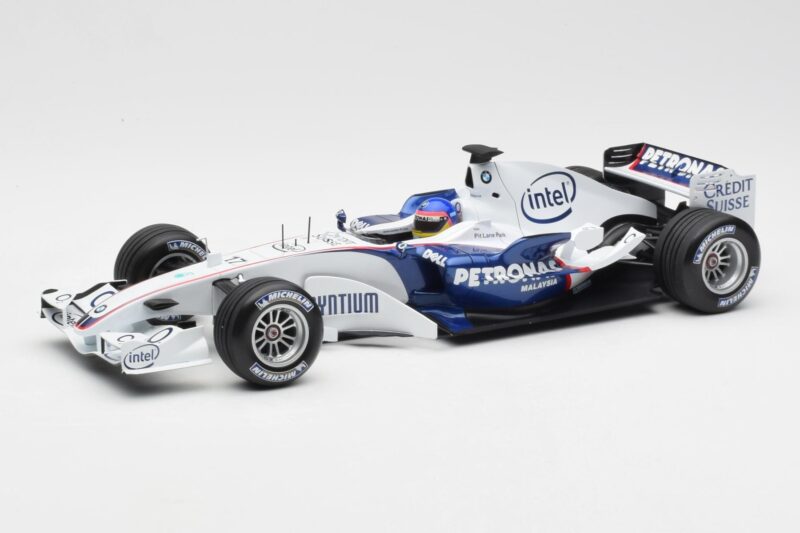
Minichamps' 1:18 diecast BMW Sauber F1.06 recreates Jacques Villeneuve's 2006 Formula 1 season, BMW's first year running the Swiss team as a full works outfit rather than a customer engine supplier. Finished in blue and white with car number 17, it captures the 1997 world champion's last extended F1 campaign before Robert Kubica took the seat. Diecast construction with separately fitted aerodynamic parts and cockpit detail keeps the finish sharp at 1:18 scale.
About the BMW Sauber F1.06 #17 J. Villeneuve F1 2006 Minichamps 1:18
TL;DR: Minichamps' 1:18 diecast reproduces the BMW Sauber F1.06 raced by Jacques Villeneuve during the 2006 Formula 1 season, BMW's first year running the Swiss team as a full works outfit. Finished in the team's blue and white livery with car number 17, it captures the 1997 champion's last extended F1 campaign.
Jacques Villeneuve's Formula 1 story wound down quietly at BMW Sauber, a team just beginning its own new chapter as a full works outfit. Minichamps reproduces his F1.06 from that transitional 2006 season, a car that marks both a champion's twilight and a manufacturer's opening move.
Minichamps' BMW Sauber F1.06 in 1:18 Diecast
BMW Sauber Livery and Number 17 Graphics
BMW Sauber's dark blue and white scheme covers the F1.06 in clean, precisely separated panels, with car number 17 sitting correctly on the nose and sidepods for Villeneuve's 2006 entry. Minichamps keeps the BMW roundel and the smaller technical partner decals sharp along the sidepod flanks, and the transition from the previous Sauber-run livery to BMW's own corporate colours is rendered with the same clean registration throughout the bodywork.
Construction Detail and Cockpit
The zinc alloy body has genuine weight in the hand, with the front wing, mirrors and aerial fitted separately to keep these slender aerodynamic elements properly proportioned rather than thickened in the casting. The cockpit carries a detailed steering wheel and harness, and the raised airbox intake above the driver's head reflects the 2.4-litre V8 that all teams adopted for 2006, replacing the previous decade's larger-displacement V10s. Comparing panel gap consistency and paint depth against a rival manufacturer's same-era diecast is a worthwhile exercise, since finishing standards varied noticeably across the mid-2000s Formula 1 diecast market.
BMW's Takeover and Villeneuve's Final Full Season
From Customer Engine Supplier to Works Team
BMW had supplied engines to the Sauber team since 2003 before buying the Swiss outfit outright and rebranding it BMW Sauber for 2006, its first season as a genuine manufacturer entry rather than a customer relationship. The F1.06 was the first chassis built entirely under that new ownership, based at the team's long-standing Hinwil facility in Switzerland, and it represents the opening move in a project that would eventually produce a race win under Robert Kubica a few seasons later. That shift also changed how the car was engineered and marketed, moving the team from a respected independent operation into part of a global manufacturer's broader motorsport programme.
Villeneuve's Last Extended Campaign
Villeneuve had already won the 1997 world championship with Williams and spent several difficult seasons afterward without matching that early form. His 2006 season with BMW Sauber turned out to be his last extended campaign in the sport, cut short mid-year when the team replaced him with Robert Kubica for the final races. He returned briefly to motorsport in other categories after leaving BMW Sauber, but never again in a full Formula 1 seat, which gives this particular season an unmistakable sense of closure.
Positioning This Car in a Villeneuve or BMW Collection
For a Villeneuve collection, the F1.06 sits near the end of the timeline rather than the beginning, a useful companion to his earlier Williams championship model precisely because the contrast tells the fuller story. For a BMW Sauber or BMW motorsport collection, it captures the team at its most transitional, in the colours it wore before Kubica's era began to define the project. At roughly 20 centimetres, the model fits naturally alongside other mid-2000s V8-era single-seaters, and checking the airbox shape and sidepod undercut against period photography remains the fastest way to judge fidelity on any Formula 1 diecast from this generation. Against a 1:43 version of the same livery, the 1:18 scale earns its larger footprint by rendering the cockpit and sponsor graphics with noticeably more clarity. Kept out of direct light, the printed livery should hold its colour for years, needing only occasional dusting in a sealed display cabinet.
Create a free account and claim 10% off your first order — from hundreds of collectible 1:18, 1:43 and 1:12 models by Porsche, Mercedes-Benz, BMW and more.
{"id":452549,"name":"BMW Sauber F1.06 #17 J. Villeneuve F1 2006 Minichamps 1:18","price":"£<\/span>122.00<\/bdi><\/span>","image":"https:\/\/models118.co.uk\/wp-content\/uploads\/2026\/06\/f1-bmw-sauber-f106-jacques-villeneuve-2006-minichamps-1-18-400x400.jpg","permalink":"https:\/\/models118.co.uk\/bmw-sauber-f1-06-17-j-villeneuve-f1-2006-minichamps-1-18-100060017\/","brand":"BMW"}