Used
Back in stock
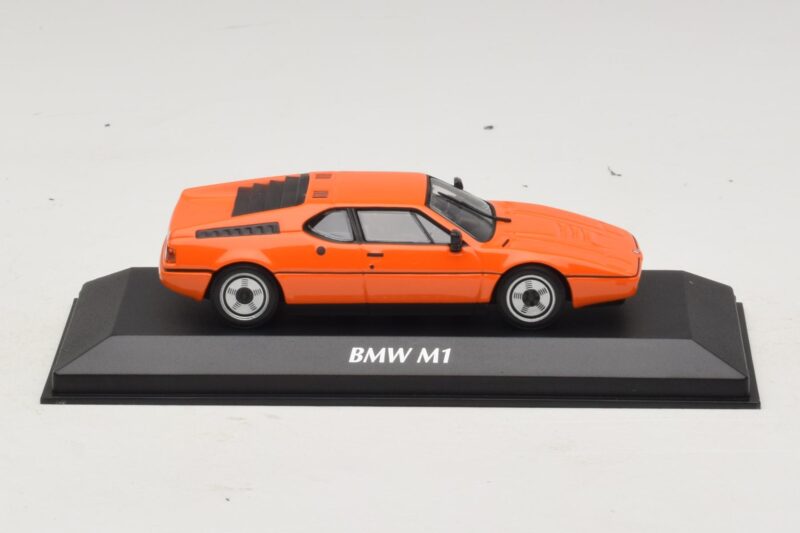
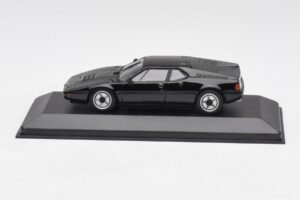
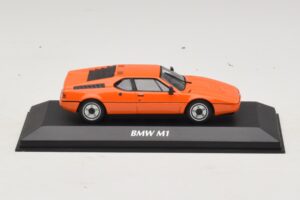
TL;DR: Maxichamps' 1:43 BMW M1 reproduces the 1979 orange supercar, the Giorgetto Giugiaro-designed coupe that became BMW's first M-badged production car. Cast as a sealed one-piece diecast body, it connects directly to the road platform behind the Procar racing series, suiting BMW M or 1970s supercar collectors.
Every BMW M car traces its lineage back to one starting point, and that starting point wore Giorgetto Giugiaro's wedge-shaped bodywork rather than a saloon's four doors. The M1 launched the M badge in 1979, and Maxichamps' orange rendering captures the shape that eventually spawned an entire performance division.
Giorgetto Giugiaro's ItalDesign studio penned the M1's wedge profile, a shape built specifically around the mid-engined layout BMW needed to homologate a Group 4 and eventually Group 5 racing programme. Production proved famously difficult: Lamborghini's early involvement in assembly fell through, and BMW ultimately routed manufacturing through Baur in Germany instead, a convoluted process that limited total production numbers significantly. The M88 straight-six engine sat behind the cabin, an engineering configuration entirely new to BMW's road car range at the time, and it went on to underpin both the M1's road performance and its motorsport ambitions in equal measure.
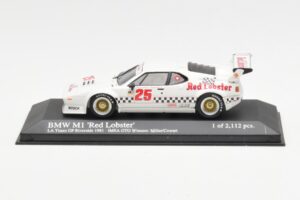
BMW's racing ambitions for the M1 eventually produced the Procar Championship, a one-make support series that put identically prepared M1s in the hands of Formula 1 drivers at Grand Prix weekends through 1979 and 1980. This particular release represents the road-going starting point of that entire story, the street car rather than any race-liveried variant, which makes it a natural companion piece to a Procar-liveried M1 for collectors tracing the full arc from homologation special to grid regular. Orange was among the period's more distinctive factory colours, and it suits the M1's angular surfacing better than a more conservative shade might.
The model is cast in zinc alloy with a sealed, one-piece body and no opening doors or engine cover, the standard construction for a subject at this scale focused on body-line accuracy over cabin detail. That approach suits the M1 particularly well, since Giugiaro's design lives or dies on crisp, unbroken surfacing along the wedge profile, and a sealed casting holds those flat panel sections and sharp waistline creases without the tolerance gaps an opening door or bonnet would introduce. The pop-up headlamp housings, a signature 1970s supercar detail, read correctly in their closed position, and the rear engine louvres behind the cabin carry genuine depth rather than a flat, printed approximation.
Orange is a distinctive enough colour that inaccuracies show immediately against reference photographs of the original factory shade, so check the tone against period M1 imagery before assuming any orange casting is automatically correct. Panel colour consistency across the bonnet, roof, and rear deck matters here more than on darker liveries, since orange tends to expose uneven paint application under direct light far more readily than black or white does. A well-matched, evenly applied orange is the clearest sign of careful finishing work on this particular subject.
This M1 belongs at the start of any BMW M-badge collection arranged chronologically, the point every subsequent M car's performance philosophy traces back to. It pairs naturally with a Procar-liveried M1 to show the road-to-race arc in a single grouping, or with later M3 and M5 generations to demonstrate how the division's early ambitions matured into a full model range. Giugiaro's design and the M1's genuinely awkward production story give this supercar more depth than its relatively brief production run might suggest at first glance. For collectors building a 1970s supercar shelf or specifically tracing BMW M's origins, this orange example offers a historically grounded, accessible entry point into a genuinely significant chapter of the marque's history.