Last one
Used
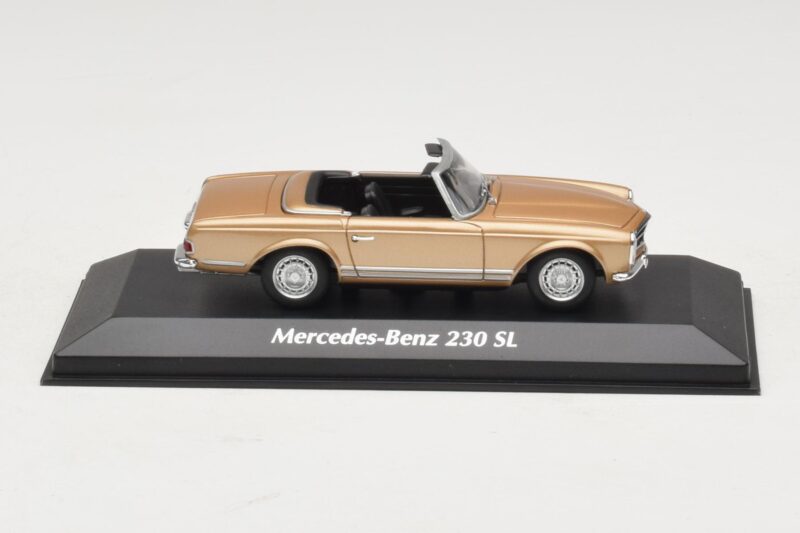
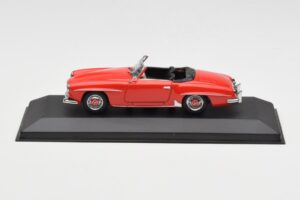
TL;DR: Maxichamps' 1:43 diecast Mercedes 230 SL wears Gold Metallic over the W113's distinctive concave hardtop, the shape that earned the car its Pagoda nickname. The sealed body holds a clean roadster silhouette, and Maxichamps' accessible pricing makes this an easy way into 1960s Mercedes collecting.
Mercedes called it the 230 SL; enthusiasts have called it the Pagoda for six decades, after a concave hardtop roofline that looked more like a temple roof than anything else on the road in 1963. It replaced the 300 SL Gullwing and Roadster as Mercedes' sports flagship, trading outright speed for the refinement the W113 became known for.
The casting is a single diecast shell, so the Pagoda's low beltline and gently curved bonnet run without a shut line breaking the silhouette. That matters on a car whose entire appeal rests on proportion rather than aggressive styling: any interruption along the bonnet or boot line would undercut the elegance the real W113 is known for. The Gold Metallic finish sits with real depth over the zinc alloy shell, catching light along the car's rounded wings in a way that suits the period colour palette Mercedes offered on the original. Chrome trim around the windscreen and bumpers is picked out cleanly against the body colour rather than left flat.
Maxichamps sits as Minichamps' value-focused line for classic subjects, built to bring older Mercedes, Porsche and BMW models into diecast at a lower price than the parent brand's premium 1:18 and 1:43 releases. That positioning shows in the build approach: a sealed one-piece body rather than an opening-door casting, which keeps tooling and assembly costs down while still holding accurate proportions and a stable, well-weighted feel in the hand. For a collector who wants a recognisable 1960s Mercedes without stretching to premium-tier pricing, this is exactly the trade the Maxichamps range is built around, and it is an honest one.
The 230 SL launched in 1963 as the first of the W113 series, taking over from the 300 SL Gullwing coupe and its roadster sibling as Mercedes' sports car flagship. Where the 300 SL had prioritised outright pace, the Pagoda leaned toward comfort and everyday usability, a shift that widened the car's appeal well beyond dedicated enthusiasts. The concave hardtop that gave the series its nickname was more than styling flourish; the shape improved visibility and structural rigidity compared with a flat roof, a detail Mercedes' engineers cared about as much as the design department did.
The Pagoda's styling is generally credited to Paul Bracq, working within Mercedes' design office through the early 1960s, and the car's clean surfacing has aged more gracefully than many of its contemporaries. Mercedes built the 230 SL through 1967 before evolving it into the 250 SL and then the 280 SL, refining mechanical detail while keeping the Pagoda roofline largely intact across the whole series. That continuity is part of why the nickname stuck to all three cars rather than just the original.
A Pagoda is one of the more approachable ways into pre-war-to-postwar Mercedes collecting precisely because Maxichamps prices it below the brand's premium-tier releases, without sacrificing the proportions that make the W113 recognisable at a glance. At 1:43, it sits comfortably alongside other 1960s European roadsters and coupes without demanding a large display footprint, and its sealed body means there is nothing to realign or loosen over years on the shelf. Placed next to a later 280 SL or a contemporary Jaguar E-Type at the same scale, it tells a coherent story about how European sports car design moved from outright performance toward refined, comfortable cruising through the decade.