{"ajaxurl":"https:\/\/models118.co.uk\/wp-admin\/admin-ajax.php?lang=en_GB","nonce":"639ff23817","homeUrl":"https:\/\/models118.co.uk\/","shopUrl":"https:\/\/models118.co.uk\/shop\/","cartUrl":"https:\/\/models118.co.uk\/cart-en-gb\/","checkoutUrl":"https:\/\/models118.co.uk\/checkout\/","skipCart":true,"collectionLimit":12,"i18n":{"addedToCart":"Added to basket","addToWishlist":"Add to wishlist","addedToWishlist":"Added to wishlist","removeFromWishlist":"Remove from wishlist","removedFromWishlist":"Removed from wishlist","undo":"Undo","error":"Something went wrong","loading":"Loading...","outOfStock":"Out of stock","viewCart":"View basket","proceedToCheckout":"Proceed to checkout","addedToCollection":"Added to your collection","reserved":"Added to your collection","soldOut":"Sold out","invalidEmail":"Please enter a valid email address","connectionError":"Connection error. Please try again.","tocToggle":"On this page","close":"Close","inCartTooltip":"Already in your basket \u2013 open your basket to check out","loginToSave":"Sign in to save this model","waitlistNotify":"Notify me","waitlistOnList":"On the waiting list \u2713","waitlistJoined":"You're on the waiting list. We'll email you the moment this model is available again.","waitlistRemoved":"Done \u2014 you're off the waiting list for this model.","waitlistRateLimit":"Too many attempts \u2014 please try again shortly","waitlistTurnstile":"We couldn't complete the check \u2014 please try again","waitlistError":"Sorry, something went wrong. Please try again in a moment."},"wishlist":{"loggedIn":false,"loginUrl":"https:\/\/models118.co.uk\/my-account\/","addAction":"models118_wishlist_add","removeAction":"models118_wishlist_remove"},"waitlist":{"loggedIn":false,"subscribeAction":"models118_waitlist_subscribe","toggleAction":"models118_waitlist_toggle","stateAction":"models118_waitlist_state"},"stats":{"models":2665,"brands":215,"manufacturers":129,"collectors":10000},"product":{"id":1701307,"sku":"940113601","condition":"new","availability":"in_stock","name":"Alpine A110 Yellow Maxichamps 1:43","brand":"Alpine","manufacturer":"Maxichamps","scale":"1:43","material":"Diecast","price":58,"regularPrice":58,"isOnSale":false,"savingsAmount":0,"stockQty":2,"stockStatus":"very_low","isDiscontinued":false,"image":"https:\/\/models118.co.uk\/wp-content\/uploads\/2026\/10\/alpine-a110-yellow-maxichamps-1-43-940113601-1-1-300x200.jpg","permalink":"https:\/\/models118.co.uk\/alpine-a110-yellow-maxichamps-1-43-940113601\/"}}
Cookies on Models118
We use cookies to remember your preferences, understand how the shop is used and show you models and offers that suit your interests. What you allow is up to you, and you can change it at any time.
Always active
The technical storage or access is strictly necessary for the legitimate purpose of enabling the use of a specific service explicitly requested by the subscriber or user, or for the sole purpose of carrying out the transmission of a communication over an electronic communications network.
The technical storage or access is necessary for the legitimate purpose of storing preferences that are not requested by the subscriber or user.
The technical storage or access that is used exclusively for statistical purposes.
The technical storage or access is required to create user profiles to send advertising, or to track the user on a website or across several websites for similar marketing purposes.
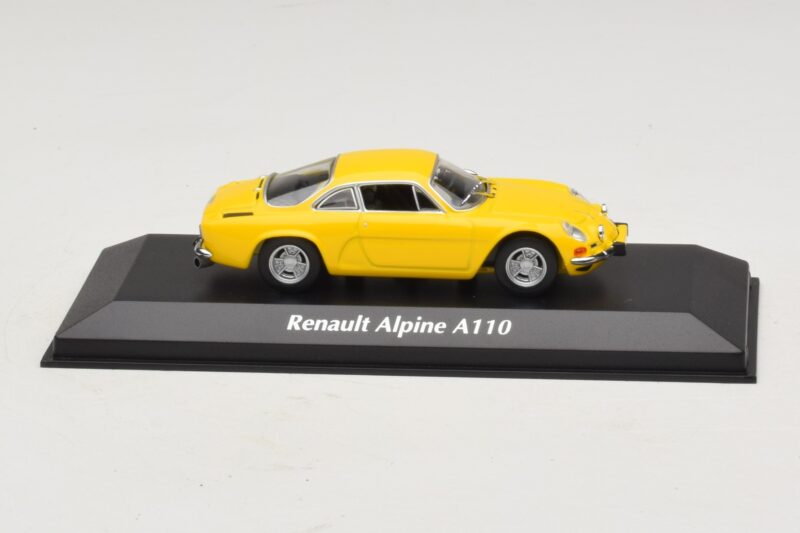
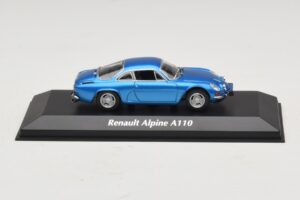
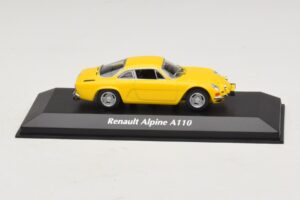
Maxichamps' 1:43 diecast Alpine A110 in yellow reproduces the 1971 French rear-engined coupe as a sealed one-piece casting. Nothing opens, so the appeal is the rounded body, the bright paint and the compact stance of a small car with a large rally reputation. A natural first Alpine for 1970s sports car shelves, and easy to pair with the later A310.
TL;DR: The Maxichamps Alpine A110 Yellow is a 1:43 diecast replica of the 1971 French rear-engined coupe. Its sealed one-piece body puts the interest on the compact, rounded profile and the bright yellow finish. A road-car model with a rally reputation behind it, it suits collectors of small 1970s sports cars.
Few small sports cars carry a reputation as large as the Alpine A110's. Built at Dieppe with a glass-fibre body and its engine behind the rear axle, it grew from a road car into a rally winner. This Maxichamps Alpine A110 in 1:43 shows the road-going side of that story, finished in yellow, a colour that makes the rounded body read even smaller and sharper.
Maxichamps Alpine A110 1:43 Judged from the Outside
Curves Without a Single Crease
The A110 is a car of soft, continuous curves: a low nose, a bulging cabin and a short tail that tapers away. Those compound surfaces are hard to reproduce at small scale, and a sealed one-piece casting gives the manufacturer the freedom to model them without hinge lines breaking the flow. Here the body is exactly that, with nothing opening, so the shut lines are fine engraved grooves rather than joints. Tilt it under a lamp and watch how the highlight travels from bonnet to roof to tail. On a good casting it moves smoothly. A flat spot or a kink tells you the tooling is soft, and it is the quickest test a collector can make.
Yellow Paint and the Small Printed Details
Yellow is forgiving about dust but unforgiving about coverage; thin paint over a darker casting shows as a faint greenish cast along the edges. Check the leading edges and the lower flanks, where a hard metal shell tends to hold an even, glossy coat. Then look to the lights, grille and badge, which at 1:43 are only a few millimetres across and are normally printed or applied rather than separately moulded. Crisp edges and correct placement signal careful finishing. Wheels deserve a glance too: their spoke pattern and how far they sit within the arches define the stance as much as the body does.
The Road Car Behind the Rally Reputation
Dieppe, Glass-Fibre and Renault Mechanicals
Alpine was a small French manufacturer based in Dieppe, and the A110 combined a glass-fibre body with mechanical parts drawn from Renault's road cars, mounted at the rear. That recipe kept the car light and affordable to build, and it gave the A110 agile handling on twisty roads. The road versions were genuine small sports cars rather than detuned specials, which is worth remembering when you place this yellow model beside its competition siblings. That the yellow car carries no number boards or lamp pods makes the body shape unusually easy to study.
From Monte Carlo 1971 to the 1973 Title
Alpine took the 1971 Monte Carlo Rally, and in 1973 the marque won the first World Rally Championship for manufacturers. Those results gave the little coupe its fame far beyond Dieppe, and they are why a road-car A110 still draws attention in a cabinet. The model here does not carry a rally livery, so treat the history as context rather than a feature of the casting. Painted yellow, it also suits the period palette of early-seventies road cars, when bright colours were far from unusual.
Starting an Alpine Line-Up at 1:43
At 1:43 the A110 is only a few centimetres long, so a handful of Alpines costs very little shelf space. Start here if you want the marque's most recognisable shape, then add the later A310 to show how the range changed. Keep the yellow out of strong sunlight, which can dull the finish over the years, and use a lidded case to protect the gloss from dust. Handle the casting by its base. Diecast is robust, but fine printed details wear with repeated fingerprints. Weigh the sealed body honestly: you give up an interior view, and you gain tidy lines and a model that tolerates being picked up. For collectors who like small cars with big histories, buying the A110 is an easy decision.
Create a free account and claim 5% off your first order — from hundreds of collectible 1:18, 1:43 and 1:12 models by Porsche, Mercedes-Benz, BMW and more.