{"ajaxurl":"https:\/\/models118.co.uk\/wp-admin\/admin-ajax.php?lang=en_GB","nonce":"d590ce0ccb","homeUrl":"https:\/\/models118.co.uk\/","shopUrl":"https:\/\/models118.co.uk\/shop\/","cartUrl":"https:\/\/models118.co.uk\/cart-en-gb\/","checkoutUrl":"https:\/\/models118.co.uk\/checkout\/","skipCart":true,"collectionLimit":12,"i18n":{"addedToCart":"Added to basket","addToWishlist":"Add to wishlist","addedToWishlist":"Added to wishlist","removeFromWishlist":"Remove from wishlist","removedFromWishlist":"Removed from wishlist","undo":"Undo","error":"Something went wrong","loading":"Loading...","outOfStock":"Out of stock","viewCart":"View basket","proceedToCheckout":"Proceed to checkout","addedToCollection":"Added to your collection","reserved":"Reserved!","soldOut":"Sold out","invalidEmail":"Please enter a valid email address","connectionError":"Connection error. Please try again.","loginToSave":"Sign in to save this model","waitlistNotify":"Notify me","waitlistOnList":"On the waiting list \u2713","waitlistJoined":"You're on the waiting list. We'll email you the moment this model is available again.","waitlistRemoved":"Done \u2014 you're off the waiting list for this model.","waitlistRateLimit":"Too many attempts \u2014 please try again shortly","waitlistTurnstile":"We couldn't complete the check \u2014 please try again","waitlistError":"Sorry, something went wrong. Please try again in a moment."},"wishlist":{"loggedIn":false,"loginUrl":"https:\/\/models118.co.uk\/my-account\/","addAction":"models118_wishlist_add","removeAction":"models118_wishlist_remove"},"waitlist":{"loggedIn":false,"subscribeAction":"models118_waitlist_subscribe","toggleAction":"models118_waitlist_toggle","stateAction":"models118_waitlist_state"},"stats":{"models":2159,"brands":206,"manufacturers":127,"collectors":10000},"product":{"id":490180,"sku":"08905SR","condition":"new","availability":"out_of_stock","name":"Rolls-Royce Phantom VI Silver Red Kyosho 1:18","brand":"Rolls-Royce","manufacturer":"Kyosho","scale":"1:18","material":"Diecast","price":193.33,"regularPrice":193.33,"isOnSale":false,"savingsAmount":0,"stockQty":0,"stockStatus":"out_of_stock","isDiscontinued":true,"image":"https:\/\/models118.co.uk\/wp-content\/uploads\/2026\/06\/rolls-royce-phantom-vi-silver-red-kyosho-1-18-300x200.jpg","permalink":"https:\/\/models118.co.uk\/rolls-royce-phantom-vi-silver-red-kyosho-1-18-08905sr\/"}}
Cookies on Models118
We use cookies to remember your preferences, understand how the shop is used and show you models and offers that suit your interests. What you allow is up to you, and you can change it at any time.
Always active
The technical storage or access is strictly necessary for the legitimate purpose of enabling the use of a specific service explicitly requested by the subscriber or user, or for the sole purpose of carrying out the transmission of a communication over an electronic communications network.
The technical storage or access is necessary for the legitimate purpose of storing preferences that are not requested by the subscriber or user.
The technical storage or access that is used exclusively for statistical purposes.
The technical storage or access is required to create user profiles to send advertising, or to track the user on a website or across several websites for similar marketing purposes.
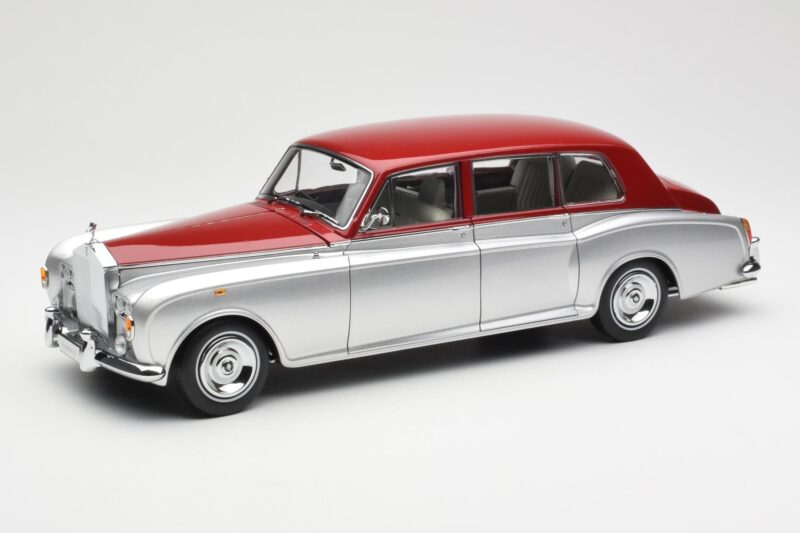
Kyosho's 1:18 diecast Rolls-Royce Phantom VI recreates the 1968 state limousine in a silver-over-red two-tone finish, a warmer alternative to the black liveries most surviving cars wear. Zinc alloy construction gives the long-wheelbase body genuine heft, with the division glass and coachbuilt proportions from Mulliner Park Ward carried through into the casting. Built on the last separate chassis Rolls-Royce ever used, the Phantom VI anchors a ceremonial or ultra-luxury sedan display with a presence smaller models simply cannot match.
About the Rolls-Royce Phantom VI Silver Red Kyosho 1:18
TL;DR: Kyosho's 1:18 diecast Rolls-Royce Phantom VI reproduces the 1968 state limousine in a silver-over-red two-tone finish, with zinc alloy construction giving the long-wheelbase body real presence on a shelf. Built on the last separate chassis Rolls-Royce ever used, the Phantom VI remains a distinctive anchor for a luxury sedan collection.
Few cars carry the word "state" as naturally as the Phantom VI, built to carry monarchs and presidents rather than turn heads on the high street. Kyosho's silver-over-red take on that formality gives it a warmer presence than the black liveries most Phantom VIs actually wore.
Kyosho's Diecast Rendering of a Coachbuilt Phantom VI
Zinc Alloy Weight for a Full-Size Limousine
A Phantom VI in 1:18 is a big diecast piece by any measure, since the real car's limousine proportions scale up to one of the longer models in a collection. Zinc alloy construction gives it the density to feel substantial rather than toy-like, with the extended wheelbase and upright glasshouse reproduced without the compromises a smaller-scale casting would need. Shut lines along the long doors stay consistent, and the division glass behind the front seats, a genuine Phantom VI feature separating chauffeur from passengers, is picked out rather than glossed over.
Silver Over Red: A Two-Tone State Car Look
Most surviving Phantom VIs were finished in sober black or dark liveries suited to formal duty, so a silver-over-red two-tone stands out immediately on a shelf of period luxury cars. The paint break between the two colours sits along the waistline where the coachbuilder would have applied a coachline, and the finish holds an even gloss across both tones rather than one looking flatter than the other, a detail that separates a careful two-tone job from a rushed one.
The Last Rolls-Royce Built on a Separate Chassis
Mulliner Park Ward Coachwork and Royal Use
The Phantom VI was coachbuilt by Mulliner Park Ward on a traditional separate chassis, a construction method Rolls-Royce abandoned everywhere else in its range by the late 1960s in favour of unitary bodies. That old-fashioned approach was deliberate: state and ceremonial customers wanted a car built the way limousines had always been built, heavy, formal, and finished to order. Several examples went to royal households and heads of state, part of why the model rewards a two-tone finish that photographs as ceremonial rather than merely expensive.
A Production Run Measured in Decades, Not Years
Rolls-Royce kept the Phantom VI in production for more than two decades, an unusually long run for a car built almost entirely to individual order rather than volume manufacture. Each example differed slightly depending on the customer's specification, which is part of the appeal for collectors researching a specific chassis. That bespoke, made-to-order history is exactly the kind of provenance detail British collectors tend to dig into before buying a model of a car this exclusive.
Fitting a Full-Size Sedan Into a 1:18 Display
At full-size limousine proportions, this Phantom VI needs more shelf depth than a typical 1:18 sports car, closer to 28 or 29 centimetres given the real car's extended wheelbase. It sits best on its own rather than crowded next to smaller saloons, where its scale advantage gets lost. Diecast construction at this size means opening doors and bonnet are realistic to expect, though the finer coachbuilt details, like the division glass mechanism, are represented rather than functional.
A silver-over-red Phantom VI works particularly well alongside other 1960s luxury sedans or ceremonial vehicles, forming a small display built around formality rather than speed. Keep it out of direct sun given the long, flat panels most likely to show fading first, and judge the model's fidelity by checking the grille detailing and the proportions of the passenger compartment glass against period photographs of the real car, two areas where cheaper castings often simplify.
Create a free account and claim 10% off your first order — from hundreds of collectible 1:18, 1:43 and 1:12 models by Porsche, Mercedes-Benz, BMW and more.
{"id":490180,"name":"Rolls-Royce Phantom VI Silver Red Kyosho 1:18","price":"£<\/span>193.33<\/bdi><\/span>","image":"https:\/\/models118.co.uk\/wp-content\/uploads\/2026\/06\/rolls-royce-phantom-vi-silver-red-kyosho-1-18-400x400.jpg","permalink":"https:\/\/models118.co.uk\/rolls-royce-phantom-vi-silver-red-kyosho-1-18-08905sr\/","brand":"Rolls-Royce"}