Last one
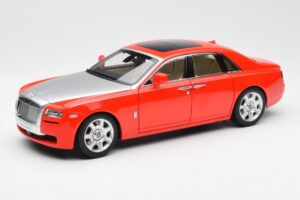
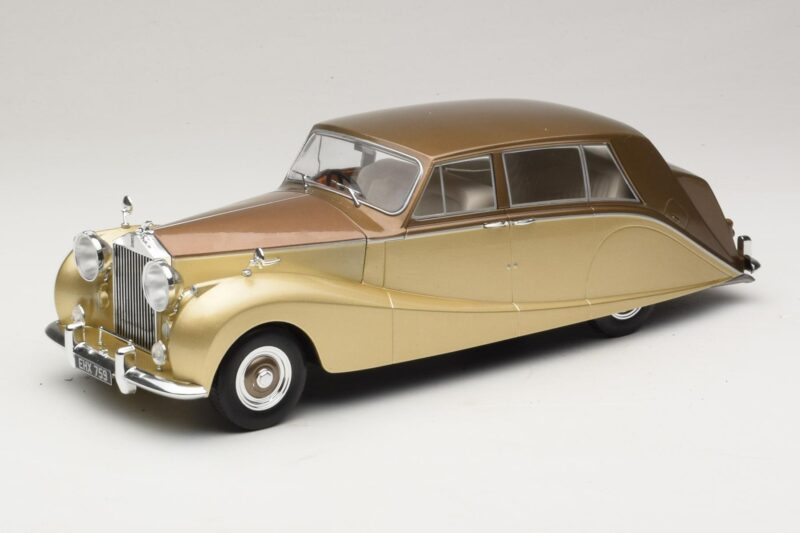
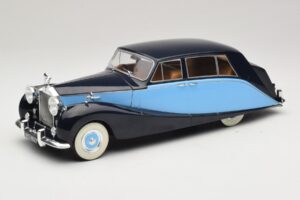
TL;DR: MCG's 1:18 diecast Rolls-Royce Silver Wraith reproduces Hooper's 1956 Empress-line coachwork in a brown and gold two-tone finish. Cast as a sealed body with no opening doors or bonnet, it captures the formal proportions of a bespoke 1950s coachbuilt saloon.
Rolls-Royce sold the Silver Wraith as a bare chassis, leaving buyers to commission a coachbuilder for the body itself, and Hooper's Empress line was among the most sought-after results of that arrangement. This 1:18 diecast reproduces a 1956 example finished in brown and gold, a formal two-tone treatment typical of the era's most prestigious commissions.
Rolls-Royce's prewar and postwar business model rested on selling a rolling chassis and engine, leaving the bodywork to independent coachbuilders chosen by the customer. Hooper, one of Britain's oldest and most respected coachbuilding houses, built a reputation for restrained, formal designs that suited Rolls-Royce's clientele particularly well, and the Silver Wraith, produced from the mid-1940s into the late 1950s, gave the firm a long-running chassis to refine its ideas against across more than a decade. Very few of these coachbuilders survived the shift to unitary construction that reshaped the industry through the following decade, which makes surviving Hooper-bodied cars from this period particularly valued among collectors.
Hooper's Empress-line bodies moved away from the sharper, more angular coachwork common earlier in the decade, favouring a longer, more flowing roofline and a gently sloped rear that gave the car a more contemporary silhouette without abandoning the formality customers expected. On a chassis as long as the Silver Wraith's, that flowing treatment had room to work properly, producing proportions that read as distinctly of their era. That silhouette is the detail worth studying first on any scale reproduction, since it is where a faithful casting and a merely adequate one diverge most visibly.
MCG casts this Silver Wraith as a single sealed body, with no door, bonnet or boot built to open. On a formal saloon defined by its long, unbroken flanks, that construction works in the subject's favour: there is no hinge gap to interrupt the sweep of a wing or the line of a sill, and the roofline runs as one continuous curve exactly as Hooper's coachbuilders intended it to look from the kerb. That precision matters more on a subject this formal than it would on a sports car, where a visible seam can be forgiven far more easily.
The brown and gold combination sits at the more formal end of period two-tone treatments, a pairing that would have signalled status rather than sportiness to anyone who saw the car parked outside a period hotel or embassy. Diecast construction gives that finish real depth under direct light, since the paint sits on a hard metal shell rather than a lighter, more porous surface, and the model's weight in the hand reinforces the sense of a substantial, formally proportioned car. Getting a two-tone split right at this scale is harder than a single colour, since the waistline crease has to align precisely on both sides of the body for the effect to read correctly.
A car built on the Silver Wraith's long-wheelbase chassis occupies real shelf space at 1:18, likely closer to 27 or 28 centimetres given the proportions of the original, and that length is worth planning for before committing a cabinet slot to it. Formal saloons like this one reward being displayed at eye level rather than from above, since much of their character sits in the relationship between the long bonnet, the upright grille and the flowing Empress roofline, a relationship that a downward view tends to flatten. Direct lighting from the side, rather than straight overhead, brings out the depth of a two-tone finish far more effectively, since it lets the waistline crease catch a highlight rather than disappearing into flat, even light. Collectors assembling a British luxury theme will find the Silver Wraith an obvious anchor piece, representing an era when a Rolls-Royce customer chose a coachbuilder the way a modern buyer might choose an options list.
This Silver Wraith sits naturally at the formal end of a British classics shelf, a counterpoint to the sportier coupes and roadsters that tend to dominate most collections. Because the body is sealed, care is straightforward: no hinges to check, no interior trim to protect from handling, just a finish that holds its two-tone paintwork indefinitely under normal display conditions. Collectors drawn to the coachbuilding story behind this car may also want to consider MCG's black and dark blue Empress finish, since seeing two genuine period colour schemes on the same chassis side by side says more about Hooper's range than either car could alone. For a collection organised around prestige marques or postwar British engineering, a bespoke coachbuilt Rolls-Royce like this one earns its place as a reference point rather than a passing addition.