{"ajaxurl":"https:\/\/models118.co.uk\/wp-admin\/admin-ajax.php?lang=en_GB","nonce":"8688bd9d48","homeUrl":"https:\/\/models118.co.uk\/","shopUrl":"https:\/\/models118.co.uk\/shop\/","cartUrl":"https:\/\/models118.co.uk\/cart-en-gb\/","checkoutUrl":"https:\/\/models118.co.uk\/checkout\/","skipCart":true,"collectionLimit":12,"i18n":{"addedToCart":"Added to basket","addToWishlist":"Add to wishlist","addedToWishlist":"Added to wishlist","removeFromWishlist":"Remove from wishlist","removedFromWishlist":"Removed from wishlist","undo":"Undo","error":"Something went wrong","loading":"Loading...","outOfStock":"Out of stock","viewCart":"View basket","proceedToCheckout":"Proceed to checkout","addedToCollection":"Added to your collection","reserved":"Added to your collection","soldOut":"Sold out","invalidEmail":"Please enter a valid email address","connectionError":"Connection error. Please try again.","tocToggle":"On this page","close":"Close","inCartTooltip":"Already in your basket \u2013 open your basket to check out","loginToSave":"Sign in to save this model","waitlistNotify":"Notify me","waitlistOnList":"On the waiting list \u2713","waitlistJoined":"You're on the waiting list. We'll email you the moment this model is available again.","waitlistRemoved":"Done \u2014 you're off the waiting list for this model.","waitlistRateLimit":"Too many attempts \u2014 please try again shortly","waitlistTurnstile":"We couldn't complete the check \u2014 please try again","waitlistError":"Sorry, something went wrong. Please try again in a moment."},"wishlist":{"loggedIn":false,"loginUrl":"https:\/\/models118.co.uk\/my-account\/","addAction":"models118_wishlist_add","removeAction":"models118_wishlist_remove"},"waitlist":{"loggedIn":false,"subscribeAction":"models118_waitlist_subscribe","toggleAction":"models118_waitlist_toggle","stateAction":"models118_waitlist_state"},"stats":{"models":2418,"brands":213,"manufacturers":128,"collectors":10000},"product":{"id":1657308,"sku":"5011407615","condition":"used","availability":"out_of_stock","name":"Audi Q7 4M Argus Brown Minichamps 1:18","brand":"Audi","manufacturer":"Minichamps","scale":"1:18","material":"Diecast","price":145,"regularPrice":145,"isOnSale":false,"savingsAmount":0,"stockQty":0,"stockStatus":"out_of_stock","isDiscontinued":true,"image":"https:\/\/models118.co.uk\/wp-content\/uploads\/2026\/08\/audi-q7-4m-argus-brown-minichamps-1-18-5011407615-1-1-300x200.jpg","permalink":"https:\/\/models118.co.uk\/audi-q7-4m-argus-brown-minichamps-1-18-5011407615\/"}}
Cookies on Models118
We use cookies to remember your preferences, understand how the shop is used and show you models and offers that suit your interests. What you allow is up to you, and you can change it at any time.
Always active
The technical storage or access is strictly necessary for the legitimate purpose of enabling the use of a specific service explicitly requested by the subscriber or user, or for the sole purpose of carrying out the transmission of a communication over an electronic communications network.
The technical storage or access is necessary for the legitimate purpose of storing preferences that are not requested by the subscriber or user.
The technical storage or access that is used exclusively for statistical purposes.
The technical storage or access is required to create user profiles to send advertising, or to track the user on a website or across several websites for similar marketing purposes.
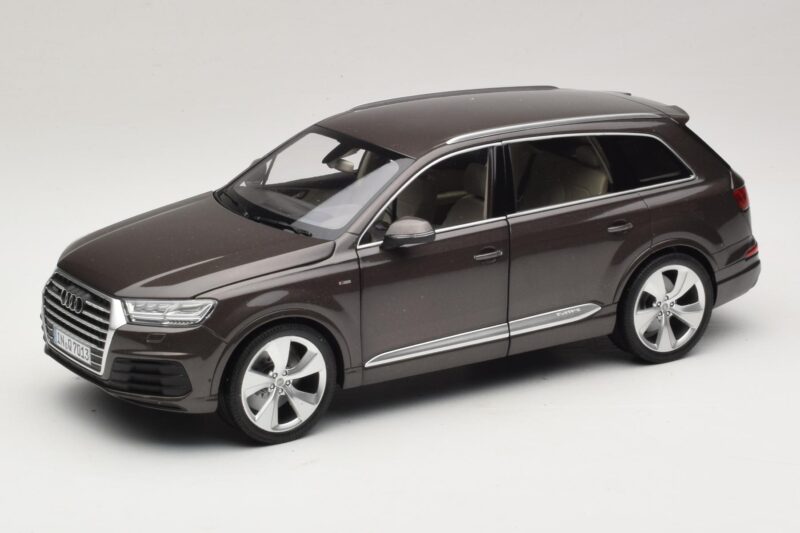
Minichamps' 1:18 diecast Audi Q7 4M reproduces the second-generation luxury SUV in Argus Brown, its aluminium-intensive platform shared with the Porsche Cayenne and Bentley Bentayga. The zinc alloy body includes opening panels, with the imposing single-frame grille and full-size seven-seat proportions kept correct at scale. A significant modern addition for any complete Audi range, filling a gap most vintage-focused collections never address.
TL;DR: Minichamps' 1:18 diecast reproduces the second-generation Audi Q7 4M in Argus Brown, the luxury SUV that shed significant weight over its predecessor through extensive aluminium construction. The zinc alloy body includes opening panels, and captures the Q7's imposing single-frame grille and full-size seven-seat proportions.
Audi's second-generation Q7 arrived in 2015 with a genuinely different engineering priority from its predecessor: shedding weight rather than simply adding equipment. That aluminium-intensive construction let the 4M generation feel noticeably more agile than the first Q7 ever managed, despite retaining the same full-size, seven-seat luxury SUV positioning that made the original such a commercial success.
The 4M Generation Q7 and Audi's Weight-Saving Redesign
Aluminium Construction and a Lighter Second Generation
The original Q7, launched in 2005, established Audi as a genuine player in the full-size luxury SUV segment previously dominated by traditional off-roaders and American models, but its considerable weight blunted handling and fuel economy in ways buyers increasingly noticed as the segment matured. The 4M generation addressed that criticism directly, using an aluminium-intensive platform shared with the Porsche Cayenne and Bentley Bentayga to cut a substantial amount of mass compared with its predecessor. That shared platform strategy, spreading development costs across the Volkswagen Group's most prestigious brands, is part of why the second-generation Q7 could afford such extensive use of lightweight materials at a price still accessible to Audi's own customer base.
Luxury SUV Proportions and the Single-Frame Grille
Audi's single-frame grille had grown steadily larger across every model line through the 2010s, and the Q7 wore one of the most imposing versions of it, a genuinely commanding front end that signalled flagship status within the range at a glance. Full-size seven-seat capacity remained central to the Q7's appeal even after the weight-saving redesign, and the proportions Minichamps reproduces reflect that: a long wheelbase, a tall greenhouse to accommodate three rows, and a wide track that fills a driveway in a way the smaller Q5 never quite manages. Getting that scale correct at 1:18 matters, since the Q7's size is a core part of its market positioning.
Minichamps' Detail Standard Applied to a Modern SUV
Zinc Construction and Opening Panels
Modern SUVs present a different casting challenge from a sports car or saloon: flatter surfaces and larger, simpler panels leave less room to hide any inconsistency in paint or fit, since there are fewer curves to distract the eye. Minichamps' zinc alloy construction gives the Q7 real heft that suits its full-size subject matter, and the body opens on a hinge solid enough to handle the model's own substantial mass without sagging. That mechanical solidity matters more on a large-scale SUV casting than it might on a smaller sports car, simply because there is more model to support.
Argus Brown Finish Over Imposing Bodywork
Argus Brown is a distinctive choice against the black, white and silver that dominate most SUV diecast catalogues, and it suits the Q7's imposing bodywork with a warmth that a more clinical metallic would not achieve. Minichamps picks out the single-frame grille's chrome surround and the roof rails against the brown body, details a buyer checking fidelity should look for first, since a poorly researched SUV reproduction often gets the grille proportions wrong even when the overall shape is close. Under directed light the brown shows genuine metallic depth rather than a flat single tone.
Modern Luxury SUVs as a Growing Collecting Category
Luxury SUVs have historically received less attention from diecast manufacturers than sports cars or saloons, a gap that reflected the segment's own relatively recent rise to commercial dominance rather than any lack of engineering interest in the vehicles themselves. That has shifted noticeably over the past decade, as manufacturers like Minichamps recognised that buyers who own a Q7, a Cayenne or a Range Rover in real life increasingly want a scale version to match, particularly at the flagship end of each maker's range. The Q7's shared aluminium platform with the Cayenne and Bentayga gives a collector an interesting opportunity to display genuinely related engineering across three different badges, something rarely possible with more traditional sports car subjects built on bespoke architecture. For anyone assembling a modern luxury vehicle theme rather than a purely performance-focused shelf, the Q7 supplies a genuinely significant and commercially important subject that older diecast catalogues, built when SUVs were a niche rather than the mainstream, simply never covered. That absence in older catalogues makes a well-detailed modern SUV reproduction like this one genuinely useful for filling a gap most vintage-focused collections cannot address at all.
Positioning the Q7 in a Modern Collection
This Q7 suits a collector tracking Audi's modern range comprehensively rather than focusing solely on performance models like the RS6 or R8. At roughly 27 centimetres in 1:18, it is one of the larger models a standard cabinet will accommodate, and its height demands slightly more vertical shelf clearance than a saloon or estate of the same scale. The zinc body's substantial weight matches its full-size subject appropriately, and Argus Brown keeps it distinct from the more commonly reproduced black and white Q7 liveries. It is not the piece that draws the most immediate attention on a shelf, but it is the one that completes the story of what Audi actually built and sold during this decade.
Create a free account and claim 10% off your first order — from hundreds of collectible 1:18, 1:43 and 1:12 models by Porsche, Mercedes-Benz, BMW and more.