{"ajaxurl":"https:\/\/models118.co.uk\/wp-admin\/admin-ajax.php?lang=en_GB","nonce":"2258313ba7","homeUrl":"https:\/\/models118.co.uk\/","shopUrl":"https:\/\/models118.co.uk\/shop\/","cartUrl":"https:\/\/models118.co.uk\/cart-en-gb\/","checkoutUrl":"https:\/\/models118.co.uk\/checkout\/","skipCart":true,"collectionLimit":12,"i18n":{"addedToCart":"Added to basket","addToWishlist":"Add to wishlist","addedToWishlist":"Added to wishlist","removeFromWishlist":"Remove from wishlist","removedFromWishlist":"Removed from wishlist","undo":"Undo","error":"Something went wrong","loading":"Loading...","outOfStock":"Out of stock","viewCart":"View basket","proceedToCheckout":"Proceed to checkout","addedToCollection":"Added to your collection","reserved":"Added to your collection","soldOut":"Sold out","invalidEmail":"Please enter a valid email address","connectionError":"Connection error. Please try again.","tocToggle":"On this page","close":"Close","inCartTooltip":"Already in your basket \u2013 open your basket to check out","loginToSave":"Sign in to save this model","waitlistNotify":"Notify me","waitlistOnList":"On the waiting list \u2713","waitlistJoined":"You're on the waiting list. We'll email you the moment this model is available again.","waitlistRemoved":"Done \u2014 you're off the waiting list for this model.","waitlistRateLimit":"Too many attempts \u2014 please try again shortly","waitlistTurnstile":"We couldn't complete the check \u2014 please try again","waitlistError":"Sorry, something went wrong. Please try again in a moment."},"wishlist":{"loggedIn":false,"loginUrl":"https:\/\/models118.co.uk\/my-account\/","addAction":"models118_wishlist_add","removeAction":"models118_wishlist_remove"},"waitlist":{"loggedIn":false,"subscribeAction":"models118_waitlist_subscribe","toggleAction":"models118_waitlist_toggle","stateAction":"models118_waitlist_state"},"stats":{"models":2269,"brands":214,"manufacturers":129,"collectors":10000},"product":{"id":1688732,"sku":"U18RDC004-B","condition":"new","availability":"in_stock","name":"Volkswagen T2 Elektrotransporter EPRI-TVA Orange IXO 1:18","brand":"Volkswagen","manufacturer":"IXO","scale":"1:18","material":"Diecast","price":50,"regularPrice":50,"isOnSale":false,"savingsAmount":0,"stockQty":6,"stockStatus":"in_stock","isDiscontinued":false,"image":"https:\/\/models118.co.uk\/wp-content\/uploads\/2026\/10\/volkswagen-t2-elektrotransporter-epri-tva-orange-ixo-1-18-u18rdc004-b-1-1-300x200.jpg","permalink":"https:\/\/models118.co.uk\/volkswagen-t2-elektrotransporter-epri-tva-orange-ixo-1-18-u18rdc004-b\/"}}
Cookies on Models118
We use cookies to remember your preferences, understand how the shop is used and show you models and offers that suit your interests. What you allow is up to you, and you can change it at any time.
Always active
The technical storage or access is strictly necessary for the legitimate purpose of enabling the use of a specific service explicitly requested by the subscriber or user, or for the sole purpose of carrying out the transmission of a communication over an electronic communications network.
The technical storage or access is necessary for the legitimate purpose of storing preferences that are not requested by the subscriber or user.
The technical storage or access that is used exclusively for statistical purposes.
The technical storage or access is required to create user profiles to send advertising, or to track the user on a website or across several websites for similar marketing purposes.
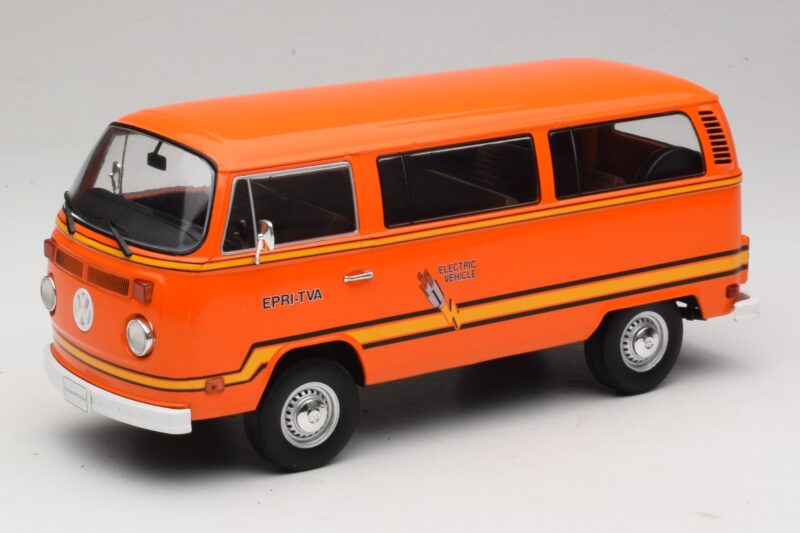
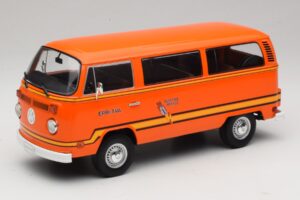
IXO's 1:18 diecast Volkswagen T2 Elektrotransporter reproduces a 1978 electric test van in orange EPRI-TVA livery, one of the period conversions trialled by American utility research bodies during the 1970s energy crisis. The sealed body carries tampo-printed graphics with crisp, unbroken lines across the flanks, and the deep orange paint holds its gloss under direct light. A genuinely uncommon commercial-vehicle subject for collectors who have moved past standard liveries.
About the Volkswagen T2 Elektrotransporter EPRI-TVA Orange IXO 1:18
TL;DR: IXO's 1:18 diecast Volkswagen T2 Elektrotransporter reproduces a 1978 electric test van in the orange EPRI-TVA livery, one of the period conversions trialled by American utility research bodies. The body is a sealed one-piece casting with crisp panel lines and deep orange paint, a niche entry for 1970s commercial-vehicle collectors.
Before electric vans became a mainstream pursuit, oil-crisis-era America ran small fleets of converted VW Transporters through utility research programmes. This T2 wears the result: a factory bus reworked for battery power and liveried for the companies that tested it. IXO's rendition gives commercial-vehicle collectors a rare, honestly obscure corner of Volkswagen history to add to a shelf.
IXO's 1:18 T2 Elektrotransporter in Orange EPRI-TVA Livery
A Sealed Body Built Around Bay-Window Proportions
IXO casts this T2 in zinc alloy, and the weight is the first giveaway when it clears its packaging foam. The model reproduces the Bay Window-era Transporter, named for the curved single-pane windscreen that replaced the split screen of the earlier T1, and by 1978 the shape was a familiar sight on European and American roads alike. The body is a single sealed casting with no opening doors or tailgate, which for a commercial van this plain actually works in its favour: the slab-sided profile depends on flat, true panels rather than hinge detail, and a one-piece shell holds that flatness better than an articulated one ever could. The roofline, wheel arches and bumper line all read as one continuous surface, exactly how a real panel van presents itself kerbside.
Tampo Work and Paint Depth on the Livery
The orange base coat sits with real depth over the metal shell, holding an even gloss under direct light rather than looking chalky the way lower-tier finishes sometimes do. EPRI and TVA graphics are tampo-printed rather than applied as decals, which means the lettering sits flush with the paint and keeps its edges sharp instead of silvering at the corners over time. Because the body is sealed, the livery panels run unbroken across where a door seam would otherwise interrupt them, letting the lettering track cleanly along the flank. Wheels and trim pick up a contrasting dark finish against the orange, keeping the commercial-fleet read intact rather than dressing the van up as something sportier than it is.
Electric Vans Before Electric Vans Were Normal
VW's Late-1970s Electric Transporter Programme
The 1970s oil shocks pushed manufacturers and utility companies to take battery power seriously long before it became a mainstream pursuit. Volkswagen was among the firms experimenting with electric conversions of its existing commercial range, swapping the T2's combustion drivetrain for batteries and an electric motor aimed at short-haul fleet duty rather than private ownership. These were working test vehicles, not showroom products, built in small numbers and handed to organisations willing to run them on real routes and report back. A liveried example like this one speaks to that trial period more than to any production run most collectors will recognise.
EPRI, TVA, and the Oil-Crisis Research Push
The Electric Power Research Institute and the Tennessee Valley Authority were among the American bodies with a direct stake in that research, both tied to the electricity-generation side of the equation rather than the car industry itself. Branding a test van for organisations like these signalled exactly what the vehicle was for: proving that utility-scale power could do useful work on the road, not selling a product to the public. That makes this T2 a document of a specific, short-lived research effort as much as a model of a van, and it is a genuinely uncommon angle for a 1:18 diecast to take. Few diecast ranges touch this corner of automotive history at all, which gives the subject a quiet appeal for collectors who have already covered the obvious liveries.
Where This T2 Sits on a Commercial-Vehicle Shelf
Commercial vehicles occupy a smaller corner of 1:18 collecting than sports cars or saloons, which is exactly why a van with a documented purpose stands out rather than blending in. This T2 works best alongside other period utility and fleet vehicles, where its orange livery and research-programme story give a shelf of otherwise similar vans something to talk about. At 1:18 the Transporter's boxy proportions translate into a genuinely substantial footprint, taller and longer than most passenger cars at the same scale, so it needs real shelf depth rather than a narrow gap. Buyers drawn to Volkswagen's commercial history, or to the oddities of early electric vehicle development, get more from this piece than a typical liveried van offers.
Create a free account and claim 5% off your first order — from hundreds of collectible 1:18, 1:43 and 1:12 models by Porsche, Mercedes-Benz, BMW and more.