{"ajaxurl":"https:\/\/models118.co.uk\/wp-admin\/admin-ajax.php?lang=en_GB","nonce":"8a70d40d00","homeUrl":"https:\/\/models118.co.uk\/","shopUrl":"https:\/\/models118.co.uk\/shop\/","cartUrl":"https:\/\/models118.co.uk\/cart-en-gb\/","checkoutUrl":"https:\/\/models118.co.uk\/checkout\/","skipCart":true,"collectionLimit":12,"i18n":{"addedToCart":"Added to basket","addToWishlist":"Add to wishlist","addedToWishlist":"Added to wishlist","removeFromWishlist":"Remove from wishlist","removedFromWishlist":"Removed from wishlist","undo":"Undo","error":"Something went wrong","loading":"Loading...","outOfStock":"Out of stock","viewCart":"View basket","proceedToCheckout":"Proceed to checkout","addedToCollection":"Added to your collection","reserved":"Reserved!","soldOut":"Sold out","invalidEmail":"Please enter a valid email address","connectionError":"Connection error. Please try again.","loginToSave":"Sign in to save this model","waitlistNotify":"Notify me","waitlistOnList":"On the waiting list \u2713","waitlistJoined":"You're on the waiting list. We'll email you the moment this model is available again.","waitlistRemoved":"Done \u2014 you're off the waiting list for this model.","waitlistRateLimit":"Too many attempts \u2014 please try again shortly","waitlistTurnstile":"We couldn't complete the check \u2014 please try again","waitlistError":"Sorry, something went wrong. Please try again in a moment."},"wishlist":{"loggedIn":false,"loginUrl":"https:\/\/models118.co.uk\/my-account\/","addAction":"models118_wishlist_add","removeAction":"models118_wishlist_remove"},"waitlist":{"loggedIn":false,"subscribeAction":"models118_waitlist_subscribe","toggleAction":"models118_waitlist_toggle","stateAction":"models118_waitlist_state"},"stats":{"models":2167,"brands":205,"manufacturers":127,"collectors":10000},"product":{"id":133527,"sku":"08048BK","condition":"new","name":"Shelby Cobra 427 S\/C Black Kyosho 1:18","brand":"Shelby","manufacturer":"Kyosho","scale":"1:18","material":"Diecast","price":140,"regularPrice":140,"isOnSale":false,"savingsAmount":0,"stockQty":0,"stockStatus":"out_of_stock","isDiscontinued":true,"image":"https:\/\/models118.co.uk\/wp-content\/uploads\/2026\/03\/shelby-cobra-427-s-c-black-kyosho-1-18-300x200.jpg","permalink":"https:\/\/models118.co.uk\/shelby-cobra-427-s-c-black-kyosho-1-18-08048bk\/"}}
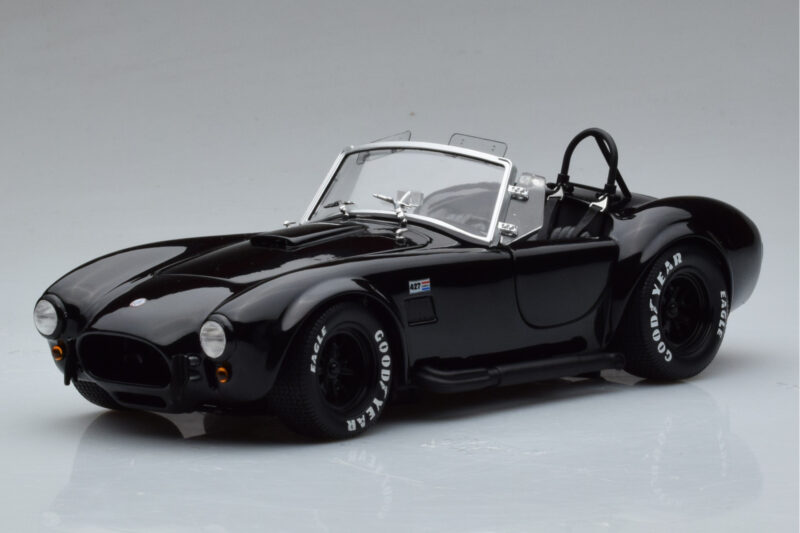
Kyosho's 1:18 diecast Shelby Cobra 427 S/C in black captures the flared arches, side exhausts, and open-top stance of Shelby's ultimate big-block roadster. Cast in zinc alloy with deep, even black paintwork and correct wire-style wheel detailing, it represents the semi-competition specification built for drivers who wanted the racing car's power without giving up road use. A compact but commanding classic American sports car for a 1960s shelf.
TL;DR: Kyosho's 1:18 diecast Shelby Cobra 427 S/C in black reproduces the flared arches, side exhausts, and open-top stance of Shelby's semi-competition roadster, cast in zinc alloy with deep gloss paintwork. A compact but physically imposing 1960s American sports car replica, distinct in presence from the smaller-engined Cobras that preceded it.
Few open-top sports cars look as purposeful stationary as a big-block Cobra. The flared arches and side exhausts on this 427 S/C signal exactly what sits under the bonnet before the model even reaches the shelf.
Kyosho's 427 S/C in Black Diecast
Flared Arches and Big-Block Proportions
The S/C, short for semi-competition, carried noticeably wider wheel arches than the standard Cobra to accommodate the wider wheels and tyres a genuinely powerful big-block V8 demanded. Kyosho's diecast reproduces that flare correctly, sitting proud of the door line rather than blended smoothly into it, and the side-exit exhausts run cleanly along the sill with realistic tube detailing rather than a moulded stub. The zinc alloy body carries real weight in the hand, appropriate for a car whose entire character was built around raw power over refinement.
Black Paintwork and Wire-Style Wheels
Black paint is unforgiving on a model, since it shows every inconsistency in surface prep far more readily than a lighter colour, and Kyosho's finish here stays even across the long bonnet and flowing rear haunches without the patchiness that turns up on lower-tier black diecast. The wire-style wheels are picked out with correct spoke detailing rather than a flat moulded disc, and the open cockpit reveals simple, correctly shaped bucket seats and a straightforward instrument panel, true to a car built for speed rather than luxury.
A Roadster Built for Power Over Comfort
Shelby's Big-Block Answer
The Cobra began life as a lightweight British roadster fitted with an American V8, and the 427 S/C represents that formula taken to its most aggressive extreme, a bigger engine, wider tyres, and bodywork reshaped to cope with both. It was built in small numbers for drivers who wanted genuine competition-derived performance without giving up the ability to drive the car on the road, a rare combination even by the standards of 1960s American sports cars.
An Open-Top Classic Among Closed Coupes
Displayed among the closed GT coupes that dominate most 1960s collections, an open-top Cobra reads differently on a shelf, its cockpit and dashboard visible from above rather than hidden behind a windscreen and roofline. That visibility rewards the interior detailing Kyosho includes here, and it gives the model a lower, more aggressive stance overall than a roofed contemporary of similar length.
Where This Cobra Sits in a 1960s Display
At roughly 21cm long, the 427 S/C takes up modest shelf space for how much visual presence it carries, the wide arches and low, long bonnet making it look larger than its footprint suggests. Kyosho's diecast build sits at a standard mid-tier finish, honest panel work and a correctly deep black paint job rather than the hand-finished detailing of investment-tier resin, which keeps a genuinely striking subject within reach for collectors building a broader American sports car theme rather than chasing a single hero piece. Paired with a period Ferrari or Jaguar coupe, it makes the transatlantic contrast in 1960s sports car philosophy immediately obvious.
Create a free account and claim 10% off your first order — from hundreds of collectible 1:18, 1:43 and 1:12 models by Porsche, Mercedes-Benz, BMW and more.
{"id":133527,"name":"Shelby Cobra 427 S\/C Black Kyosho 1:18","price":"£<\/span>140.00<\/bdi><\/span>","image":"https:\/\/models118.co.uk\/wp-content\/uploads\/2026\/03\/shelby-cobra-427-s-c-black-kyosho-1-18-400x400.jpg","permalink":"https:\/\/models118.co.uk\/shelby-cobra-427-s-c-black-kyosho-1-18-08048bk\/","brand":"Shelby"}
Cookies on Models118
We use cookies to remember your preferences, understand how the shop is used and show you models and offers that suit your interests. What you allow is up to you, and you can change it at any time.
Functional
Always active
The technical storage or access is strictly necessary for the legitimate purpose of enabling the use of a specific service explicitly requested by the subscriber or user, or for the sole purpose of carrying out the transmission of a communication over an electronic communications network.
Preferences
The technical storage or access is necessary for the legitimate purpose of storing preferences that are not requested by the subscriber or user.
Statistics
The technical storage or access that is used exclusively for statistical purposes.The technical storage or access that is used exclusively for anonymous statistical purposes. Without a subpoena, voluntary compliance on the part of your Internet Service Provider, or additional records from a third party, information stored or retrieved for this purpose alone cannot usually be used to identify you.
Marketing
The technical storage or access is required to create user profiles to send advertising, or to track the user on a website or across several websites for similar marketing purposes.
We use cookies to remember your preferences, understand how the shop is used and show you models and offers that suit your interests. What you allow is up to you, and you can change it at any time.
Functional
Always active
The technical storage or access is strictly necessary for the legitimate purpose of enabling the use of a specific service explicitly requested by the subscriber or user, or for the sole purpose of carrying out the transmission of a communication over an electronic communications network.
Preferences
The technical storage or access is necessary for the legitimate purpose of storing preferences that are not requested by the subscriber or user.
Statistics
The technical storage or access that is used exclusively for statistical purposes.The technical storage or access that is used exclusively for anonymous statistical purposes. Without a subpoena, voluntary compliance on the part of your Internet Service Provider, or additional records from a third party, information stored or retrieved for this purpose alone cannot usually be used to identify you.
Marketing
The technical storage or access is required to create user profiles to send advertising, or to track the user on a website or across several websites for similar marketing purposes.