{"ajaxurl":"https:\/\/models118.co.uk\/wp-admin\/admin-ajax.php?lang=en_GB","nonce":"d590ce0ccb","homeUrl":"https:\/\/models118.co.uk\/","shopUrl":"https:\/\/models118.co.uk\/shop\/","cartUrl":"https:\/\/models118.co.uk\/cart-en-gb\/","checkoutUrl":"https:\/\/models118.co.uk\/checkout\/","skipCart":true,"collectionLimit":12,"i18n":{"addedToCart":"Added to basket","addToWishlist":"Add to wishlist","addedToWishlist":"Added to wishlist","removeFromWishlist":"Remove from wishlist","removedFromWishlist":"Removed from wishlist","undo":"Undo","error":"Something went wrong","loading":"Loading...","outOfStock":"Out of stock","viewCart":"View basket","proceedToCheckout":"Proceed to checkout","addedToCollection":"Added to your collection","reserved":"Reserved!","soldOut":"Sold out","invalidEmail":"Please enter a valid email address","connectionError":"Connection error. Please try again.","loginToSave":"Sign in to save this model","waitlistNotify":"Notify me","waitlistOnList":"On the waiting list \u2713","waitlistJoined":"You're on the waiting list. We'll email you the moment this model is available again.","waitlistRemoved":"Done \u2014 you're off the waiting list for this model.","waitlistRateLimit":"Too many attempts \u2014 please try again shortly","waitlistTurnstile":"We couldn't complete the check \u2014 please try again","waitlistError":"Sorry, something went wrong. Please try again in a moment."},"wishlist":{"loggedIn":false,"loginUrl":"https:\/\/models118.co.uk\/my-account\/","addAction":"models118_wishlist_add","removeAction":"models118_wishlist_remove"},"waitlist":{"loggedIn":false,"subscribeAction":"models118_waitlist_subscribe","toggleAction":"models118_waitlist_toggle","stateAction":"models118_waitlist_state"},"stats":{"models":2159,"brands":206,"manufacturers":127,"collectors":10000},"product":{"id":490126,"sku":"08905RLB","condition":"new","availability":"out_of_stock","name":"Rolls-Royce Phantom VI Red Light Beige Kyosho 1:18","brand":"Rolls-Royce","manufacturer":"Kyosho","scale":"1:18","material":"Diecast","price":193.33,"regularPrice":193.33,"isOnSale":false,"savingsAmount":0,"stockQty":0,"stockStatus":"out_of_stock","isDiscontinued":true,"image":"https:\/\/models118.co.uk\/wp-content\/uploads\/2026\/06\/rolls-royce-phantom-vi-red-light-beige-kyosho-1-18-300x200.jpg","permalink":"https:\/\/models118.co.uk\/rolls-royce-phantom-vi-red-light-beige-kyosho-1-18-08905rlb\/"}}
Cookies on Models118
We use cookies to remember your preferences, understand how the shop is used and show you models and offers that suit your interests. What you allow is up to you, and you can change it at any time.
Always active
The technical storage or access is strictly necessary for the legitimate purpose of enabling the use of a specific service explicitly requested by the subscriber or user, or for the sole purpose of carrying out the transmission of a communication over an electronic communications network.
The technical storage or access is necessary for the legitimate purpose of storing preferences that are not requested by the subscriber or user.
The technical storage or access that is used exclusively for statistical purposes.
The technical storage or access is required to create user profiles to send advertising, or to track the user on a website or across several websites for similar marketing purposes.
Rolls-Royce Phantom VI Red Light Beige Kyosho 1:18
Sold out
1/8
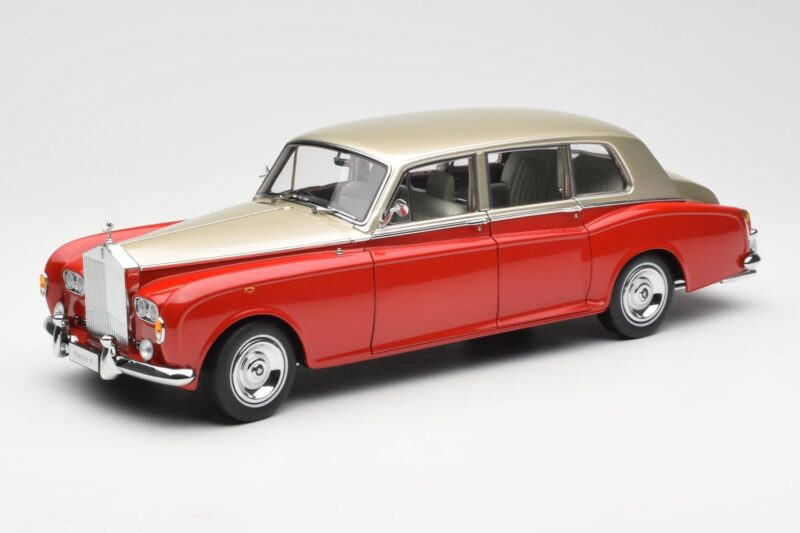
Kyosho's 1:18 diecast Rolls-Royce Phantom VI reproduces the 1968 coachbuilt state saloon in a formal red and light beige two-tone, with opening doors and a finely trimmed rear cabin. Built as Rolls-Royce's last traditional hand-finished chassis, the Phantom VI served heads of state and ceremonial duty rather than private motoring, and this diecast carries that formality through its proportions and finish. A substantial centrepiece for an ultra-luxury saloon collection.
About the Rolls-Royce Phantom VI Red Light Beige Kyosho 1:18
TL;DR: Kyosho's 1:18 diecast Rolls-Royce Phantom VI reproduces the 1968 coachbuilt state saloon in a red and light beige two-tone, with opening doors, a formal rear cabin, and correct upright proportions. Built as Rolls-Royce's last hand-finished traditional chassis, it anchors an ultra-luxury saloon display at a substantial, ceremonial scale.
No marque wears formality quite like Rolls-Royce, and no Rolls-Royce wears it more completely than the Phantom VI. Kyosho's diecast treats the coachbuilt saloon with the gravity it demands, a model built for state occasions rather than the open road.
Kyosho's Diecast Take on Mulliner Park Ward Coachwork
Two-Tone Paint and Formal Proportions
The Phantom VI's coachwork came from Mulliner Park Ward, and its upright grille, long bonnet and near-vertical rear window give it proportions unlike anything else in a 1:18 collection. Kyosho separates the red lower body from the light beige upper deck with a crisp waistline, the two-tone split landing exactly where the original coachbuilders divided the panels rather than drifting into the glass area. That kind of registration matters more on a formal saloon than on a sports car, because the whole visual effect depends on the split reading as deliberate rather than approximate. The chrome window surrounds and grille slats are picked out cleanly against both paint tones, holding their own under direct light rather than dulling into the surrounding colour.
Rear Cabin Detail and Opening Doors
All four doors open on metal hinges, revealing a rear compartment finished to suggest the deep, formal trim a Phantom VI passenger would have expected, distinct from the simpler front cabin built for the chauffeur. That distinction between front and rear trim is a detail easy to miss and worth checking for on any diecast claiming Phantom VI accuracy. The bonnet lifts to show a simplified engine bay, honest rather than exhaustive at this diecast tier, while the boot opens to a lined, formal luggage space rather than a blanked-off cavity.
Rolls-Royce's Last Traditional Chassis and State Duty
Built for Ceremony Rather Than the Open Road
Rolls-Royce introduced the Phantom VI in 1968 as the last model built on the traditional separate chassis with fully coachbuilt bodywork, produced in tiny numbers over more than two decades because its buyers were governments, heads of state and institutions rather than private owners. One Phantom VI was presented to The Queen for her Silver Jubilee in 1977, a fact that captures exactly what the model was for: representing the state rather than serving as personal transport. That ceremonial role explains the car's upright formality, its slow, dignified proportions built for standing still outside a palace as much as for moving through a city, and it is precisely that formality Kyosho's diecast is built to convey.
Positioning an Ultra-Luxury Saloon on the Shelf
Scale, Weight and Display Context
At 1:18 the Phantom VI is a genuinely large model, likely close to 30 centimetres given the real car's imposing length, and the zinc alloy diecast construction gives it real heft in the hand, distinct from the lighter resin pieces a collector might display alongside it. That size means it needs its own space on a shelf rather than being squeezed between smaller sports cars, and it reads best displayed at eye level where the two-tone paint and chrome detailing catch the light properly. Paired with other British luxury or state vehicles, it anchors a collection built around formality rather than speed, a different kind of centrepiece than a supercar but no less deserving of one.
Diecast Weight Against Resin Alternatives for Formal Saloons
What Diecast Construction Means Here
A sealed resin casting could sharpen the Phantom VI's already crisp lines further, but it would also lock the doors shut and remove the rear cabin from view, exactly the detail that gives a state saloon its story. Kyosho's diecast trades a little surface precision for that access, and the metal body's weight suits a car whose entire character was built on solid, unhurried presence rather than lightness. For a formal subject like this, the trade favours diecast: a Phantom VI that cannot open its doors loses much of what made the real car worth building in the first place.
Care and Long-Term Display
The two-tone paint benefits from indirect lighting, since direct sun accelerates fading on the lighter beige panels faster than on the red. A dust-free cabinet matters on any diecast, but especially on a model with this much flat, reflective bodywork, where dust shows readily under close inspection. Handled carefully, with support given to the door hinges rather than letting them swing freely, a diecast of this size holds its finish and its opening mechanisms well over years of display.
Create a free account and claim 10% off your first order — from hundreds of collectible 1:18, 1:43 and 1:12 models by Porsche, Mercedes-Benz, BMW and more.
{"id":490126,"name":"Rolls-Royce Phantom VI Red Light Beige Kyosho 1:18","price":"£<\/span>193.33<\/bdi><\/span>","image":"https:\/\/models118.co.uk\/wp-content\/uploads\/2026\/06\/rolls-royce-phantom-vi-red-light-beige-kyosho-1-18-400x400.jpg","permalink":"https:\/\/models118.co.uk\/rolls-royce-phantom-vi-red-light-beige-kyosho-1-18-08905rlb\/","brand":"Rolls-Royce"}