Used
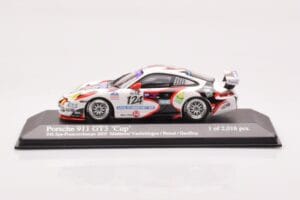
Porsche 911 997 GT3 Cup #124 Mattheus / Geoffroy / Vanbellingen / Fumal 24 Hours of Spa 2005 Minichamps 1:43
Only 3 left
Price:
£29.00
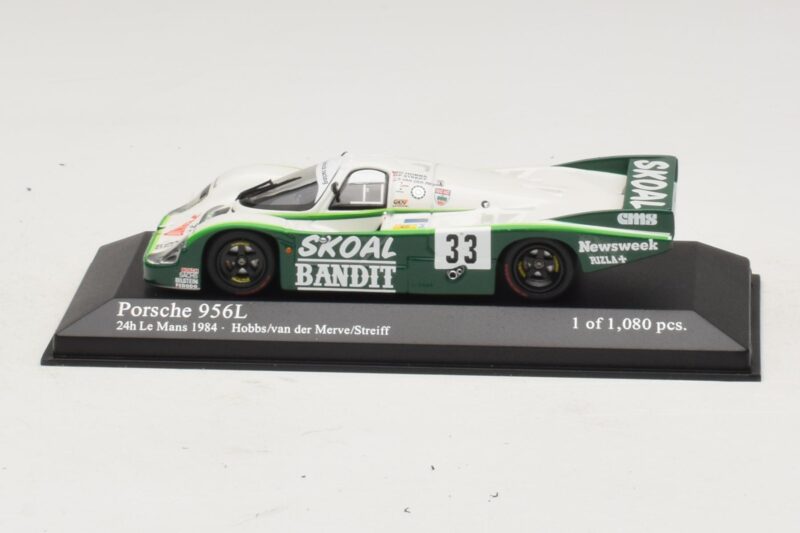
TL;DR: Minichamps' 1:43 diecast Porsche 956L reproduces car number 33, driven by David Hobbs and Philippe Streiff at the 1984 24 Hours of Le Mans. The sealed long-tail body pairs naturally with the sister Warsteiner-liveried entry from the same race, letting collectors build a two-car slice of that year's Group C grid.
British and French driving talent shared the cockpit of car number 33 at Le Mans in 1984, David Hobbs and Philippe Streiff pairing up in a long-tail 956 for one of Group C's most competitive editions. Minichamps' casting of this entry gives a UK collector a specifically British angle on a race otherwise dominated by German and French sponsor liveries.
David Hobbs built his reputation across British and American racing before becoming one of motorsport television's most recognisable commentators, and Philippe Streiff went on to a Formula One career later in the 1980s, which makes this pairing a snapshot of two drivers whose profiles grew well beyond this single Le Mans entry. Endurance racing at this level ran on multi-driver rotations through the full twenty-four hours, and a well-matched pairing mattered as much as raw pace across that distance. Minichamps' decision to model car 33 specifically, rather than a generic 956L livery, ties this casting to a documented crew and a documented race rather than an anonymous Group C subject.
Like its Warsteiner-liveried sister entry from the same race, this is the long-tail 956L configuration, built specifically for the low-drag demands of the Sarthe circuit's Mulsanne straight rather than for tighter, more technical circuits. The stretched rear bodywork is the clearest visual signal that a 956 was set up for Le Mans specifically, and Minichamps holds that elongated tail shape accurately in the tooling. Two long-tail 956s from the same race, in different sponsor liveries, is a genuinely coherent way to represent Group C's mid-1980s peak rather than owning two nearly identical cars by accident.
This entry's livery differs noticeably from the bold Warsteiner scheme carried by its sister car, giving a collector two visually distinct Group C entries from a single race rather than two versions of the same paint job. Tampo-printed graphics keep the sponsor lettering and car number crisp against the body's curved surfaces, avoiding the lifted edges an adhesive decal would eventually show. Number 33 sits in a clean roundel on the door and nose, positioned to match period photography from the 1984 race rather than a generic placement borrowed from another 956 casting.
The casting is a sealed, one-piece zinc alloy shell with no opening doors or engine cover, which suits the subject honestly: Group C prototypes used lightweight, quickly removable bodywork panels for pit stops rather than hinged access, so a fixed casting reflects genuine period practice rather than compromising for the sake of the model. That density in the hand, real weight from pressure-cast metal, is immediately obvious against any lighter resin prototype on the same shelf.
Bought alongside the Warsteiner-liveried sister car, this number 33 entry turns a single Le Mans model into the beginning of a proper Group C grid, two cars from the same race in genuinely different sponsor colours rather than a pair of near-duplicates. That kind of thematic pairing is exactly what Group C rewards: the cars were mechanically similar beneath wildly different liveries. For a UK collector with an interest in the era's British driving talent, David Hobbs' presence in the cockpit gives this particular 956L a personal hook the sister entry does not carry.
Save £14.00