Used
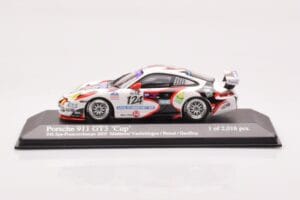
Porsche 911 997 GT3 Cup #124 Mattheus / Geoffroy / Vanbellingen / Fumal 24 Hours of Spa 2005 Minichamps 1:43
Only 3 left
Price:
£29.00
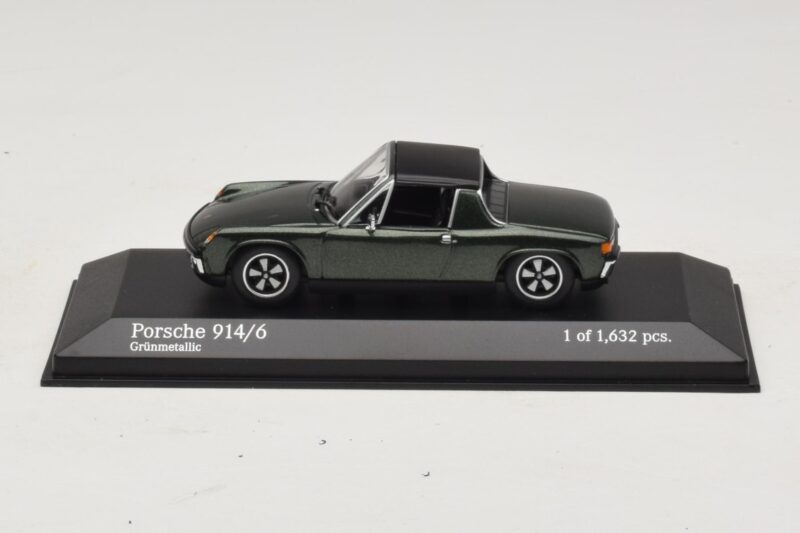
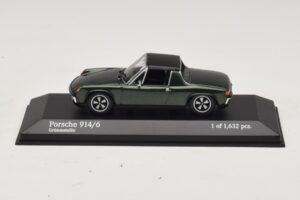
TL;DR: Minichamps' 1:43 diecast Porsche 914/6 in Green reproduces the performance variant of Porsche's 1970 VW collaboration, fitted with a flat-six engine rather than the standard 914's four-cylinder unit. The body is a sealed, one-piece casting, with the removable roof panel and 914/6-specific trim rendered as fixed exterior detail.
The 914 was a joint venture born of necessity: Volkswagen needed a successor to the Karmann Ghia, and Porsche needed an affordable entry model beneath the 911. Most 914s ran a flat-four VW engine, but the 914/6 slotted in the 911's flat-six instead, turning a shared-platform economy car into a genuine, if modest, sports car.
The real 914's removable roof panel, a flat targa-style piece that stowed in the front boot, is cast into this model as a fixed part of the roofline rather than a separate lift-out piece. That is the correct choice for a sealed body: the panel's join lines, the roof rail detailing, and the slight step where the panel meets the windscreen frame all read as surface detail, giving the roofline its distinctive flat profile without needing anything to actually lift free. Zinc alloy construction holds that flat roof panel's edges cleanly at 1:43, where a softer material would tend to round the join into an indistinct blur.
Green paint on the 914/6 sits within a period-correct palette that Porsche and Volkswagen both used across their 1970s ranges, and on this hard-shell casting it reads with a clean, even gloss rather than the slightly warmer tone resin can pick up. The 914's proportions are unusual for a Porsche of this era, low and wedge-shaped with the engine sitting behind the passenger compartment rather than at either extreme, and the casting captures that stance accurately at a footprint small enough to sit three or four Porsches deep on a single shelf tier. The shut lines around the doors and the front and rear luggage lids hold a consistent width across the body, a useful quick check for tooling quality on any sealed 1:43 casting.
Volkswagen's brief was straightforward: replace the ageing Karmann Ghia with something more modern, built to a price Porsche could also use for its own cheaper model. The result shared a platform and much of its structure, but the missions diverged at the engine bay. Standard 914s used VW's air-cooled flat-four, keeping the car affordable and mechanically simple, while the 914/6 borrowed the 911's flat-six, adding performance and cost in equal measure. Fewer 914/6s left the factory than their four-cylinder siblings, which is part of why the six-cylinder version carries more weight among Porsche specialists today.
Spotting a 914/6 apart from a standard 914 comes down to a handful of exterior cues this casting reproduces: larger brake vents at the rear, a different wheel design borrowed from contemporary 911s, and badge detailing that marks the six-cylinder specification rather than the base car. None of those details depend on opening anything, since the six-cylinder identity was never about visible engine access on the real car either, the flat-six sat under a rear deck lid like any other 914 engine. Checking those specific cues is the fastest way to confirm a 914/6 casting has been tooled correctly rather than adapted from the more common four-cylinder version.
A green 914/6 makes an interesting counterpoint on a shelf built around 911s and 356s, a reminder that Porsche's history includes a genuine mid-engine departure alongside the rear-engine cars the marque is best known for. It also pairs naturally with any 911 from the same period, since the two shared engines even if they never shared a body. The sealed casting needs no adjustment before display, and at the 1:43 diecast tier it offers an accessible way to add this less common chapter of Porsche's range without the premium that six-cylinder 914s command in the full-size collector car market. That premium, driven by scarcity relative to the four-cylinder cars, is exactly what makes the miniature version an appealing substitute for most collections.
Save £14.00