Used
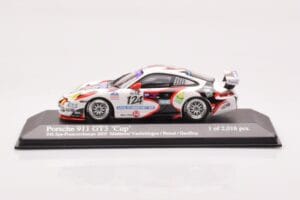
Porsche 911 997 GT3 Cup #124 Mattheus / Geoffroy / Vanbellingen / Fumal 24 Hours of Spa 2005 Minichamps 1:43
Only 3 left
Price:
£29.00
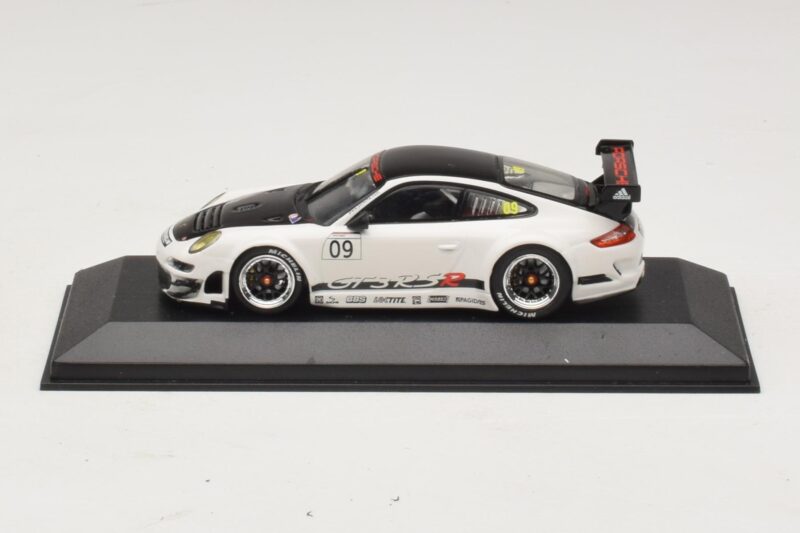
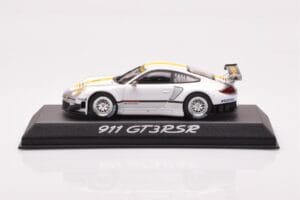
TL;DR: Minichamps' 1:43 diecast Porsche 911 997 GT3 RSR carries the #9 livery from a 2009 presentation, the factory-built endurance racer's wide-body shell reproduced as a sealed casting. Built for the FIA GT and ALMS GT2 categories rather than the road, the RSR sits apart from Porsche's road-going GT3 RS.
A presentation livery marks a car's unveiling to press and teams ahead of a season rather than a specific race weekend, and this #9 scheme belongs to that moment in 2009 rather than to a documented finishing position. The GT3 RSR is a further step beyond the road-legal GT3 RS, built by Porsche Motorsport specifically for FIA GT and American Le Mans Series GT2 competition.
Where the road-going GT3 RS shares its silhouette closely with the street car, the RSR is a purpose-built racing shell wearing a familiar shape: a wider composite body to cover a substantially wider track, a large adjustable rear wing tuned for each circuit, and a splitter and diffuser package designed entirely around aerodynamic load rather than road manners. It competed at the top of GT racing's production-based classes through the late 2000s, sharing grids with rival GT2 machinery from other manufacturers. The RSR badge signals a car built to win outright within its class, not merely to look the part.
A presentation livery exists to show off a scheme before a season begins, often photographed at a factory or team launch event rather than trackside, and #9 here should be read that way rather than assumed to carry a specific circuit or finishing result. That distinction matters for collectors who value accuracy in what a model claims: this is a documented factory livery from 2009, and describing it honestly as a presentation scheme is more useful than inventing a race history it never had. Collectors who prize that kind of precision tend to value the honesty as much as the artwork itself.
The RSR's wide-body shell, its flared arches, deep front splitter and towering rear wing, translates well to a sealed diecast casting, since every one of those elements is an exterior surface rather than an interior feature a spectator would ever see. This model reproduces the flared arches sitting proud of the standard 997 silhouette, the front splitter running the full width of the nose, and the rear wing mounted high enough to clear the deck lid, all as continuous cast detail.
The number 9 and surrounding sponsor artwork sit registered cleanly against the body colour, with no bleed where one printed element meets another, and the cup-style wheels fill the flared arches at the correct offset rather than sitting recessed. The glazing carries a tint consistent with the real car's polycarbonate windows. It is exactly the level of finish a mid-tier GT racer casting should deliver.
A presentation-liveried RSR sits well beside race-specific GT3 Cup or GT3 RS models in a themed Porsche GT collection, marking the top rung of the factory's production-based racing programme without overstating what this particular scheme represents. It works especially well paired with a road-going GT3 RS from the same generation, showing exactly how far Porsche pushed the same architecture once regulations rather than road use took over.
Save £14.00