Used

Porsche 911 997 GT3 Cup #124 Mattheus / Geoffroy / Vanbellingen / Fumal 24 Hours of Spa 2005 Minichamps 1:43
Only 3 left
Price:
£29.00
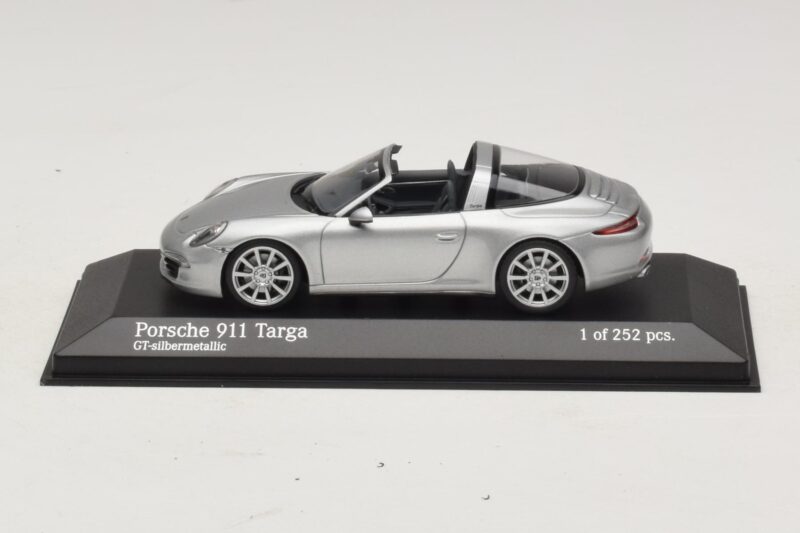
TL;DR: Minichamps' 1:43 diecast Porsche 911 991 Targa in Silver reproduces the 2013 revival of Porsche's original 1965 Targa roll-hoop styling on a modern 911. The body is a sealed, one-piece casting, with the wraparound rear glass and brushed Targa bar rendered as fixed exterior detail rather than moving hardware.
The Targa name means something specific to Porsche enthusiasts: the safety roll-hoop body style introduced in 1965 as an open-top alternative before proper convertibles were considered crashworthy. The 991-generation Targa, launched in 2013, revived that hoop as a design signature rather than a necessity, wrapping it around a wide glass hatch that gave the car its distinctive silhouette.
Minichamps casts this Targa as a single fixed shell, so the roll hoop, the fabric-look roof section, and the curved rear glass all read as cast and painted surface rather than working parts. That is the right call for a body defined almost entirely by its silhouette: the eye tracks the hoop's brushed-look band, the tapering C-pillar glass, and the way the roofline steps down into the rear deck, and none of that depends on anything opening. Zinc alloy construction gives the casting enough structural rigidity to hold that stepped roofline crisply at 1:43, where the smallest scale details, window surrounds, hoop edge lines, are the ones a soft material would round off first.
The silver finish sits on a hard metal shell, and that pairing is what gives the paint its even, slightly cool gloss under a display light, a different read from the warmer sheen resin sometimes takes on. Because the body has no hinge lines to interrupt the surface, the paint runs unbroken from the front wing to the sill, and the shut lines that do exist, around the doors and the front and rear lids, hold a consistent width rather than widening near a hinge point. At this scale that consistency is worth checking closely: it is one of the clearest, cheapest tells of a well-tooled casting.
Porsche introduced the original Targa in 1965 as a practical response to proposed American convertible safety rules that never fully materialised, giving buyers an open-air 911 with a roll-over bar built in rather than bolted on afterwards. For decades that followed, the badge drifted onto different roof treatments, including full glass-roof coupes that carried the Targa name without the hoop. The 991 generation, arriving for 2013, reversed that drift deliberately, bringing back the wide brushed bar and the wraparound rear glass as a direct visual quotation of the 1965 car, updated with a sliding fabric roof section rather than a lift-out panel.
At roughly a tenth of the real car's length, 1:43 keeps a 911 to a shelf footprint that a handful of models will share comfortably, which matters for anyone tracking a generation-by-generation Porsche display rather than building around one hero piece. It carries less surface for interior mapping than 1:18 would allow, so the strongest case for a 1:43 Targa is exterior fidelity: the hoop's proportions, the glazing line, the wheel design, rather than cabin detail. Minichamps aims the finish at that expectation, favouring a clean, accurate silhouette over interior texture a buyer would need a loupe to appreciate anyway.
A silver 991 Targa reads well as the modern bookend on a Porsche roof-style shelf, sitting alongside earlier open-top variants to show how one safety idea from 1965 kept resurfacing across five decades of 911 generations. It also works as a standalone piece for anyone who simply likes the current Targa's silhouette without needing the rest of the lineage around it. The sealed body means there is nothing to check for fit or alignment before display, no door to worry about closing evenly, just a casting to place directly on the shelf. Against pricier 1:18 alternatives, this scale trades cabin detail for footprint efficiency, a fair exchange for a buyer building breadth across Porsche's model history rather than depth on a single generation.


Save £14.00