Used
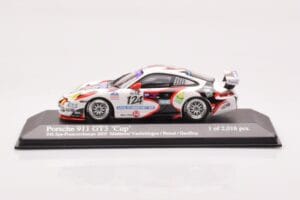
Porsche 911 997 GT3 Cup #124 Mattheus / Geoffroy / Vanbellingen / Fumal 24 Hours of Spa 2005 Minichamps 1:43
Only 3 left
Price:
£29.00
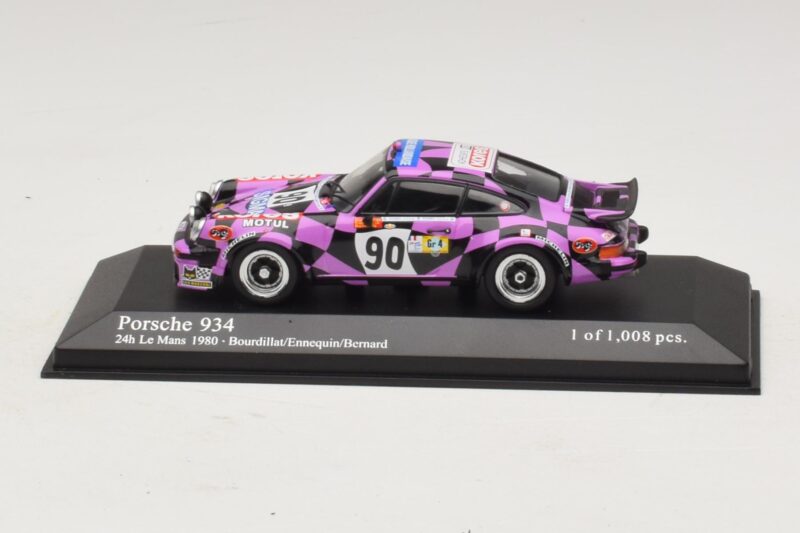
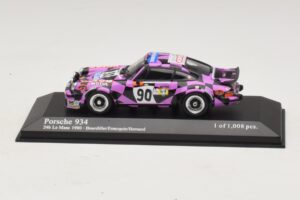
TL;DR: Minichamps' 1:43 diecast Porsche 934 reproduces car #90, driven by Bourdillat and Ennequin at the 1980 Le Mans 24 Hours, the same pairing that ran car #86 the year before. A sealed zinc alloy casting with fresh tampo-printed livery, ideal for collectors tracking one team across consecutive Le Mans campaigns.
Bourdillat and Ennequin returned to Le Mans in 1980 with a new car number, having campaigned #86 the year before, and Minichamps' 1:43 model of their #90 934 captures that continuity: the same driving pair, a different livery, one more attempt at the same 24 Hours.
Like every 934 in this Le Mans series, the #90 car arrives as a single fixed casting, doors, bonnet and engine cover cast into the shell with nothing designed to hinge open. At 1:43, that decision keeps panel lines around the wide arches and rear wing supports consistently tight, avoiding the wider tolerances a working mechanism would demand at such a compact size. The zinc alloy build carries genuine weight for its footprint, a density that separates it immediately from a lighter resin piece of the same dimensions, and that heft gives the model a settled, planted feel when it's set down on a shelf. Wheel arches, driving lights and the roll cage glimpsed through the glazing all retain sharp, defined edges, the kind of crispness a sealed construction makes achievable at this scale.
Although the same two drivers are behind the wheel, the #90 livery differs from the #86 car they ran in 1979, new sponsor placement and a different number applied through Minichamps' tampo printing rather than as a decal that could shift or lift over time. That printing method keeps the graphics flush against the bodywork, holding registration consistently across the door panels and rear wing endplates even where multiple colour blocks meet at sharp angles. Displayed next to the earlier #86 model, the differences become a small case study in how a single team dressed their car differently from one Le Mans to the next, sponsors changing, numbers changing, while the underlying 934 and the driving pair stayed exactly the same.
Returning to Le Mans a second year running was itself an achievement for a privateer team; the cost and logistics of campaigning a GT car at the 24 Hours meant plenty of squads managed it only once. That Bourdillat and Ennequin came back with car #90 in 1980, a year after running #86, points to a team with the budget and the appetite to keep at it, even without a factory contract behind them. It's a smaller, quieter kind of motorsport story than an overall win, but it's a genuinely common one across the history of Le Mans's GT class, teams built around a consistent driving pair rather than a single headline result, returning year after year for the challenge itself rather than a guaranteed outcome.
Between one Le Mans campaign and the next, a privateer 934 team typically kept the mechanical basics unchanged: the same fundamentally 930 Turbo-derived platform, the same Group 4-compliant bodywork, updated where money and time allowed but never overhauled wholesale. What did change was sponsorship, and with it the livery and race number that identify each specific entry to collectors decades later. That's precisely why the #86 and #90 cars, both driven by the same pairing a year apart, look different on the shelf despite representing essentially the same underlying campaign. For a collector, that distinction rewards close attention: two models that might seem interchangeable at a glance actually document a specific, traceable continuation of one team's Le Mans effort across successive seasons.
Owning both the #86 car from 1979 and this #90 from 1980 turns two individual purchases into a small narrative: the same drivers, one year apart, dressed in different sponsor colours but built on the identical 934 platform underneath. That's a more specific kind of collecting than simply gathering liveries at random, and it's the sort of connection that only becomes visible once a collector starts researching the entries behind each model rather than buying purely on colour scheme. At 1:43, pairing the two costs little in shelf space, and the sealed-body construction means both hold the same panel-line quality regardless of which season they represent. For anyone drawn to the human continuity behind Le Mans entries as much as the machinery itself, this #90 car is the natural second half of a story that starts with #86.

Save £14.00