Used

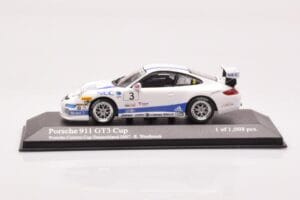
Porsche 911 997 GT3 Cup #124 Mattheus / Geoffroy / Vanbellingen / Fumal 24 Hours of Spa 2005 Minichamps 1:43
Only 3 left
Price:
£29.00
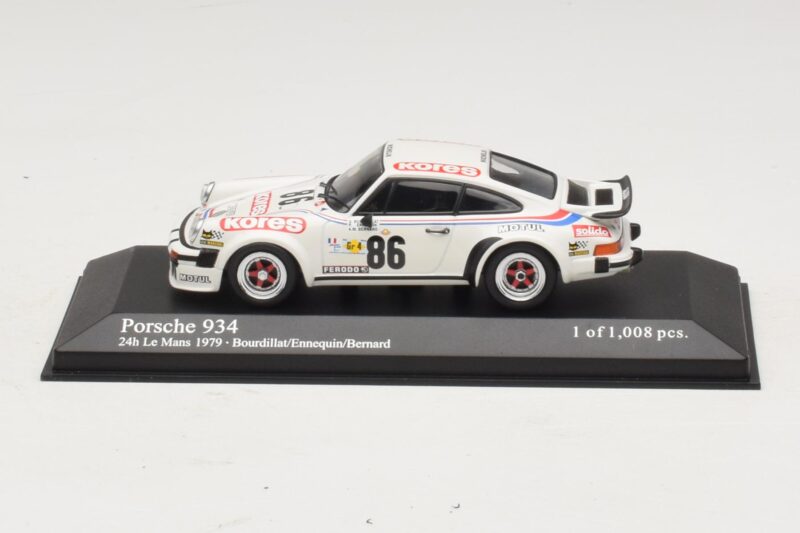
TL;DR: Minichamps' 1:43 diecast Porsche 934 reproduces car #86, driven by Bourdillat and Ennequin at the 1979 Le Mans 24 Hours, its sealed body carrying tampo-printed livery. This GT-class privateer ran the same year a Kremer Porsche 935 K3 won outright, giving the pairing genuine historical context for a 1970s Porsche shelf.
1979 belongs to the Kremer 935 K3 in most retellings of Le Mans, the customer-built car that beat Porsche's own factory effort outright. This #86 934 raced the same 24 Hours in the GT class, a reminder that the entry list ran far deeper than the overall winner, and Minichamps' 1:43 model puts that privateer story back on the shelf.
This 934 arrives as a single sealed shell, no doors, bonnet or engine cover hinging open, which at 1:43 is the construction choice that actually serves the subject best. A one-piece casting holds continuous, even panel lines across the wide fibreglass arches and rear wing mounts that defined the 934's silhouette, detail a smaller opening mechanism would blur or exaggerate. The zinc alloy build gives the model real density for its size, noticeably heavier in the hand than a resin piece of the same dimensions, and that mass helps it sit securely on a shelf rather than feeling like a lightweight toy. Wheel arches, driving lights and the roll cage visible through the glazing are all cast with sharp, defined edges rather than softened for ease of moulding.
The #86 livery carries its own colour scheme and sponsor placement, distinct from other 934s Minichamps has produced from the same era, and every graphic is tampo-printed directly onto the shell rather than applied as a separate decal that could lift over time. That method keeps the paint and the printed elements at the same level, so the number roundels and sponsor panels sit flush against the bodywork instead of standing slightly proud. Registration across the door panels, bonnet and rear wing endplates holds consistently, which matters most on a livery with multiple colour blocks meeting at sharp edges. Collectors comparing several 934 liveries side by side will notice how differently each team dressed an otherwise identical car, which is much of the appeal in collecting more than one.
1979 stands out in Le Mans history as the year a customer team beat the factory at its own game. Kremer Racing's 935 K3, driven by Klaus Ludwig and the Whittington brothers, took overall victory, a result that remains one of the most celebrated upsets in the race's history and cemented the 935's reputation as Porsche's ultimate customer racer. The 934 raced in a separate class that same weekend, less radical and less powerful than the 935, but no less present on the entry list. For a privateer team, simply lining up in the same 24 Hours that produced that famous result gives even a modest GT finish a place in a genuinely significant edition of the race.
The 934 and 935 shared a starting point in the 911 Turbo but ended up as very different racing cars because they answered to different rulebooks. Group 4 kept the 934 close to its road-going shape, silhouette and running gear largely stock beneath wider arches. Group 5 gave the 935 far more latitude, and Porsche used every inch of it, reshaping bodywork almost completely around the same basic mechanical package. Displaying a 934 next to a 935 from the same period makes that divergence obvious in a way text never quite manages: one still looks like a 911 wearing a wing, the other looks like nothing else on the grid. Both trace back to the same turbocharged flat-six, which is worth remembering when the shapes suggest otherwise.
Minichamps has produced 934s from several Le Mans years across the late 1970s and into the 1980s, each carrying its own team's livery, and this #86 car sits naturally alongside those siblings from 1978 and 1980 on the same shelf. At 1:43 that kind of set-building stays practical: several sealed-body castings occupy less space than one 1:18 piece, and the sealed construction keeps every panel line consistent regardless of which year or livery a given car represents. For a collector drawn to the GT class specifically, rather than only to overall winners like the K3, this is where the real depth of Le Mans collecting lives, one privateer entry at a time. That approach rewards patience over impulse, each purchase filling a specific gap in a growing grid rather than chasing a single famous name.




Save £14.00