Used

Porsche 911 997 GT3 Cup #124 Mattheus / Geoffroy / Vanbellingen / Fumal 24 Hours of Spa 2005 Minichamps 1:43
Only 3 left
Price:
£29.00
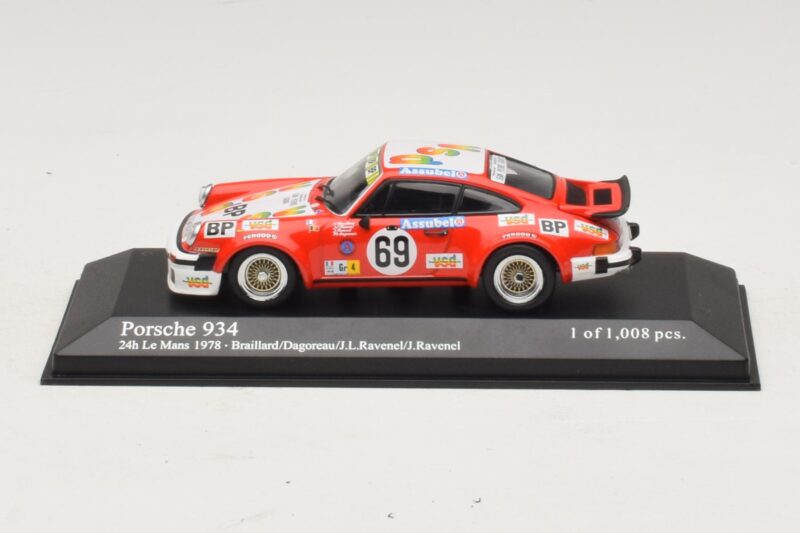
TL;DR: Minichamps' 1:43 diecast Porsche 934 reproduces car #69, driven by Braillard and Dagoreau at the 1978 Le Mans 24 Hours, its sealed zinc alloy body carrying tampo-printed sponsor livery. Built from Porsche's Group 4 homologation special, based on the 930 Turbo road car, for collectors assembling a 1970s GT racing shelf.
Group 4 rules asked Porsche for a homologation special, not a pure racer, and the 934 answered by wrapping 930 Turbo mechanicals in wider arches and a rear wing. This #69 entry carried Braillard and Dagoreau's colours at the 1978 Le Mans 24 Hours, one of the privateer 934s that filled out the GT class as the decade closed.
At 1:43, Minichamps builds this 934 as a single sealed casting, doors, bonnet and engine cover fixed into the body rather than hinged. That's the right call at this scale: a one-piece shell holds tighter, more consistent panel lines than an opening mechanism could manage in a car this small, and it lets the whole design read as one continuous form rather than a collection of separate fitted parts. The zinc alloy build carries real weight for its size, a small but dense object that sits with authority next to lighter 1:43 resin alternatives. Wheel arches, the rear wing and the flared bodywork that made the 934 instantly recognisable on track are all cast with crisp, defined edges rather than softened or simplified detail.
The #69 livery is applied through tampo printing rather than waterslide decals, which keeps the sponsor graphics and race number flat against the bodywork with no risk of the silvering or lifted edges that transfers develop over time. At 1:43, registration matters more than at larger scales: a printed number one millimetre out of place is obvious under close inspection, and Minichamps holds that alignment consistently across the door panels and rear wing endplates. The base colour and the graphics sit in sharp contrast rather than bleeding at the edges, and the printed detail extends to smaller elements like the windscreen banner and headlight covers, features easy to lose at this size but visible here under a loupe or a strong display light.
Porsche built the 934 to satisfy FIA Group 4 rules, which required a racing car to stay close to its production basis. That basis was the 930 Turbo, and the 934 kept the road car's basic silhouette while adding a fixed rear wing, wider fibreglass arches to cover racing rubber, and a roll cage behind largely stock-looking bodywork. It was a deliberately conservative approach next to Porsche's more radical 935, which pushed Group 5's looser rules much further, but that conservatism suited the customer teams the 934 was built for. Privateers could buy a 934 that was recognisably a Porsche 911 road car underneath, run it competitively, and still service it with mechanics who understood a production 930 Turbo.
By the late 1970s Le Mans's overall prototype battle sat alongside a growing GT contingent, and the 934 became a mainstay of that class for privateer teams across Europe. French squads in particular ran 934s regularly through the era, entering cars under their own colours rather than factory backing, which is exactly the context this #69 car occupied. These weren't factory-supported efforts with unlimited budgets; they were teams campaigning a genuinely capable GT car within reach of a serious privateer operation, finishing the 24 Hours being the primary goal rather than an afterthought. That grassroots character is part of why the 934 still draws collector interest decades later, each liveried entry telling a different team's story from the same starting point.
A single 934 tells one team's story; several together, each in a different livery, start to recreate the look of the Le Mans GT grid itself. At 1:43, that ambition is realistic in a way it wouldn't be at 1:18, since a full field of privateer entries fits a single shelf without dominating a display cabinet. This #69 car sits naturally alongside other Minichamps 934s from the same Le Mans years, each sealed body holding its own printed livery without the panel-line inconsistencies an opening mechanism would introduce at this size. For a collector working through the late 1970s and early 1980s at Le Mans, entry by entry, this is an accessible way to build genuine depth: not a single hero piece, but a growing field of GT competitors from an era when privateers still had a real shot at finishing.






Save £14.00