{"ajaxurl":"https:\/\/models118.co.uk\/wp-admin\/admin-ajax.php?lang=en_GB","nonce":"1bbaa8ccd4","homeUrl":"https:\/\/models118.co.uk\/","shopUrl":"https:\/\/models118.co.uk\/shop\/","cartUrl":"https:\/\/models118.co.uk\/cart-en-gb\/","checkoutUrl":"https:\/\/models118.co.uk\/checkout\/","skipCart":true,"collectionLimit":12,"i18n":{"addedToCart":"Added to basket","addToWishlist":"Add to wishlist","addedToWishlist":"Added to wishlist","removeFromWishlist":"Remove from wishlist","removedFromWishlist":"Removed from wishlist","undo":"Undo","error":"Something went wrong","loading":"Loading...","outOfStock":"Out of stock","viewCart":"View basket","proceedToCheckout":"Proceed to checkout","addedToCollection":"Added to your collection","reserved":"Added to your collection","soldOut":"Sold out","invalidEmail":"Please enter a valid email address","connectionError":"Connection error. Please try again.","tocToggle":"On this page","close":"Close","inCartTooltip":"Already in your basket \u2013 open your basket to check out","loginToSave":"Sign in to save this model","waitlistNotify":"Notify me","waitlistOnList":"On the waiting list \u2713","waitlistJoined":"You're on the waiting list. We'll email you the moment this model is available again.","waitlistRemoved":"Done \u2014 you're off the waiting list for this model.","waitlistRateLimit":"Too many attempts \u2014 please try again shortly","waitlistTurnstile":"We couldn't complete the check \u2014 please try again","waitlistError":"Sorry, something went wrong. Please try again in a moment."},"wishlist":{"loggedIn":false,"loginUrl":"https:\/\/models118.co.uk\/my-account\/","addAction":"models118_wishlist_add","removeAction":"models118_wishlist_remove"},"waitlist":{"loggedIn":false,"subscribeAction":"models118_waitlist_subscribe","toggleAction":"models118_waitlist_toggle","stateAction":"models118_waitlist_state"},"stats":{"models":2712,"brands":215,"manufacturers":129,"collectors":10000},"product":{"id":1697558,"sku":"940066030","condition":"new","availability":"in_stock","name":"Porsche 550 Spyder Silver Maxichamps 1:43","brand":"Porsche","manufacturer":"Maxichamps","scale":"1:43","material":"Diecast","price":50,"regularPrice":50,"isOnSale":false,"savingsAmount":0,"stockQty":2,"stockStatus":"very_low","isDiscontinued":false,"image":"https:\/\/models118.co.uk\/wp-content\/uploads\/2026\/10\/porsche-550-spyder-silver-maxichamps-1-43-940066030-1-1-300x200.jpg","permalink":"https:\/\/models118.co.uk\/porsche-550-spyder-silver-maxichamps-1-43-940066030\/"}}
Cookies on Models118
We use cookies to remember your preferences, understand how the shop is used and show you models and offers that suit your interests. What you allow is up to you, and you can change it at any time.
Always active
The technical storage or access is strictly necessary for the legitimate purpose of enabling the use of a specific service explicitly requested by the subscriber or user, or for the sole purpose of carrying out the transmission of a communication over an electronic communications network.
The technical storage or access is necessary for the legitimate purpose of storing preferences that are not requested by the subscriber or user.
The technical storage or access that is used exclusively for statistical purposes.
The technical storage or access is required to create user profiles to send advertising, or to track the user on a website or across several websites for similar marketing purposes.
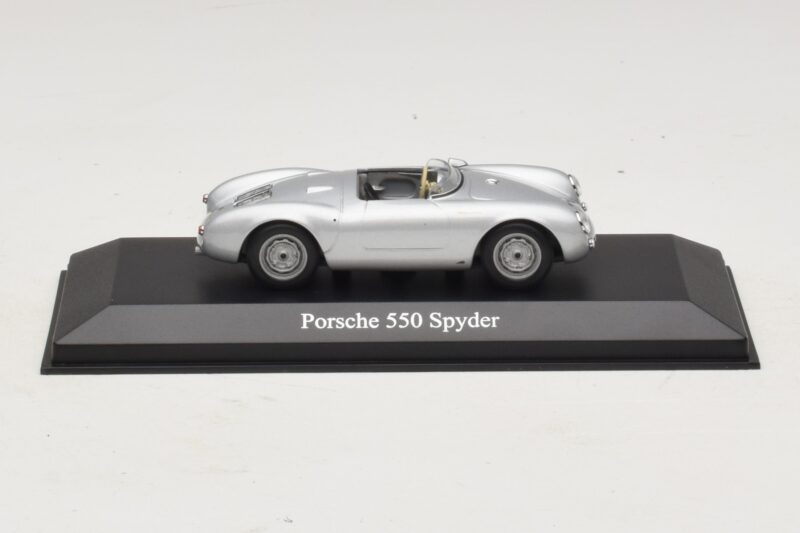
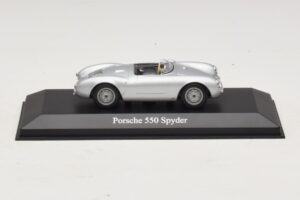
Maxichamps' 1:43 diecast Porsche 550 Spyder in silver reproduces the 1955 mid-engined open-top, a small, light sports car that helped build Porsche's competition reputation. The body is a sealed one-piece casting, so the interest lies in the rounded wings, low windscreen and open cockpit. A natural anchor for a 1950s sports car or early Porsche shelf.
About the Porsche 550 Spyder Silver Maxichamps 1:43
TL;DR: The Maxichamps Porsche 550 Spyder 1:43 is a silver diecast of the 1955 mid-engined open-top, with a sealed one-piece body and an exposed cockpit you can read from above. Zinc alloy gives it weight at small scale. It suits anyone building a 1950s sports car shelf or an early Porsche chronology.
Small, low and mid-engined, the 550 Spyder is a sports car whose whole argument is lightness. At 1:43 that argument translates well: the shape is compact and rounded, with nothing to hide behind. Maxichamps finishes this one in silver, a colour that shows off every curve of the wings and the shallow windscreen under a shelf lamp.
Maxichamps Porsche 550 Spyder 1:43 in Silver
An Open Cockpit on a Sealed Body
With no roof, the cockpit is the one interior you can see without glazing in the way, so it is worth checking first. Look down at the seats, steering wheel and dashboard area and judge whether the finishing matches the care taken outside. The body itself is a one-piece casting with no opening parts, which lets the curves of the wings and the long, smooth tail sit unbroken by panel cuts. That suits a shape this simple. Silver is also a revealing colour on a sealed shell: any ripple or uneven surface shows in the reflections, so a clean, even finish tells you the casting was well prepared. Turn it slowly under a lamp and watch the highlight run from nose to tail.
Silver Paint and Zinc Alloy Mass
The zinc alloy brings real mass for such a small car, a dense feel in the palm that thin plastic imitations cannot fake. Metal also resists the slight warping that can creep into long, low shapes on a shelf over the decades. Silver paint on a hard shell reads smooth and cool, and fine details such as badges, lamps and wheel centres are where the finishing effort is concentrated. At 1:43 you should expect selective detail rather than every fixing and rivet, and that is a fair trade for a piece that sits comfortably beside other small-scale sports cars without needing a second shelf.
The 550 Spyder in Porsche's Story
Mid-Engine Layout and the Four-Cam Flat-Four
Porsche put the engine behind the seats in the 550 and fitted a four-cam flat-four, designed by Ernst Fuhrmann, that later powered the first 356 Carrera road cars. The result was a light, low-slung competition sports car from the middle of the 1950s, built to take on bigger-engined rivals in the smaller racing classes. For a collector this is the foundation of the Porsche lineage, the car that set a template of compact, carefully engineered machinery rather than brute force. The proportions on the model reflect that: short overhangs, a tail that tapers away and a stance that sits close to the ground.
The James Dean Association
Popular memory links the 550 Spyder with James Dean, who died in one in 1955, and that association gives the shape a cultural afterlife well beyond motor racing. The model stands on its own merits, though. Silver is a fitting colour for a German sports car of the era, and the shape needs no backstory to hold attention. For British collectors, the Spyder sits naturally against home-market sports racers of the same decade, giving a shelf a conversation about small, light machines from two countries.
Pairing the Spyder With Other 1950s Sports Cars
A 1:43 Spyder rewards a themed cabinet. Put it among other small sports cars of the 1950s and the contrast in layout becomes the point: front-engined roadsters against a flat-four behind the seats. Tight spacing works at this scale, but leave a finger's width between pieces so wings and windscreens are not rubbed during handling. Display it away from direct sun, which can cloud glazing and fade paint, and lift it by the body rather than the wheels. Check stance, wheel fit and the cockpit finish when comparing versions, and keep the original box for completeness. For anyone starting a Porsche chronology, this is a sensible and accessible place to begin.
Create a free account and claim 5% off your first order — from hundreds of collectible 1:18, 1:43 and 1:12 models by Porsche, Mercedes-Benz, BMW and more.