Used
Porsche 911 997 GT3 Cup #124 Mattheus / Geoffroy / Vanbellingen / Fumal 24 Hours of Spa 2005 Minichamps 1:43
Only 3 left
Price:
£29.00
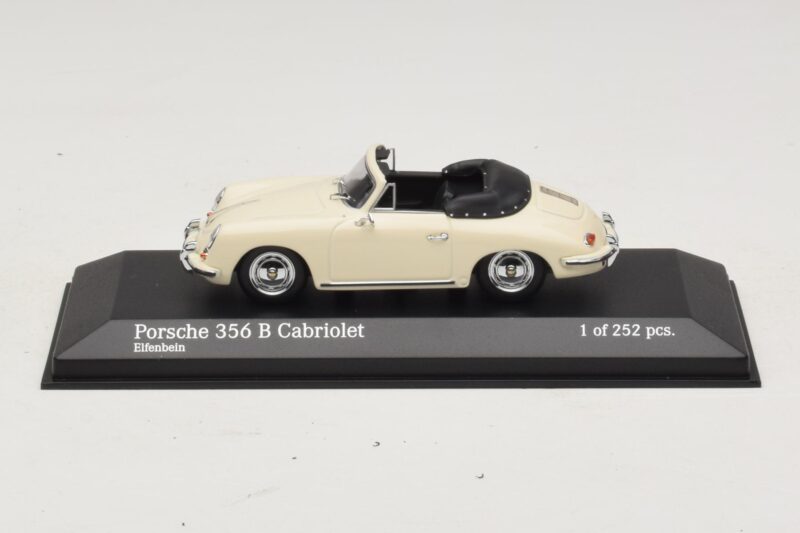
TL;DR: Minichamps' 1:43 diecast Porsche 356 B Cabriolet in Ivory White reproduces the 1960 mid-cycle update, with raised headlamps and reshaped bumpers on Reutter's open-top body. The casting is a sealed, one-piece shell, so the revised silhouette is rendered entirely as painted exterior surface rather than moving panels.
The 356 B arrived in 1959 as Porsche's answer to feedback on the original 356: headlamps raised higher in the front wings for better night visibility, larger bumpers set further from the body, and a reworked dashboard inside. It was a running refinement rather than a redesign, built on the same Reutter-bodied Cabriolet shape that had carried Porsche's reputation since the early 1950s.
Minichamps casts the 356 B Cabriolet as a fixed, one-piece shell, which suits a car whose changes from the earlier 356 A were entirely about surface detail rather than shape. The raised headlamp position sits noticeably higher in the wing than on the earlier model, the horn grilles below take a different outline, and the bumpers stand slightly further from the body on their own brackets. None of that depends on a door or bonnet opening to read correctly, since every one of those changes lives on the outer skin. At 1:43 the casting holds those edges cleanly, with the headlamp surrounds and bumper gaps kept crisp rather than softened into the body.
Ivory White sits on a hard zinc alloy shell, and the gloss reads clean and slightly cool under direct light, a texture worth comparing against a resin cabriolet in the same colour if a buyer is choosing between materials for a themed shelf. Because the folded soft-top is cast into the body rather than left loose or hinged, the paint runs unbroken across the deck behind the seats, and the shut lines that remain, at the doors and the front lid, sit at a consistent width rather than widening near a pivot point. At roughly a tenth of full size, the whole car occupies a genuinely modest footprint, easy to group several-wide on a single shelf tier.
Reutter built 356 bodies for Porsche from the model's earliest days, and by 1960 that partnership had matured into a settled production rhythm rather than an experimental one. The firm's coachbuilding background shows in details this casting reproduces: the way the windscreen frame meets the scuttle, the taper of the rear wings, the low, level waistline that gives the open car its uncluttered profile. Reutter would go on to become part of Porsche's own body operations later in the decade, but in 1960 it was still an independent supplier building to Porsche's specification, a working relationship rather than an in-house department.
For an early 356, the checks worth making first are the headlamp height relative to the front wing crown, the depth and shape of the bumper overriders, and the rake of the windscreen, three details that shifted across the 356's production and that a careless casting tends to blur together. The wheel design and hubcap detail are worth a second look too, since Porsche ran several wheel styles across this era and a mismatched set is an easy way to spot a generic tooling reused across variants. None of these checks require opening anything, since the whole comparison happens on the surface.
A 356 B Cabriolet earns its place as the starting point for a Porsche road-car chronology, the model that predates the 911 by three years and shows where the marque's open-top instincts began. Set beside a later 911 Cabriolet or Targa on the same shelf, it makes the design lineage legible in a way text alone cannot. The sealed casting asks nothing of the buyer beyond placement, no alignment to check, no panel to settle into position, simply a finished shape to set down. At this scale and price tier, it is an accessible way to anchor the earliest chapter of an air-cooled Porsche collection without committing to a costlier 1:18 piece.
Save £14.00