Last one
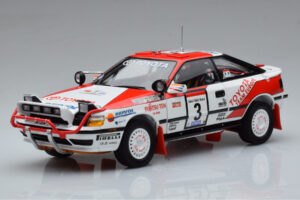
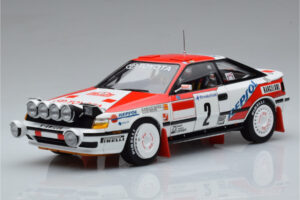
Toyota Celica GT-Four ST165 #3 B. Waldegard / F. Gallagher Winner Safari Rally 1990 Kyosho 1:18
Only 1 left
Price:
252.00 €
This model is currently sold out. Enter your email and we'll let you know when it's back in stock.
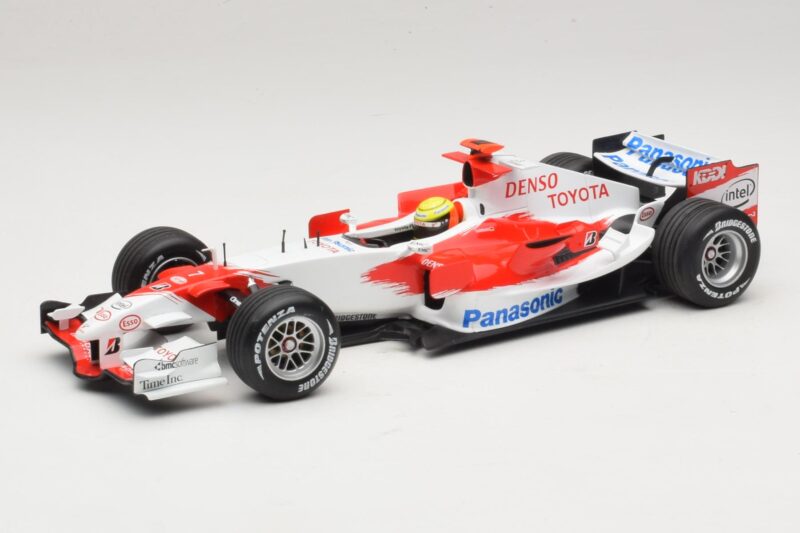
TL;DR: Minichamps' 1:18 diecast Panasonic Toyota TF106 recreates Ralf Schumacher's #12 entry from the 2006 Formula One season, the year V8 engines replaced V10s. Finished in Panasonic Toyota Racing livery with tampo-printed sponsor logos, the sealed zinc-alloy body suits an open-cockpit racer with no bonnet or doors to hinge.
Ralf Schumacher arrived at Toyota for 2005 after six seasons at Williams, bringing the surname that already carried seven world championships through his elder brother Michael. By 2006 he wore number 12 for Panasonic Toyota Racing, the Cologne-based factory team navigating Formula One's biggest technical shift in years: the switch from 3.0-litre V10s to smaller, quieter V8s.
Toyota's Formula One team operated from Cologne, Germany, its European base since entering the championship in 2002, rather than from a facility in Japan. For 2006 the whole grid faced a mandated shift from 3.0-litre V10 engines to smaller 2.4-litre V8s, a change intended to slow lap times and cut costs. Toyota's response was the RVX-06, developed alongside a chassis under technical director Mike Gascoyne, who had joined from Renault the previous year. The TF106 carried Panasonic's title sponsorship into its fifth F1 season, a livery scheme instantly recognisable across the 2006 grid for its clean white and red panels. Toyota introduced an upgraded TF106B specification partway through the season, a mid-year revision aimed at closing the gap to the sport's established constructors.
Ralf Schumacher joined Toyota for 2005 after six seasons at Williams, where he had taken six grand prix wins. He arrived carrying a surname already synonymous with seven world championships through his elder brother Michael, a comparison that followed him through his career regardless of his own results. By 2006 he wore number 12 for Panasonic Toyota Racing, running alongside Jarno Trulli's number 11 TF106 in the sister garage. The pairing gave Toyota an experienced, race-tested line-up as the team tried to close the gap to the sport's established front-runners in a season reshaped by new engine rules.
Minichamps casts the TF106 in zinc alloy, and the weight is the first thing noticed lifting it from its packaging: a density that plastic or resin alternatives at the same scale cannot replicate. The Panasonic branding, Bridgestone tyre lettering and sponsor decals along the sidepods are tampo printed rather than applied as stickers, a process that lays ink directly onto the casting so it survives handling without lifting at the edges. Getting F1 livery right depends on precise registration across compound curves, since a sponsor logo that drifts even slightly off the sidepod line reads as wrong to anyone who watched the car race.
This TF106 has no opening doors, bonnet or boot, and unlike a road car reproduction that would be a genuine construction choice, a single-seat Formula One car has none of those panels to begin with. The cockpit is open by design, the bodywork a fixed aerodynamic shell rather than a set of hinged surfaces, so a sealed casting is simply the correct way to build one. What that buys in practice is unbroken bodywork lines from the nose cone to the diffuser, with none of the seam shadows a hinge would introduce along a surface shaped entirely around airflow, right down to the barge boards ahead of the sidepods.
At 1:18 an F1 car from the mid-2000s comes out to roughly 25 centimetres nose to diffuser, considerably more compact than a road car at the same scale because the proportions follow an open-wheel racer rather than a saloon. That footprint makes a full ten-car grid, or even the whole 2006 field, realistic to display along a single long shelf, something a fleet of full-size touring cars at the same scale would never allow. Because the body is a fixed casting rather than an assembly of separately opening panels, the model sits flat and stable without a stand needing to brace an open door or raised bonnet, which matters when several cars share the same run of shelf. Paired with the sister Toyota entry, Jarno Trulli's number 11 TF106 in matching Panasonic livery, this Ralf Schumacher car completes the full 2006 Toyota line-up rather than a single isolated entry. Collectors building a season-by-season F1 chronology find the V8 transition year a natural dividing line, since the engine note, the aerodynamic packages and even the sponsor liveries across the grid shifted noticeably from the V10 seasons either side of it. British collectors in particular tend to build these grids around the home race at Silverstone, a fixture on the calendar that both TF106s contested as part of the 2006 championship.
Minichamps has built F1 diecast at 1:18 for decades, and a mid-2000s Toyota sits comfortably alongside the manufacturer's wider grid coverage from the same era, priced in line with other factory-team entries rather than at the premium reserved for championship-winning cars or drivers. The honest trade-off is the sealed body: nobody opens an engine cover to see the RVX-06 V8, because there is no cover built to open, and buyers wanting mechanical detail will find more of it in static museum-style displays than in a diecast built for accuracy of line rather than disassembly. What this piece offers instead is a correctly proportioned, correctly liveried record of a specific car, driver and season, useful as a standalone piece for a Schumacher family collection or as one entry in a full 2006 grid. For a British buyer, that record also plugs neatly into a home-grown F1 fair or swapmeet display alongside period Silverstone programmes and other Panasonic Toyota memorabilia.